


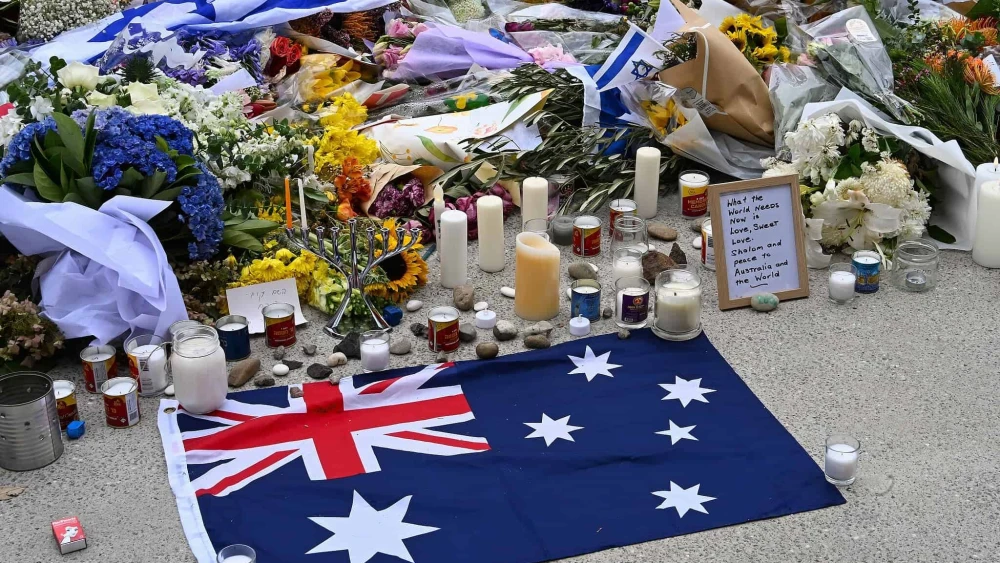

The first responsibility of any government is to protect its citizens. For Australia’s Jewish community, still confronting the consequences of the deadly Bondi Beach terrorist attack, that responsibility has particular urgency.
At the moment, the government of Australian Prime Minister Anthony Albanese faces serious questions about its oversight of taxpayer funding, its response to antisemitic incitement and the consequences imposed when recipients of public money fail to meet expected standards.
On Oct. 14, the government confirmed that it had initiated the termination of a AU$308,000 grant to OnePath, an Islamic media organization based in western Sydney, following concerns about antisemitic material.
The decision raises a fundamental question: How did the grant receive approval in the first place?
Robert Gregory, president of the Australian Jewish Association, criticized the government’s handling of the matter. “Labor is more concerned about winning votes than confronting extremism,” he said. “Australians are entitled to know how organizations spreading antisemitism and radicalism came to receive taxpayer funding in the first place. Revoking a grant after public outrage is not evidence of a functioning system.”
His criticism comes as Australia’s auditor-general investigates the government’s Supporting Multicultural Communities program following allegations of political favoritism and noncompetitive grant allocations.
The questions extend beyond Sydney.
In Melbourne, MyCentre—a registered Islamic charity—has come under scrutiny following allegations concerning the accused co-pilot in the Sept. 30 attempted hijacking of a flydubai passenger aircraft bound for Israel.
According to authorities in the United Arab Emirates, the suspect reported contact with individuals associated with MyCentre while studying at Melbourne’s RMIT University in 2017. His alleged radicalization did not occur in a traditional Middle Eastern conflict zone. According to the suspect’s account, it occurred in Melbourne, one of Australia’s largest and most multicultural cities.
MyCentre founder Samir Mohtadi, also known as Sheikh Abu Hamza, denies the allegations. Nevertheless, the reported investigation by the Australian Federal Police has intensified questions about public funding and oversight because MyCentre has received grants from both federal and Victorian state governments.
Its financial statements reportedly contain qualified audit opinions concerning cash donations, missing documentation relating to a Victorian government grant worth nearly AU$240,000, and substantial transactions involving related entities. One financial disclosure reportedly recorded AU$1.15 million under the name “Mohtadi M.S.,” an amount subsequently reduced to zero.
These disclosures do not, by themselves, establish wrongdoing. They do raise questions about financial controls, transparency and the scrutiny applied before public grants were approved.
Were officials aware of the audit qualifications? Were related party transactions examined? What safeguards exist when grant recipients become the subject of serious governance concerns?
The same questions about accountability extend to Australia’s Middle East policy.
The Albanese government has continued to support Palestinian institutions while calling for democratic elections, financial transparency, education reform and changes to controversial “pay-for-slay” payments.
Australia’s recognition of Palestinian statehood drew expressions of approval from Hamas. Such approval does not establish that Canberra supports Hamas. It does, however, raise questions about how the government assesses whether its diplomatic decisions advance peace and security or risk being used by terrorist organizations for political legitimacy.
What happens when public money is awarded to organizations that subsequently face credible allegations concerning extremist rhetoric, financial governance or compliance with funding conditions?
Meanwhile, Palestinian Authority leader Mahmoud Abbas has again postponed elections, now until September 2027. Abbas was elected in January 2005 for a four-year term. More than 21 years later and at the age of nearly 91, he remains in office without a renewed presidential mandate.
The P.A. has cited security conditions and Israeli restrictions as obstacles to holding elections. Those circumstances are relevant, but they do not resolve the question of democratic accountability.
The issue of accountability is equally pressing at home.
Following the deadly Bondi terrorist attack, Australia enacted tougher hate and extremism legislation in January, including increased penalties for religious leaders who advocate or threaten violence. But legislation alone cannot demonstrate effective enforcement.
How many credible allegations of antisemitic incitement have been investigated? Where evidence establishes criminal conduct, how many prosecutions have followed? And what measures have been taken to review public funding for organizations associated with individuals promoting extremist rhetoric?
Gregory emphasized the distinction between freedom of expression and public financial support: “Offensive speech shouldn’t be illegal, but at the same time, taxpayers shouldn’t be forced to fund it.”
“After the Bondi terrorist attack, Australians deserve more than tough speeches and new laws,” he said. “They deserve to know who is being held accountable, what funding has been suspended and what concrete action is being taken to prevent the next tragedy.”
His remarks highlight an important distinction: Offensive expression is not automatically criminal, but direct threats and unlawful incitement can attract criminal penalties.
Chants such as “gas the Jews” warrant particular scrutiny because of their explicit threatening language. Other slogans, including “from the river to the sea” and “globalize the intifada,” are calls for Israel’s elimination or for violence. The applicable laws need to be enforced, despite the urge to pander to Muslim voters.
The broader question remains: What happens when public money is awarded to organizations that subsequently face credible allegations concerning extremist rhetoric, financial governance or compliance with funding conditions?
The cases of OnePath and MyCentre, together with Australia’s assistance to Palestinian institutions, involve different circumstances and legal obligations. They nevertheless illustrate the importance of transparent oversight and clearly defined consequences when breaches are established.
Australians are entitled to know whether grant recipients have undergone appropriate scrutiny, whether funding has been suspended where warranted and whether promised reforms are independently verified.
For Jewish Australians, these questions are not abstract. They concern the ability to live openly and safely without fear of antisemitic threats or violence. Remember, it never stops with the Jews.
The Albanese government must explain what action follows when warnings are raised, funding conditions are breached or commitments remain unfulfilled. Protecting citizens requires more than new legislation, diplomatic statements and expressions of concern. It requires transparent decisions, effective enforcement and demonstrable accountability.


