


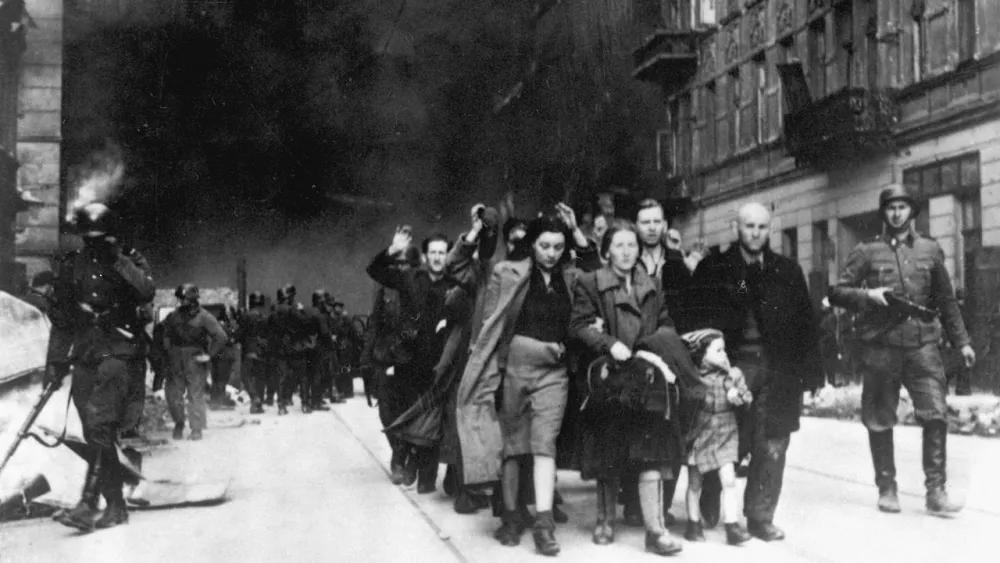

On July 22, 1942, 84 years ago, the darkest chapter in the history of the Warsaw Ghetto began: “The Great Action” (Grossaktion Warsaw). This secret operation, part of Operation Reinhard, led by Odilo Globocnik, was a central event in the Holocaust of Polish Jewry.
The Jews in the Warsaw Ghetto were beaten and driven to the Umschlagplatz (“dispatch plaza”) in the ghetto. From there, they were taken in freight trains to the Treblinka extermination camp. The largest deportations of Jews from the Warsaw Ghetto to the death camp occurred on Tisha B’Av (July 23) and Yom Kippur (Sept. 21) of 1942.
The date of the Tisha B’Av fast was deliberately chosen. On the eighth of Av, 5702 (July 21, 1942), SS forces raided the Judenrat headquarters in Warsaw, arrested most of its occupants and informed the remaining members that it had been decided to deport the ghetto’s Jews for “resettlement in the East.” The task of organizing the deportations was imposed on the Judenrat, and its leaders were ordered to ensure that approximately 6,000 Jews presented themselves daily at the Umschlagplatz plaza.
Initially, the ghetto population believed this was a transfer to more comfortable locations than the crowded and starving ghetto. Even the incentives, in the form of three kilograms of bread and one kilogram of jam promised by the Germans to those who reported for deportation, had their effect.
However, the picture soon became clear: The packed trains were making their way to destruction in Treblinka. The ghetto population tried to flee the deportation and crowds stormed the factories where work permits were supposed to protect against abduction to the Umschlagplatz. This act did not always help the workers, and certainly not their families.
At the beginning of the deportation, the head of the Judenrat, Adam Czerniaków, took his own life, and his successors cooperated with the Germans, believing this would save their lives and the lives of their relatives. They were wrong. In the end, more than a quarter of a million Jews were sent to their deaths at Treblinka during that summer.
One of the most chilling and significant details of this is not technical, but cultural and psychological: the timing. The largest and most massive deportations of Warsaw’s Jews to their deaths occurred on the two most sacred and sensitive days of the Hebrew calendar.
This choice of dates was not accidental. It did not stem from logistical considerations of train schedules, but malicious and well-planned intent. This teaches us a lesson about the nature of the Jewish people’s existential struggle: Extreme antisemitism and murderous ideologies do not merely strive for physical destruction, but for the complete shattering of our spirit and heritage.
The Nazis understood very well the power of Jewish days of remembrance and fasting. By choosing Tisha B’Av, the day of the destruction of the Temples and the exile, and Yom Kippur, the day of judgment and forgiveness, they sought to intensify the Jews’ sense of helplessness. They wanted the bowed Jew, led to the freight car, to feel that his history was collapsing in upon him, thereby preventing resistance and generating absolute defeatism.
This phenomenon is not a relic of the past. It repeats itself time and again throughout Jewish history when our enemies have used our calendar as a psychological and operational weapon.
This was the case with the expulsion of the Jews of England, which took effect on Tisha B’Av 1290, through the expulsion of the Jews of Spain, whose final evacuation deadline was set for Tisha B’Av 1492, and into the modern era, with Egypt and Syria’s decision to launch a surprise war on Yom Kippur 1973, the murderous terrorist attack at the Park Hotel in Netanya on Passover seder night 2002 and the Hamas-led terrorist attacks on Simchat Torah on Oct. 7, 2023.
In all these cases, our enemies deliberately chose Jewish holidays because they are engaged in a religious, cultural and ideological struggle against the very right of the Jewish people to exist as a nation with its own heritage.
This is the supreme strategic lesson: military and technological might alone is not enough. It must be anchored in spiritual resilience and a deep historical consciousness. Only by understanding the depth of our national roots and deciphering the enemy’s systematic attempts to sever them will we know how to build the endurance required to stand firm against the existential threats of the present and the future.
“The Great Action,” which began on the eighth of Av and reached its tragic peak on Tisha B’Av and Yom Kippur, remains an eternal reminder that the defense of the Jewish people does not boil down to a tactical mission of guarding borders. It is the historic mission of securing the eternity of Israel and keeping the fire of national existence alive.


