


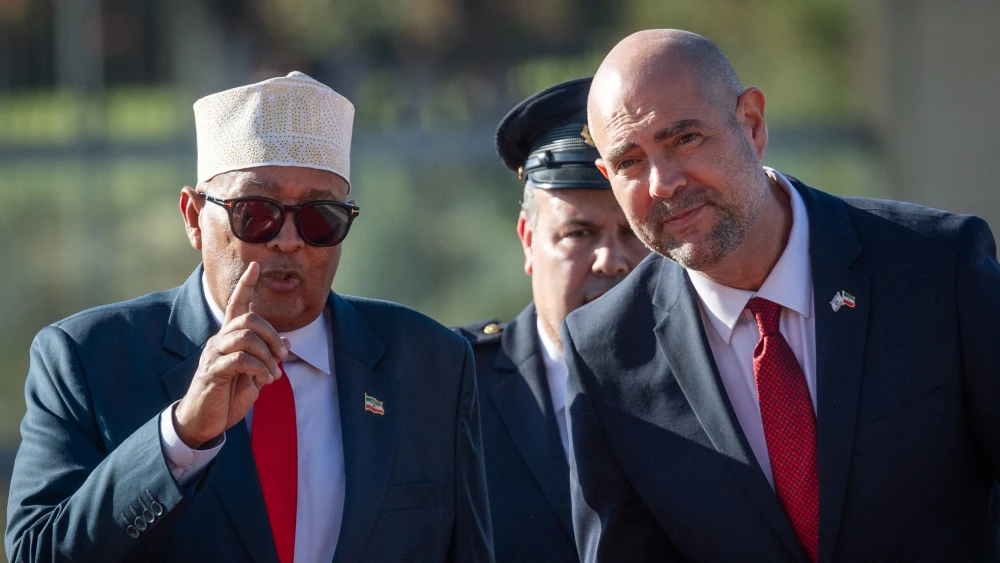

On a recent visit to Israel, former Obama administration Chief of Staff Rahm Emanuel mocked Israeli Prime Minister Benjamin Netanyahu’s Somaliland strategy, arguing that Israel had “lost Europe” and “lost America,” and was left with only the small republic in the Horn of Africa.
He badly misread Netanyahu’s strategic calculus. Israel’s recognition of Somaliland is Israel’s most strategically consequential foreign-policy move in years. Far from diminishing its Western alignment, this opening gambit positions Israel as the indispensable security guarantor of the world’s most critical maritime corridors, exponentially increasing its value to both the United States and Europe.
Israel’s recognition of Somaliland roots the Jewish state firmly in its own region—the Middle East and the Red Sea—where its future will actually be decided, not in Washington or Europe. By expanding its partnership with Eritrea and deepening ties with Ethiopia, Somaliland and Sudan, Israel will become the ultimate security guarantor of the Red Sea, the Gulf of Aden, the Arabian Sea and the southwestern Indian Ocean.
Partnering with Horn of Africa nations allows Israel to deploy its advanced technology and agriculture to lift hundreds of millions out of poverty, cementing it as an undeniable force for good.
In doing so, Israel will make itself indispensable to the security and economy of Europe, America and the Gulf states threatened by Iran. The West supports Israel not out of sentiment, but because it is indispensable to security and economic interests. During the Cold War, Israel contained Soviet influence and hostile Arab states; today, its strategic role in counterterrorism remains unmatched.
However, Israel was strongest when it had alliances with regional actors, such as Iran, Turkey and an Ethiopia that controlled Eritrea and the Red Sea. Today, Iran and Turkey are enemies, while a struggling Ethiopia is choked off from the sea, denied access to Eritrean ports by Eritrean dictator Isaias Afwerki. This tyrant now aligns with Iran, opposes Israel, fuels Sudan’s Muslim Brotherhood, tried to block Somaliland’s independence, and actively backs the Houthis and Al-Shabaab to destabilize the region.
Today, Israel counts the Gulf states, particularly the United Arab Emirates, as allies, while Saudi Arabia navigates the volatile landscape left by America’s regional retreat. If Israel steps up to secure the region, Saudi Arabia will inevitably fall into alignment once Israel proves it is the only reliable security provider in the Red Sea.
Israel’s traditional Arab adversaries—Iraq, Syria, Libya and Yemen—have collapsed, only to be replaced by a far more volatile threat: radical non-state Islamist actors like Hezbollah and the Houthis, alongside the imminent rise of Iran-backed forces in Sudan. Meanwhile, severe economic crises render Israel’s cold peace with Egypt and Jordan entirely unpredictable.
Partnering with Horn of Africa nations allows Israel to deploy its advanced technology and agriculture to lift hundreds of millions out of poverty, cementing it as an undeniable force for good.
Israel must forge a new security apparatus tailored to its own survival while making itself indispensable to the United States and Europe. This requires crushing the Houthis, restoring Yemen’s legitimate government and containing Iran-backed Islamist threats in Sudan as well as the Eritrean regime. Ultimately, the United States and Europe need a reliable Israeli security guarantee in the Red Sea and the Persian Gulf to safeguard their own economic and existential interests.
It is within this new strategic framework that Somaliland becomes vital. Recognizing Somaliland is not only a moral imperative for Israel—aligning with Jewish values of backing liberty and self-determination—but also a cornerstone of Israel’s future security architecture. This grand strategy requires Israel to fill the security vacuum across the Red Sea, the Gulf of Aden, the Arabian Sea and the southwestern Indian Ocean in partnership with regional powers, and Somaliland is the beginning of that vision.
Israel already aligns with Ethiopia and Somaliland; Eritrea is the missing piece of the puzzle. Sudan lies within Eritrea’s strategic geography, and its ground forces possess the military capacity to crush the Houthis. With an aging dictator making political change inevitable, a powerful coalition is within reach. By combining Israel’s air superiority and defensive tech, Gulf financial power and the proven ground forces of Eritrea and Ethiopia, only a strong naval force to pacify Yemen and Sudan, contain Iran and permanently secure the Red Sea is required.
The Tigrinya people, the overwhelming majority who live in Eritrea, share a common destiny with Israel and the Jewish people. Just as the Jews have no homeland but Israel, they have no homeland but their own. Neither Eritrea nor Israel is a member of the Arab League or the Organisation of Islamic Cooperation (OIC). Although the Tigrinya and the Jews are the overwhelming majorities in their respective countries, they remain tiny minorities in the wider region, surrounded by half a billion Arabs and Muslims.
Eritrea holds a strategic location at Bab el-Mandab in the Red Sea, ground military capability, historical perspective and the strategic patience to play the long game thanks to the Tigrinya nation’s homogeneity and nationalism. Eritrea stands as the region’s most stable state, yet its dictator weaponizes that stability to fuel regional chaos. A partnership with Israel would leverage the Tigrinya’s cheap labor and abundant resources alongside Israel’s know-how to produce high-quality ammunition and drones more cheaply than Iran and Turkey.
Their survival and future are permanently bound together. Today, China and the imperialist leaders of Iran and Turkey use proxies to threaten the Tigrinya’s historical role as the ultimate security guarantor of the Red Sea. That role must be reclaimed to remain vital to the security of Israel, the United States and Western allies, leveraging technology, investment and markets to overcome our existential crises at home: abject poverty and environmental devastation.
Rahm Emanuel thus missed a core truth: Israel’s survival depends on mastering its own backyard, not relying on Western capitals. Somaliland is just the start.
The final, essential piece of this Red Sea architecture is Eritrea, anchored by a Tigrinya majority bound to the Jewish people through the ancient Orit faith, and united against the shared security threat from Iran and its Islamist proxies.


