I follow Auschwitz on Facebook. That’s a strange concept. If Facebook had existed when Auschwitz was operational, perhaps history would have been different.
Today, the Auschwitz Memorial page has more than 250,000 followers on Facebook.
Sunday, Jan. 27, is International Holocaust Remembrance Day. This previous Sunday, the Auschwitz Memorial published a sobering reminder. Sunday was the 77th anniversary of the Wannsee Conference, which took place on Jan. 20, 1942, and brought together 15 high-ranking civil servants and SS officers to discuss the technical, logistical and legal implementation of the “Final Solution,” the planned mass extermination of the Jewish people.
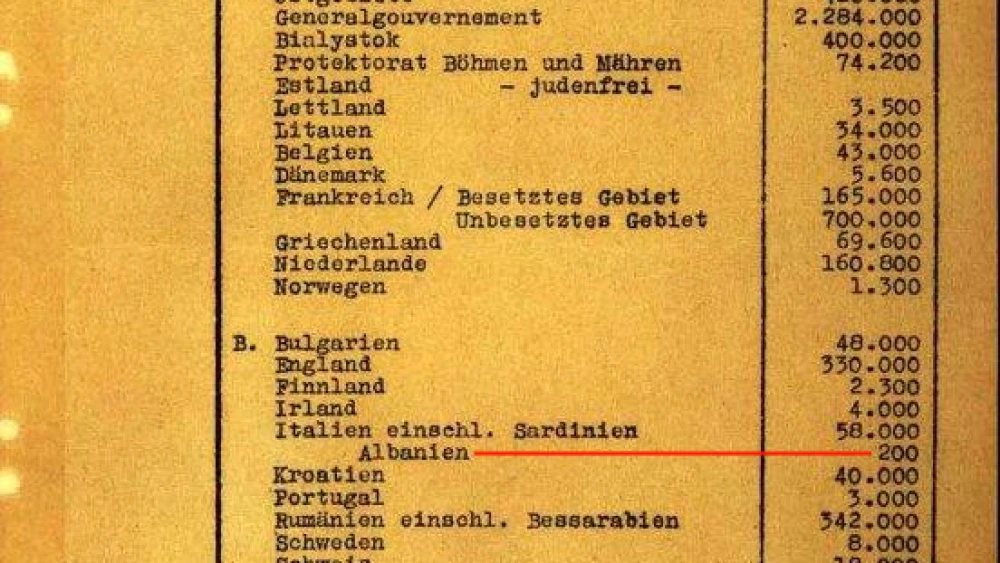
The post included a link to the minutes of the conference. That too was made available via the social network. I found one fact presented in the document to be particularly striking. In preparation for the Wannsee Conference, Adolf Eichmann compiled a list of all European Jews. He didn’t just count the Jews of Germany; he counted the Jews of Poland (2.2 million), the Jews of the Ukraine (2.9 million), the Jews of Spain (6,000), the Jews of Turkey (55,500) and more. In total, there were 11 million Jews in the countries occupied by the Nazis and in European countries opposed to the Axis.
Eichmann told the conference participants that based on Hitler’s prior authorization, they should immediately begin “evacuating” the Jews to the East, where they would perform forced labor, during which it was hoped that most of them would die. He also hinted that those Jews who did not die “by natural reduction” should not be left alive because these more physically resilient Jews had the potential to become a “germ cell of a new Jewish revival.” The Nazi extermination machine began to work.
The number that caught my attention in Eichmann’s inventory was the smallest number: the number of Jews in Albania. There were only 200 Jews in Albania. Why was Eichmann disturbed by the existence of such a tiny Jewish community far off in Albania? Why did the fact of their existence not give him rest?
In the Torah portion, Yitro, Jews recount the story of the acceptance of the Torah. After the Exodus from Egypt, the entire Jewish people stood at Mount Sinai and heard for the first time the commandments that were to become part of our spiritual DNA, the inner pulse beating inside us. “I am the Lord your God.” “You shall not murder.” “Honor your father and mother.” “You shall not commit adultery.” “Remember the Sabbath day and keep it holy.” “You shall not make for yourself any sculptured image.”
This ethos turned us into a people. We have carried it with us ever since then, wherever we have gone, to all the lands of our dispersion. We carried it with us to European soil as well. What is it that was instilled in us when the Torah was given at Mount Sinai that bothered Eichmann so much?
Eichmann’s inventory also calls on us to look in the mirror and ask ourselves: What does this mean about us? What do we represent? Does the counting of the Jews of Albania make demands on us? What does the obsession to kill every Jew down to the very last one teach us about the connection that we should feel with every Jew no matter how far away they may be from us?
___
The author thanks Shira Pasternak Be’eri for her help with this post.
Sivan Rahav-Meir is an Israeli prime-time news reporter and TV host and a sought-after speaker in Israel and overseas.