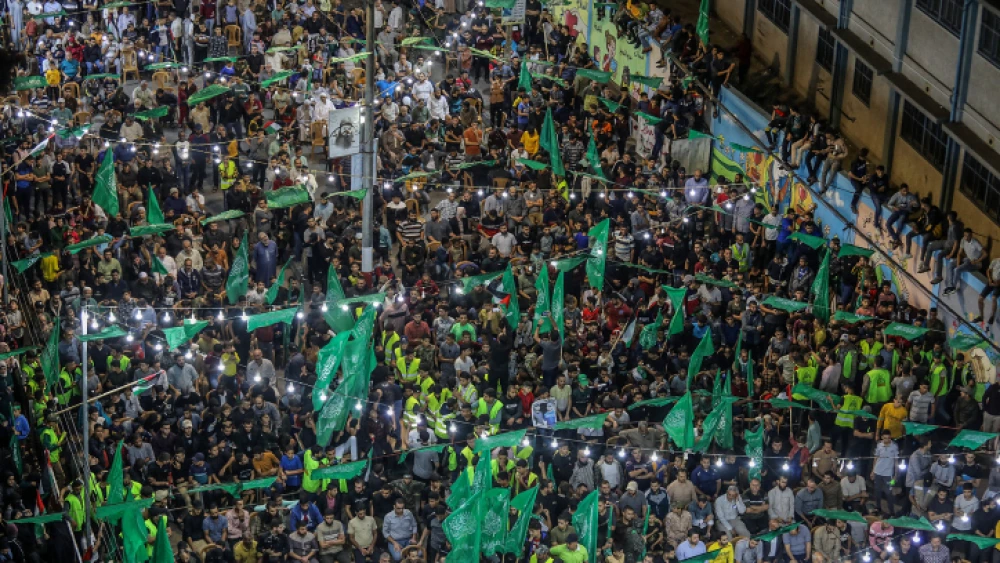

Despite claims now being made that the majority of Gaza’s population desires peace and is being held captive by Hamas, data and evidence collected over the past two decades consistently demonstrates the opposite. Hamas enjoys widespread support among Gaza’s civilian population, which voted Hamas into power and would likely do so again. This support finds expression not only in public opinion polls, but in active participation in Hamas attacks.
In the 2006 Palestinian parliamentary elections, the last to be held in the Gaza Strip as well, Hamas won 76 of 132 seats in the Palestinian Legislative Council. Of the 24 seats assigned to the Gaza Strip, Hamas won 15 (62%). Following Fatah’s refusal to recognize the results of these elections, Hamas violently took control of the Strip in 2007, and no general elections have been held in Gaza since. However, public opinion polls conducted in recent years indicate the Gazan public’s continued support of Hamas.
According to an average of polls conducted by the Palestinian Center for Policy and Survey Research (PCPSR) during 2022, approximately 60% of the Strip’s residents on average supported the “armed struggle” (i.e. terrorist attacks) against Israel, compared to approximately 40%-50% of West Bank residents. In March 2023, support for armed struggle among Gaza residents rose to 68%.
According to the same poll, in a hypothetical election between Palestinian Authority chairman Mahmoud Abbas and Hamas leader Ismail Haniyeh, 61% of Gazans would back Haniyeh while only 35% would vote for Abbas. In a hypothetical parliamentary election, 45% said they would vote for Hamas, compared to 32% who would vote for Abbas’s Fatah, while the rest would vote for other parties.
In a June 2023 PCPSR poll, support for Haniyeh rose to 65%, compared to 30% for Abbas, whereas support for armed struggle was at 64%. In this poll, 38% of the Strip’s residents felt that the rise of armed Islamic movements such as Hamas and Palestinian Islamic Jihad, and their armed struggle against Israel, were the best thing to have happened to the Palestinian people in the last 75 years (compared to 16% in the West Bank, over twice as many).
Following the Oct. 7 massacre, waves of Gazan civilians entered Israel and took part in the pogrom. Footage from a security camera at Kibbutz Be’eri shows a mob of Gazan civilians invading the kibbutz to pillage it. Gazan civilians also participated in the second wave of kidnappings of Israeli civilians to Gaza. Hamas senior leader Saleh al-Arouri, in an Oct. 12 interview on Al Jazeera, claimed that the people who abducted women and children to Gaza were not Hamas operatives but rather “ordinary Gazan civilians.”
Local journalists in Gaza have described widespread public support for the massacres committed by Hamas. Gazan journalist Hind Khoudary told the Christian Science Monitor, “It may not be aligned with international law, but, for the first time, Palestinians here in Gaza do not feel helpless.” Journalist Ahmed Dremly also described a “feeling of euphoria” following the events.
All available evidence indicates that approximately 60% of the Gaza Strip’s population supports Hamas and its armed struggle against Israel. This support is expressed both in polls and in their active participation in the organization’s terrorist acts. This leads to the conclusion that claims regarding the existence of a clear ideological or political demarcation between the majority of Gaza’s residents and Hamas are entirely unfounded.
None of the above is intended to conflate uninvolved Gazan civilians with Hamas terrorists, whether or not those civilians support Hamas, in the context of Israel’s ongoing war against the terror group. International law makes a clear distinction between uninvolved civilians and those taking part in military activities. However, both with regard to decisions related to the military campaign, and to post-war arrangements in the Gaza Strip, it is important to present an accurate picture regarding the widespread support in Gaza for Hamas.