


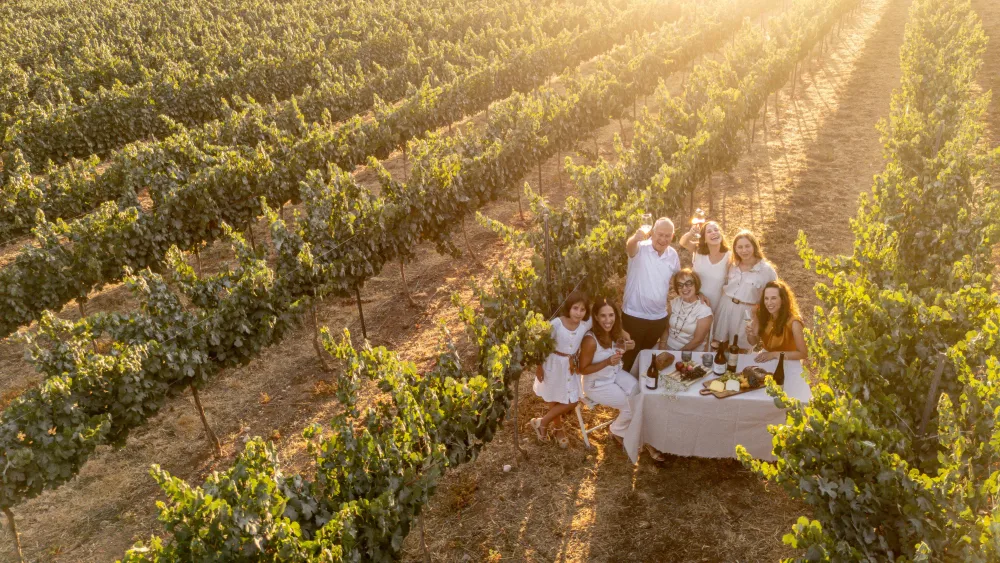
Teperberg Winery has a new target.
Ironically, it stems from the winery’s success in selling millions of bottles of good, reasonably priced wines in Israeli supermarkets. Today, however, Teperberg is producing finely crafted premium wines that still offer strong value. The target is persuading serious wine drinkers to give them a try.
Once they do, the winemakers say, the wines will speak for themselves.
“Along with the changing palate of us and our clients, the wines we are making today are quite different from the wine we made a couple of decades ago,” Shiki Rauchberger, Teperberg’s head winemaker, who has been with the winery since 2002, told JNS. “We are looking for varietal identity in our vineyards and we are more delicate about our winemaking process.”

A family legacy dating back nearly 200 years
Teperberg is Israel’s third-largest winery, after Barkan and Carmel, producing some six million bottles annually. About 15% of its production is exported mainly to the United States.
The winery maintains long-term contracts with growers throughout Israel and, in 2021, planted a large new vineyard in Moshav Aviezer in the Ella Valley. The first wines from that vineyard—including a Sauvignon Blanc in the Inspire series, retailing for about $15—are now available in wine stores.
The vineyard also carries Lodi certification, indicating that the grapes are grown using sustainable practices. Rauchberger said few vineyards outside the United States hold that designation.
Teperberg is also the largest family-owned winery in Israel, tracing its roots back five generations to 1830. That year, Abraham Teperberg, who was born in Odessa, immigrated to Austria, where he learned the art of winemaking before eventually settling in the Land of Israel and founding what became the first family winery in modern-day Israel.
In 1870, his son, Ze’ev Zaida, established the winery inside Jerusalem’s Old City walls, the first family winery founded in the modern-day Land of Israel, and it has remained under family ownership ever since. The business flourished despite the hardships of life in Ottoman Palestine.
The winery later moved to the Jerusalem neighborhood of Romema and, following the establishment of the State of Israel, returned briefly to the Old City before relocating to a larger facility in Motza, just outside Jerusalem, as demand grew.
Since 1984, Abraham’s great-grandson, Moti Teperberg, has led the winery, overseeing significant expansion and a growing emphasis on premium wines.

From supermarket staples to premium labels
The entry-level Vision series remains Teperberg’s supermarket mainstay, offering seven red and white wines that are fresh, approachable and affordable.
The lineup includes Cabernet Sauvignon, Merlot, Shiraz and Malbec, alongside white blends featuring Colombard, Sauvignon Blanc, Viognier and Muscat. There are also rosé and sparkling Moscato wines.
Most retail for about 40 shekels ($13-$16) per bottle and are frequently sold at promotional prices.
The next tier is the Impression series, featuring nine varietal and classic wines sourced from vineyards in the Judean Foothills, including Ayalon Valley. The red wines are aged for six months in oak barrels, giving them added complexity and structure.
Where things get interesting
The Inspire series marks a significant step up in quality and ambition.
The collection includes red and white wines sourced from premium vineyards around Israel. Most of the reds are blends aged for eight months in French oak barrels. Among the highlights is an outstanding Malbec-Marselan blend.
Part of the series includes the Inspire Art labels, created in collaboration with acclaimed Israeli graffiti artist Dede. These wines include Sauvignon Blanc, Dabouki—an ancient Middle Eastern grape variety—and a GSM blend of Grenache, Syrah and Marselan.
For wine drinkers looking to explore what Teperberg can do, this may be the ideal starting point. At $25 to $35 per bottle, the wines offer impressive quality for the price.
“The Inspire series focuses on the vineyards and on the terroir—the unique climate and soil conditions of each vineyard,” winemaker Daniel Friedenberg, a New York native, told JNS.

A serious contender
The Essence series, priced between $20 and $40, showcases the winery’s growing confidence.
On a recent visit to the winery, I sampled several wines from the range and found them consistently well made, with clear expressions of their vineyard origins.
As summer approaches, the Essence Rosé—a crisp, refreshing blend from the Ayalon Valley—is particularly appealing. The Chardonnay delivers classic varietal character with a restrained use of oak.
The biggest surprise, however, was the Essence Merlot 2020. Fruity and approachable yet layered and complex, it rivaled wines costing three times as much.
At the top of the portfolio sits the Legacy series, with bottles ranging from $60 to $80. The collection includes less common varietals for the Israeli market, such as Cabernet Franc, Petit Verdot and Petite Sirah.
For those looking to splurge, the wines are worth exploring.
The magic of winemaking
Both Friedenberg and Rauchberger speak passionately about their craft.
“There are some wines I analyze through my palate, but there are other wines that I feel all over my body, from my toes to my head,” Rauchberger said.
Friedenberg took the sentiment even further.
“It’s an ecstatic feeling when the moment is right, the wine is right, and everything is playing in harmony,” he said. “When a wine is showing perfectly, it’s just magic.”
