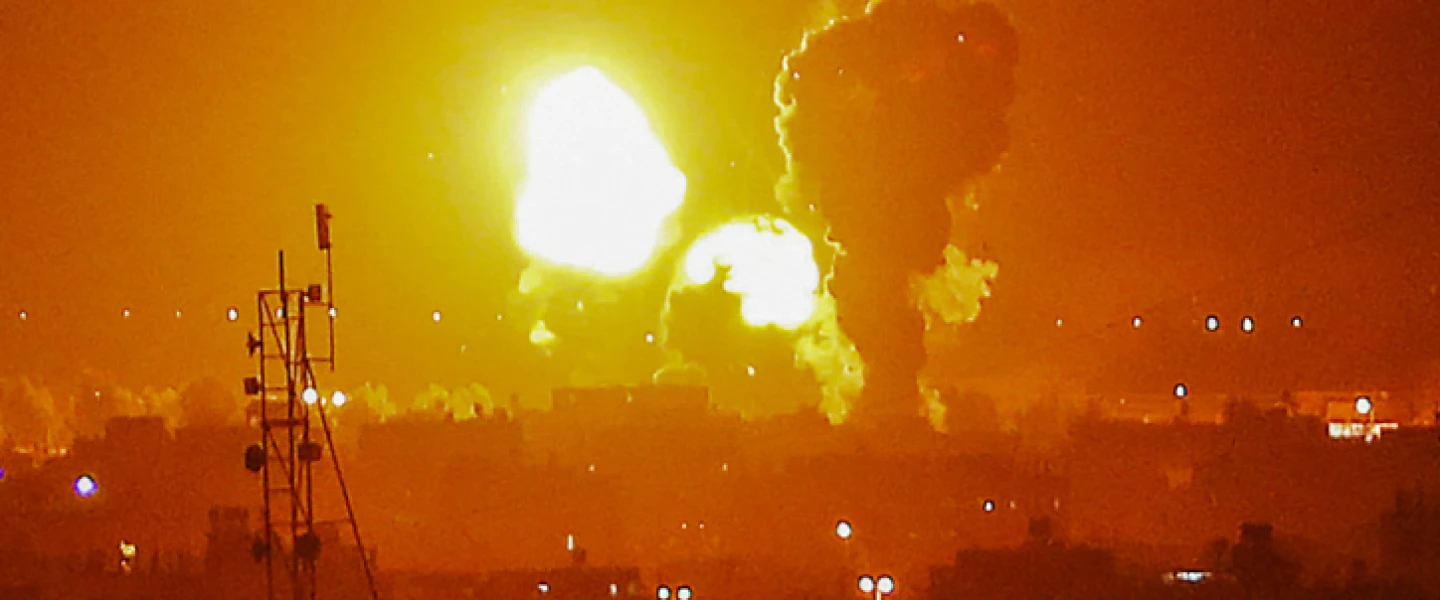
Throughout Tuesday and Wednesday, Palestinian Islamic Jihad together with smaller terror factions in Gaza fired 104 projectiles at southern Israel, and in doing so, revealed a problem regarding Israeli deterrence.
The attacks were conducted, with Hamas’s knowledge, in response to the death on Tuesday of 45-year-old PIJ security prisoner Khader Adnan, from Jenin, following a three-month hunger strike. The fate and welfare of security prisoners are of primary importance to the Palestinian street, and Adnan, a repeat hunger striker who had refused medical assistance, had become a kind of celebrity.
PIJ and Hamas felt they could and should expose themselves to Israeli air strikes in order to be seen taking revenge for Adnan’s death, and to market themselves as the authentic factions that “settle accounts” with Israel.
These events signify that despite Israel’s enormous military and intelligence advantage, armed Palestinian factions in Gaza remain prepared to terrorize Israeli civilians whenever they judge the benefit of such action to outweigh the costs.
This reality, unfortunately, calls into question fundamental assumptions about Israeli deterrence.
Tuesday’s rocket barrages included an intense, 30-rocket wave of strikes on the Sderot area in the afternoon, as children were returning home from after-school activities. A foreign worker was seriously injured at a construction site in the city, and two other workers were lightly hurt by shrapnel.
Sirens sent tens of thousands into safe areas—and the symbolism of those scenes was the objective of the attacks. Through the rockets, PIJ was saying, just as its secretary-general Ziyad al-Nakhalah, based in Damascus, had recently stated, that its asymmetric battle tactics give terror factions the ability to disrupt life in Israel when they choose to do so.
The Iron Dome air-defense system intercepted 24 projectiles. Forty-eight rockets landed in open areas and 11 fell in the sea near Gaza. The Israeli Air Force is reviewing Iron Dome’s performance.
Cool, calm decision-making is essential
According to Israel Defense Forces assessments, Hamas was well aware of PIJ’s intention to launch the escalation. As a result, the Israeli Cabinet ordered the IAF to target Hamas, not PIJ, based on the assumption that this would cause Hamas to end the escalation.
IAF fighter jets struck 16 targets in Gaza, including Hamas military posts, weapons storage sites, weapon manufacturing sites and a training facility, as well as a site used by the Hamas naval wing and an underground terror tunnel in southern Gaza. According to Palestinian sources, one person was killed and five injured during an Israeli strike on a Hamas military post.
The IDF said in a statement that “this strike significantly harms the capabilities and prevents further weapon acquisition capabilities of the Hamas terrorist organization in the Gaza Strip,” adding that it holds Hamas responsible for all terror activities emanating from the Strip.
Those who claim that the IAF is striking empty sand dunes in Gaza are mistaken. The targets that were hit represent years of work by Hamas and millions of dollars in investment by it. The strikes do sting. The problem, however, is that Hamas knew ahead of time that this would be the likely Israeli response and still gave PIJ the green light to attack southern Israeli civilians.
Israel cannot live under the equation in which PIJ and Hamas get to decide when escalations begin and end, or feel at ease to try and arrange the “rules of the game” between themselves and Israel.
It is undoubtedly true that Israel has multiple arenas to monitor and prioritize, and that cool, calm decision-making, rather than knee-jerk reactions, is essential in making strategic defense decisions.
However, it is also true that each time Israel signals to its adversaries that it is interested in ending escalations as soon as possible, and responds in more-or-less predictable manners to attacks from Gaza, other, more powerful adversaries like Hezbollah and Iran take notice.