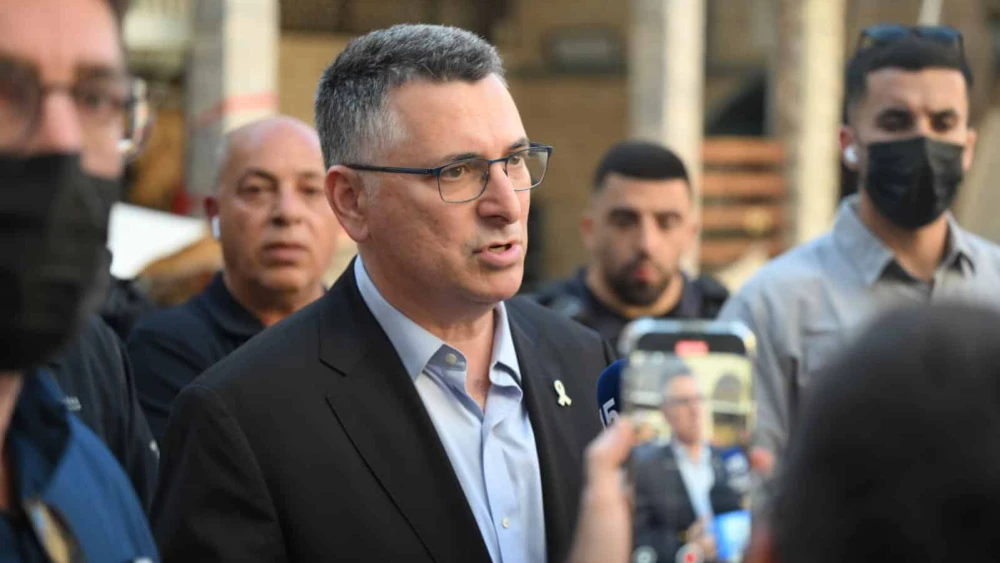
Israeli Foreign Minister Gideon Sa’ar on Tuesday said that Denmark’s prime minister “insulted” the Jewish state and its democracy when she told a newspaper that Benjamin Netanyahu was “a problem.”
Sa’ar spoke on this matter in an interview with Jyllands Posten.
The comments made by Mette Frederiksen about Netanyahu in her Aug. 16 interview with Jyllands Posten were “not respectful of Israeli democracy, of the choice of the Israeli people, and of the Israeli parliament,” Sa’ar told the newspaper.
Frederiksen, a leader of the Social Democrats center-left party, said in the Aug. 16 interview that her frustration with Netanyahu was tied to her inability to influence his actions.
“There is no doubt in my mind that Netanyahu today poses a challenge. You can see clearly that we have a very, very difficult time influencing what happens in Israel,” she said.
Sa’ar told the Danish newspaper that, despite what Frederiksen had said, “we consider the Danish prime minister a friend.” He also said he had spoken on the matter with Danish Foreign Minister Lars Løkke Rasmussen, a former prime minister and a supporter of Israel within the
European Union, who belongs to the center-right Moderates party.
Sa’ar also condemned Frederiksen’s reference in her interview to what she called “settler violence”—a disputed allegation that characterizes Israelis living in Judea and Samaria as engaged in systemic oppression of Palestinians.
“That’s something else we can’t accept. The settlers are more exposed to terrorism than anyone else in the world. And if someone breaks our laws, we condemn it, and we try to bring them to justice. It is not the government that should be blamed here. We condemn all forms of violence,” Sa’ar said.
In the interview with Frederiksen, she was asked whether she would consider applying sanctions against Israel or Netanyahu, to which she replied: “Nothing is off the table.”
Sa’ar said that Israel would not be pressured by Denmark, especially regarding security matters.
“Pressure will not affect Israel at all. We are used to being under pressure. So, we will not be influenced by others when it comes to our country’s security. We will not change policy. If we bow to pressure, it would be suicidal for us, and it would also harm European interests,” Sa’ar said.