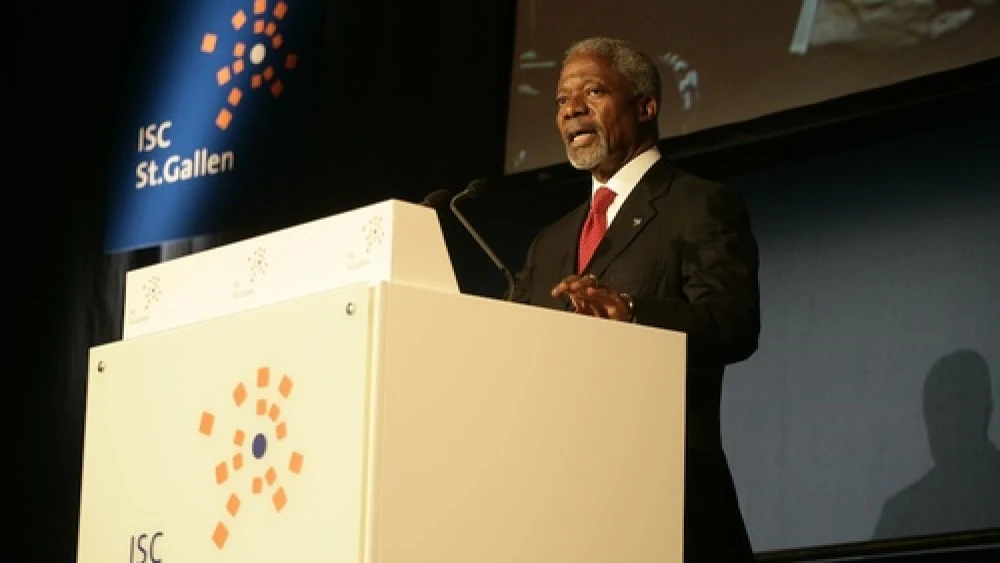
The horrors currently unfolding in Syria offer further proof of what might reasonably be described as Kofi Annan’s law of international relations: Wherever Kofi Annan turns up, bloodshed is sure to follow.
During and after his scandal-ridden decade as UN secretary-general, Annan smoothed the ruffled feathers of brutal dictators like Saddam Hussein in Iraq and Kim Jong Il in North Korea.
In October 1995, Annan remained at the UN’s peacekeeping helm as Serb forces seized control of the Srebrenica enclave in Bosnia, slaughtering the entire male population, including young boys. When he stepped down from the secretary-general’s post in 2006, he lambasted not Russia or China—the two states that did the most to prevent the UN’s lofty human rights principles from actually being implemented—but the United States, for allegedly “seeking supremacy over all others.”
Despite this shameful record, the UN and the Arab League jointly appointed Annan as their envoy to Syria in February of this year, as Bashar al Assad’s assault upon his own people grew in intensity. Sure enough, with Annan on the spot promoting a six-point peace plan that Assad assented to in public but violated on the ground, the “violence”— a lily-livered euphemism for the carnage orchestrated by the Damascus regime—got worse.
Now, more than a week after the bloodcurdling massacre in Houla, in which the bodies of at least 49 children turned up in the wreckage left by the shabiha, Assad’s execution squads, the west is again agonizing over the question of intervention. So far, expelling Syrian diplomats is about as tough as western countries have got. (Had Assad’s ambassadors instead been arrested for complicity in crimes against humanity, the democratic world might not look quite so feeble.)
In any humanitarian emergency, the prospects for intervention can be either helped or hampered by the decisions of the immediate past. In the Syrian case, the appointment of Annan as chief envoy indubitably strengthened the hand of anti-interventionist states, most obviously Russia, Assad’s key international ally. As a result, in both political and military terms, intervention is regarded by western policy-makers as more complicated and therefore less attractive.
As the commentator Michael Weiss cogently explained in a recent opinion article on Syria, Russia has a clear policy based on its commercial and military interests. And that policy is based upon ensuring that Assad retains the lion’s share of control over a rapidly fragmenting Syria.
But what about the U.S. and its policy? In the wake of the Annan plan’s failure, the Obama Administration implored Vladimir Putin, the Russian President, to use his influence over Assad to bring an end to the killing. When it comes to “leading from behind,” a phrase that has been consistently applied to Obama’s response to the upheavals across the Arab world, Syria has provided the most notorious example.
Of course, that approach bore no fruit, which may explain why Administration officials— like Secretary of State Hillary Clinton, who accused Russia of aiding the spread of open civil war in Syria—are sounding more impatient with Moscow. Yet the overriding American priority now seems to be making the most plausible case against intervention.
“We’re nowhere near putting together any type of coalition other than to alleviate the suffering,” Clinton told reporters during a visit to Denmark. “We are working very hard to focus the efforts of those, like Denmark and the United States, who are appalled by what is going on, to win over those who still support the regime, both inside and outside of Syria.”
Clinton’s spineless rhetoric was accompanied by a further explanation that military action would require the support of the UN Security Council—another way of saying that, since Russia and China would never back such an outcome, don’t bother even thinking about it.
However, recent history demonstrates that the UN Security Council doesn’t have to be an immovable impediment. In 1991, lack of Security Council authorization didn’t stop the western allies from launching a military operation to protect the Kurds of northern Iraq following Saddam Hussein’s expulsion from Kuwait. In 1999, thanks to the efforts of British Prime Minister Tony Blair, NATO evicted the Serbian regime of Slobodan Milosevic from Kosovo without a Security Council resolution.
And in 2003, Blair and US President George W. Bush courageously proceeded with a war to remove Saddam Hussein from power, in spite of the objections of the Security Council.
Sadly, this administration is not possessed of the same resolve. That’s bad news for western nations, since history has proven time and again that democracy and human rights are the best guarantors of political stability. It’s bad news for the regional allies of the west, most obviously Israel, which has endured Assad-sponsored terrorism and understandably fears the political chaos that is likely to sprout from a Syrian civil war.
Most of all, it’s bad news for the people of Syria, 12,000 of whom have already been murdered by the regime, with no end in sight. If we continue to desert them in their hour of need, we will be making new enemies in a region where we have precious few friends as it is.
Ben Cohen is the Shillman Analyst for JointMedia News Service. His writings on Jewish affairs and Middle Eastern politics have been published in Commentary, the New York Post, Ha’aretz, Jewish Ideas Daily and many other publications.