



Despite their importance, election campaigns can have the potential of centering on what appears to be a matter of crucial concern, but really isn’t. In fact, a good public-relations consultant can create an issue where there is none. Even more, he can hide an issue or deep-file it, away from too much public attention.
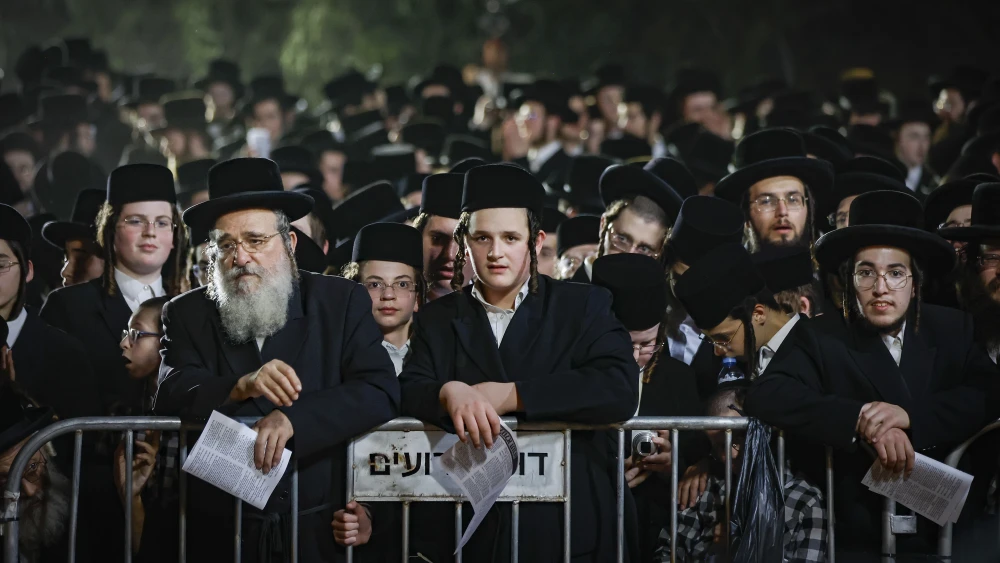
For example, it is assumed that the main theme in the campaigns of the various parties for election to Israel’s 26th Knesset—the polling day is scheduled for Oct. 27—will be Haredi enlistment into Israel’s military. Nearly three years of wars and battles on multiple fronts have highlighted the insufficient participation of this sector of society in the nation’s critical needs.
However, if manpower alone is the critical factor, then other societal elements should be focused on besides, perhaps, reviewing the system of exemptions, including medical, psychological and special categories of endeavors such as sports, music, acting and otherwise.
The Arab population also comes into play. In January 2025, a Knesset committee was informed that if universal enlistment were to be put into place, at least 10,000 Arab males would be potential recruits, and just more than double that figure if females were included.
Since the main parties using the issue of insufficient participation from the Haredi populace refer to themselves as democratic, liberal and progressive, one could question why their demand is limited solely to the uber-religious.
One answer is that Israelis have had enough trouble with the Haredim and their demonstrations. A second, obviously, is that even those who are left of center realize that a serious security issue exists. For them, so-called “apartheid” in the military is tolerable.
A third, and more pressing element, is that the Haredim do not serve and yet still receive social-welfare payments, tax benefits and so forth. In short, it is costing too much to tolerate their slack. Besides, their economic structure is simply one of not contributing to the state’s needs, combined with creating one that is too imbalanced and unproductive, since most females who support their families work in education. That said, their schools are also notoriously weak in teaching general subjects that would prepare them for better jobs.
There is an additional factor. Earlier in July, the senior spiritual leader of the non-Chassidic, Lithuanian ultra-Orthodox (Haredi) sector, Rabbi Dov Lando, was heard speaking in conversation with the heads of the Mir Yeshiva. Lando was upset at members of the Religious Zionist (“knitted kippah”) community who push for the enlistment of ultra-Orthodox yeshivah students.
The Haredim have never accepted Zionism, and despite the financial inflow from the state, remain extremely uncomfortable with the situation. Their level of ideological sensitivity becomes irregular when they have to face their pre-state opposition to Zionism, coupled with the state’s success ever since, even in Torah learning.
Lando involved himself, of all things, in the intricacies of military strategy and tactics from his point of view based in halachah, Jewish law. If the state sends soldiers to fight and kill—not purely for life-saving survival, but for “the sake of the country’s honor”—then it amounts to “outright murder,” he said. Religious Zionists who insist on Haredi enlistment are therefore “wicked people” who are “inciting murder.”
The ruckus (a term of extreme understatement) that broke out was grist for the media mill. Even Israeli Prime Minister Benjamin Netanyahu, whose political moves have displayed near-unctuous subservience to his Haredi coalition partners, expressed displeasure at Lando’s words while praising soldiers from the Religious Zionist camp.
Diatribes from the opposition parties, of course, were sharper, if not derogatory. Besides potential monetary sanctions—Yesh Atid head Yair Lapid, now politically aligned with former Israeli Prime Minister Naftali Bennett, even suggested denying Haredim the right to vote—no sensible and practicable plan to encourage them to increase their induction into military service has been presented.
That situation leaves official Israel no choice but to engage Haredim on the theological level of what Jews have done when independent in their homeland. Messaging needs to be formulated in convincing them that being in the Israel Defense Forces is indeed a mitzvah. It is a Jewish thing to be done. To be a part of a Jewish military framework is a good thing.
Abraham, or rather Avram, did battle to rescue his nephew Lot. As recounted in Genesis, Chapter 14: “He called out the 318 trained men born in his household and went in pursuit as far as Dan.” North of Damascus, the enemy was attacked and routed. Even the non-Jewish Melchizedek, king of Salem, was impressed, uttering: “Praise be to God most high, who delivered your enemies into your hand.”
Moses beat up and killed an Egyptian to protect a fellow Jew we are informed in Exodus 2:11-12. Joshua brought down the walls of Jericho; the prophet Samuel decapitated Agag, a king of the Amalekites; and Yael drove a tent peg through Sisera’s head. David led a band of 37 mighty warriors.
Even in the lands of exile, Jews fought and were trained in the military arts, such as Mar-Zutra II, a Jewish exilarch in the late fifth century C.E. He took up arms and led a revolt against the Sasanian rulers in 495 C.E., achieving seven years of political independence.
Some Haredi leaders have viewed military activity in a positive vein, such as Rabbi Tzvi Kalischer, who demanded in 1862 the formation of a Jewish military guard for the security of those returning to Zion, and Akiva Yosef Schleshinger agreed with that and published so in his 1873 book, Ḥevrah Maḥazirei ‘Aatarah le-Yoshnah.
All this, though, is not for a period of elections. What voters should be focused on is which coalition will assure the state’s security, and which government will fulfill Jewish and Zionist fundamentals. Who should be in the cabinet that will keep the country able to confront enemies and assure friends and diplomatic alliances? And which prime minister can truly represent the idea of a return to Zion.


