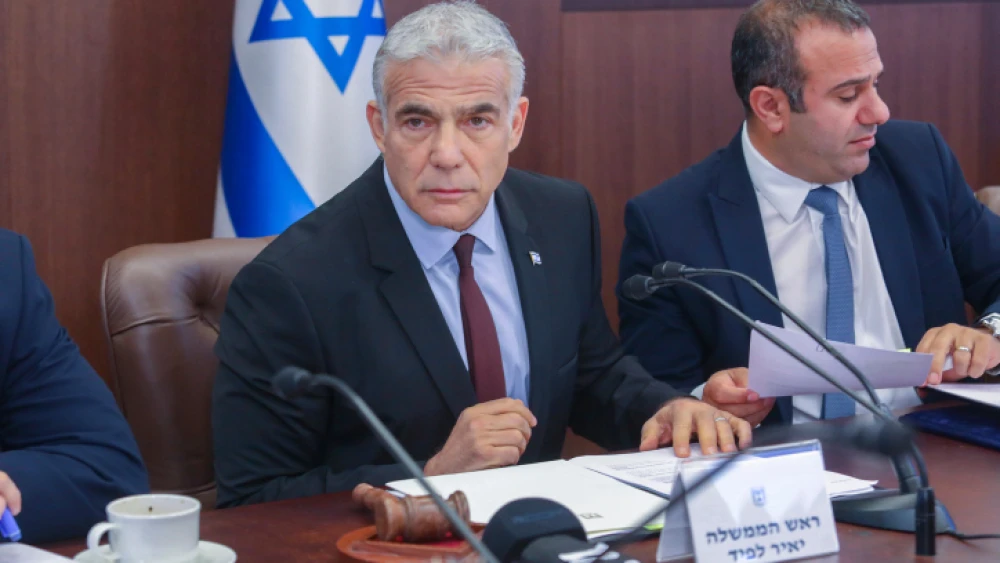
Israel is carrying out an “intensive campaign” to prevent the revival of the “dangerous” nuclear agreement between Iran and world powers, Israeli Prime Minister Yair Lapid told the weekly Cabinet meeting on Sunday.
His comments come after the United States last week characterized Tehran’s latest response to efforts to revive the 2015 nuclear accord as “not constructive.”
Lapid said the government was “hard at work” on the campaign, citing Defense Minister Benny Gantz and Alternate Prime Minister Naftali Bennett, who is responsible for the Iran portfolio.
Mossad Director David Barnea will head for Washington, D.C., on Monday for a series of meetings to express Israel’s position to the Biden administration about the dangers of an agreement, the prime minister added.
He also referred to his telephone call with U.S. President Joe Biden on Aug. 31, in which he addressed Israel’s concerns.
Lapid rejected criticism that his government was taking too cautious an approach with the U.S. administration. (Opposition Leader Benjamin Netanyahu and his Likud Party attacked the government last week for what they characterized as weak handling of the Iran issue.)
“To those who say we are not shouting loud enough, or are not outspoken enough, I recall what really happened in the past,” Lapid said, according to a government press statement. “In 2015, when Israel insisted on an unnecessary confrontation with the [Obama] administration, it was a complete failure. The Americans simply stopped listening to us. It damaged our relationship with them, and they went and signed a bad agreement.
“The correct policy is the one we have led over the past year: to continue the pressure but without going too far. To present credible intelligence, to be part of the process without destroying our special relationship with the U.S.,” he added.
“I say this cautiously, but in the meantime, it is working. The reservations that we have presented to the American administration have been taken into account,” said Lapid.
The United States last week received Tehran’s response to comments it had sent on Aug. 24 regarding a “final” E.U. draft of a revived nuclear deal.
“We are studying it and will respond through the E.U., but unfortunately it is not constructive,” a State Department spokesperson said in a statement.