


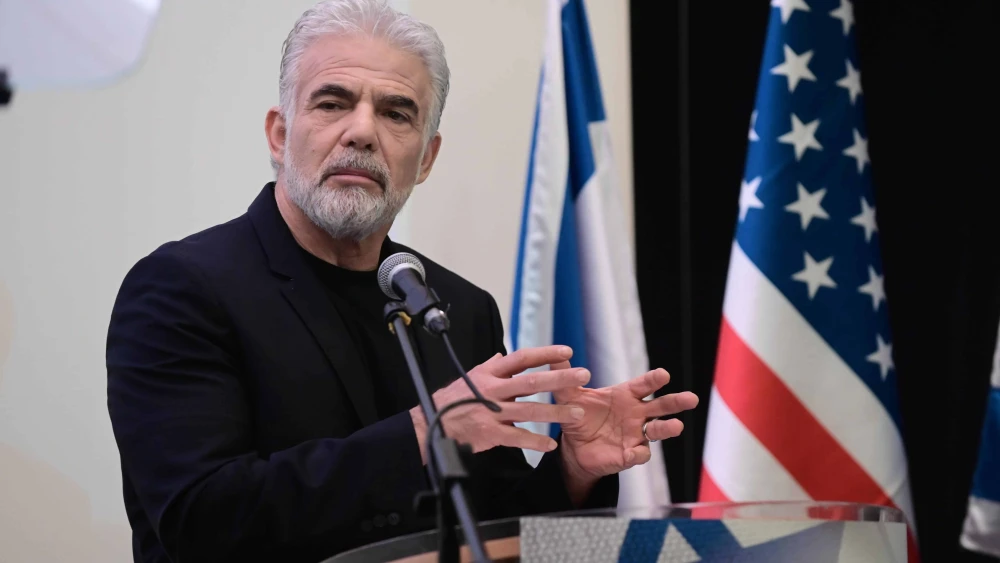
Israeli opposition leaders on Monday voiced support for U.S. President Donald Trump’s plan to get Iran to drop its nuclear weapons program, either by negotiated settlement, or by military action.
Opposition Leader Yair Lapid (Yesh Atid) told JNS during his faction meeting in the Knesset in Jerusalem, “Either maximum pressure sanctions or military action [...] will prevent Iran from becoming a nuclear state.”
Trump reiterated, in an interview with The New York Post on Saturday, that he would prefer to solve the Iran nuclear issue diplomatically, without resorting to military action.
“I would like a deal done with Iran on non-nuclear. I would prefer that to bombing the hell out of it,” he said. “They don’t want to die. Nobody wants to die. I hope they decide that they’re not going to do what they’re currently thinking of doing. And I think they’ll really be happy,” he added.
Benny Gantz, head of the National Union Party, told JNS, “If it takes a hell of a bomb, or it takes a good diplomatic deal—as long as it’s a good deal—I don’t care which.”
Avigdor Liberman of Yisrael Beitenu dismissed the effectiveness of a deal to block Iran’s path to a nuclear bomb. “There is no chance that any deal would prevent the Iranians [from obtaining nuclear arms] so the responsibility is ours. We need to take a decision as soon as possible.
“There has not been a deal with the Iranians that they didn’t violate. We saw a precedent in North Korea. There, too, there were agreements and commitments and it ended in nuclear arms,” said Liberman.
Trump signed an executive order on Feb. 4 to reimpose “maximum pressure” sanctions on the Islamic Republic.
The president said at the time that he was “torn” regarding the order. “It’s very tough on Iran,” Trump said. “Hopefully, we are not going to have to use it very much … I’m unhappy to do it,” he added.
Iran’s Supreme Leader Ali Khamenei said on Friday that “negotiating with such a government should not be done. If they threaten us, we will threaten them. If they act on those threats, we will do the same. If they undermine our nation’s security, we will undoubtedly respond in kind.”


