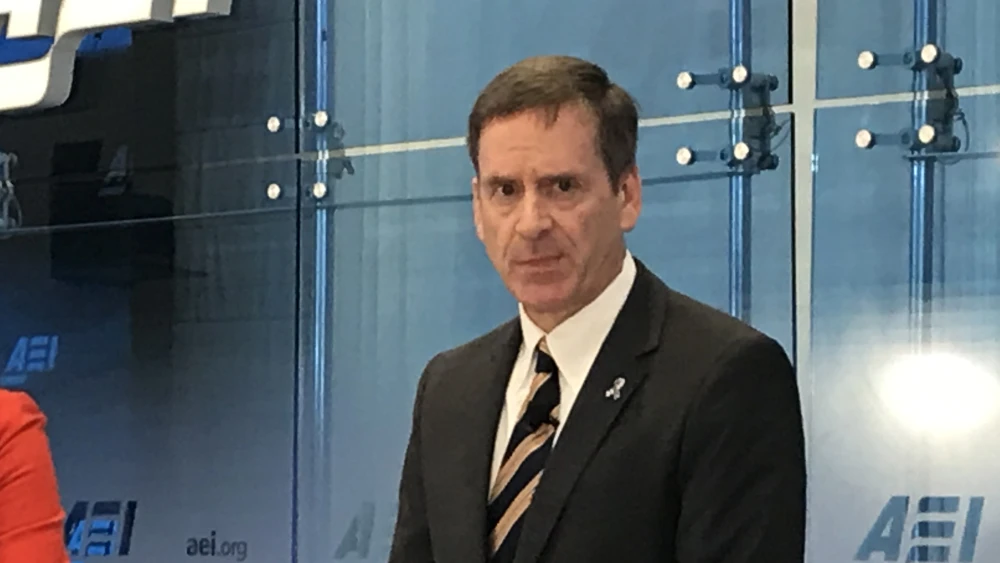
The head of the U.S. Agency for International Development confirmed on Wednesday reports that USAID will close its doors in the West Bank and Gaza by early 2019.
“We do have strict guidelines on who we work with, and that’s simply not just what we do, but across the U.S. government,” USAID administrator Mark Green told JNS.
Without elaborating, he continued: “[There] are guidelines that we follow.”
“We follow administration policy,” added Green.
This comes as the Trump administration is reportedly trying to save remaining U.S. funding towards the Palestinian Authority, most of which was cut off through the enactment of the Taylor Force Act, as the Anti-Terrorism Clarification Act would, barring changes, cut off security assistance to the P.A.
The law, signed into law in October and scheduled to take effect in January, provides protections for American victims of international terrorism.
When asked by JNS on Tuesday about this apparent development, U.S. State Department Deputy Spokesperson Robert Palladino had no comment.
Despite Green’s remarks, a USAID spokesperson denied to JNS the reports of the agency closure: “We are studying the potential impact of the Anti-Terrorism Clarification Act [ATCA]. At this time, no changes have been made to U.S. security assistance to the Palestinian Authority or other ongoing programming.”
“The broader point here is that cuts to Palestinian security could have a dilatory effect on Israeli security,” Jonathan Schanzer, senior vice president of research at the Foundation for Defense of Democracies, told JNS. “It’s one of the few positive points to note in what is otherwise a very fraught relationship. The Palestinians and Israelis have been working closely to counter the activities of Hamas, Palestinian Islamic Jihad and other terrorist organizations.”
“They’ve done a good job,” he continued. “Cutting Palestinian assistance in this space in particular, I think, strikes many, even those who are hawkish, as problematic.”
However, the civil-rights nongovernmental organization Shurat HaDin-Israel Law Center called for the funds to be cut off as planned.
“The State Department currently oversees more than a dozen programs that benefit the P.A., including training, construction and provision of equipment,” it said. “The P.A. relies on these programs for its own security. The State Department is arguing that the P.A. will cut off all these programs and existing ties with the U.S. if Congress does not delay the law.”
“Congress should do no such thing. Congress made a simple policy decision,” the NGO continued. “If the P.A. wants American assistance, it has to do so on the understanding that it will be held accountable for terror attacks that took American lives and caused severe injuries.”
New York-based hedge-fund manager Sander Gerber, who was instrumental in the passage of the Taylor Force Act, echoed Shurat HaDin’s sentiment.
“The [1992 Anti-Terrorism Act] law highlights the moral absurdity of the status quo,” he told JNS.
“The P.A. fights against certain terror organizations, but still proudly pays $350 million per year to civilians and their families who kill Israelis,” he continued. “Victims deserve compensation from the P.A. more than their murderers. I hope the Congress will not emasculate the law … [it is] high time to stop U.S. and Israeli appeasement of P.A.-sponsored terror.”