
This Fourth of July, America turns 250, and despite world events and domestic tensions, Jewish Americans have many reasons to feel proud. The values that make this nation great—freedom, hard work, family, community and faith—are also the values at the heart of Judaism, as they have been for thousands of years.
When the Founding Fathers imagined a new nation, they drew inspiration from many sources, including the Hebrew Bible.
They also made an early and clear commitment to religious freedom, none more memorably than President George Washington’s famous 1790 letter to a Jewish congregation. He promised a nation that gives “to bigotry no sanction, to persecution no assistance.”
These shared values are why America became home to half the world’s Jews and why Jewish life has been woven into the fabric of this country from its earliest days.

The founders looked to the Hebrew Bible
On July 4, 1776, only a few hours after declaring independence, the Continental Congress appointed Benjamin Franklin, Thomas Jefferson and John Adams to design the national seal. The depiction of the Exodus—of a people breaking free from a tyrant—was a story that resonated. Franklin proposed Moses parting the Red Sea as Pharaoh’s army drowns and Jefferson pictured the Israelites marching out of Egypt under a pillar of fire. Congress chose simpler images: an American bald eagle and a pyramid.
The founders saw a model in the Torah’s Hebrew commonwealth, a nation ruled by law and covenant instead of a king. Franklin’s proposed seal had included the motto: “Rebellion to tyrants is obedience to God.” Jefferson admired it so much that he took it for his own personal seal.
This was no sudden enthusiasm. Decades before independence, Hebrew was a required language for students at Harvard and Yale, so they could read scripture in its original tongue. Yale valedictorians spoke in Hebrew and the college’s coat of arms features Hebrew words once worn on the breastplate of the ancient Jewish High Priest.
Hebrew was prized so highly that Harvard’s first instructor of the language was Judah Monis, the first Jew to earn a college degree in the United States. He taught from 1722 to 1760, but only after he converted to Christianity. Generations of Jews were restricted from many of the institutions that embraced their heritage. Still, the Hebrew Bible had already been infused into the concept of a free nation. As President Calvin Coolidge highlighted in 1925: “The Jewish faith is predominantly the faith of liberty.”
The Bible’s Exodus story inspired African-Americans
For enslaved black Americans, the Exodus was not ancient history; it was their own story. They saw parallels in their bondage to that of the Israelites in Egypt. They composed spirituals that were sung in the plantation fields, including “Go Down Moses.” The lyrics went: “When Israel was in Egypt’s land, Let my people go. Go down, Moses, Tell old Pharaoh, Let my people go.”
Escaped slave and civil-rights pioneer Frederick Douglass compared “the birthday of National Independence and political freedom” to “what the Passover was to the emancipated people of God,” linking the freedom of Americans with the Israelites in an 1852 speech.
Abolitionists also found inspiration in the history of the Jews’ quest for freedom. In the 1830s, they gave Philadelphia’s old State House bell a new name: the Liberty Bell. Engraved into its rim is an inscription from the Torah’s Leviticus 25:10: “Proclaim liberty throughout all the land unto all the inhabitants thereof.” The bell carried a promise of freedom that America had not yet kept for everyone.
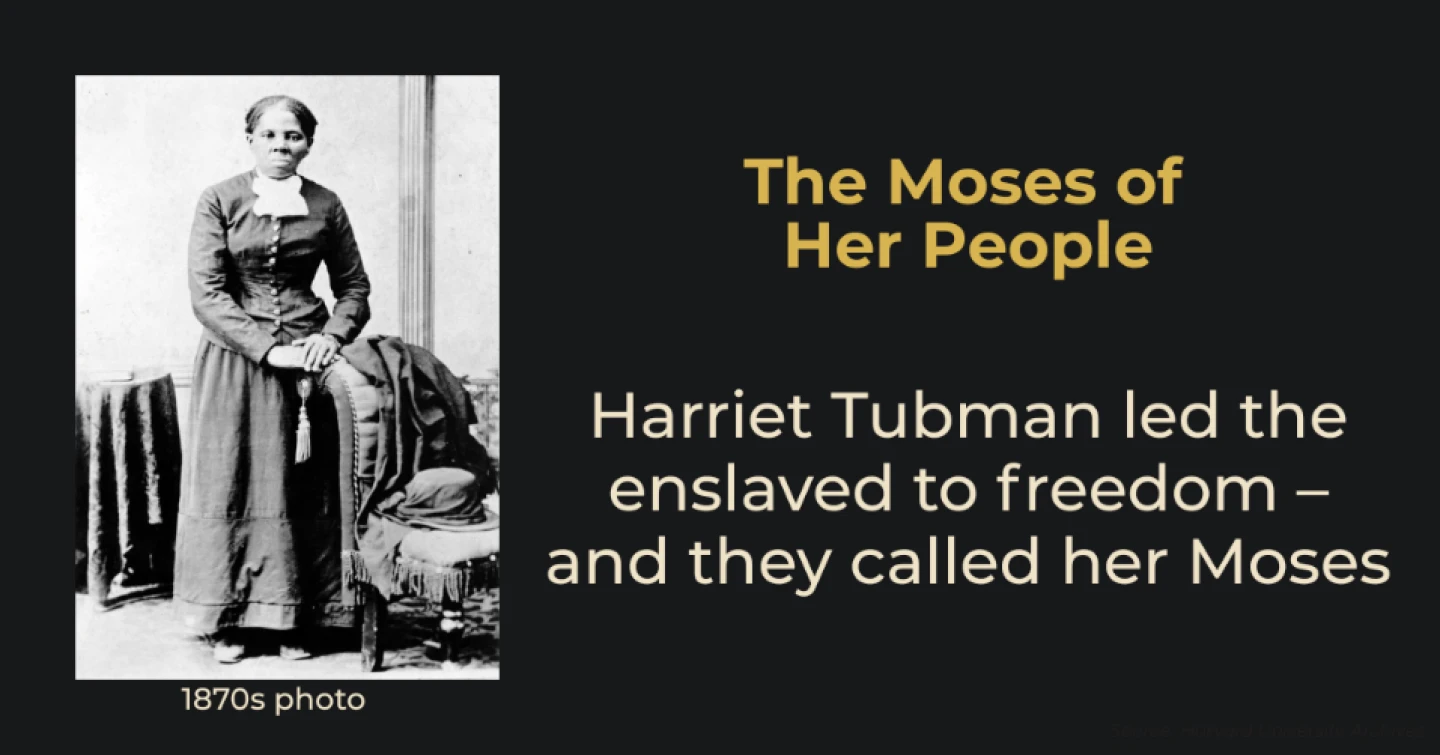
Harriet (“Moses”) Tubman led enslaved Blacks out of bondage in the 1850s on the Underground Railroad, earning the nickname for her accomplishments. After President Abraham Lincoln issued the Emancipation Proclamation in 1863. In the 1870s, freed black Americans fled from post-war violence in states in the U.S. South. About 27,000 found a new home in Kansas. Their migration became known as the Great Exodus, and they were called Exodusters.
Generations later, the 1960s civil-rights movement marched with the same values. Martin Luther King Jr. preached that black Americans, like the Israelites, “will get to the Promised Land.”

Jewish culture became American culture
Jewish ideas run through America’s founding—from its original fight for freedom to daily life today. Yiddish words became part of the national vocabulary, so that Americans of every background now schmooze and schlep, call a clumsy person a klutz and a know-it-all a maven, often without knowing the words have Jewish origins. The bagel, introduced by Jewish immigrants, has become an American staple.
The shared Jewish and American spirit is now under threat. On both political extremes, Jews are being attacked—from New York City Mayor Zohran Mamdani’s condemnation of Americans who support a strong U.S.-Israel alliance to former Fox News host and current podcaster Tucker Carlson’s promotion of anti-American and anti-Jewish conspiracy theories. History is clear about what follows: when a society turns on its Jews, it never bodes well for that society as a whole.
Points to consider:
1. America shares important values with Judaism.
Many of the ideals that Americans hold dear are rooted in the tenets of Judaism. When the founders built a new kind of nation, they reached for the Hebrew Bible as their model, a people bound by law and covenant, not ruled by a British king. It is the same source that gave the world the Ten Commandments.
2. African-Americans found freedom in the Exodus story.
Abducted from their homes and held in bondage, enslaved Africans found their own hope in Israel’s escape from Egypt. They sang of Moses in the fields. The freed families who fled the violence of the South called themselves Exodusters. A century later, Dr. Martin Luther King Jr. preached that his flock, like the Israelites, would reach the Promised Land.
3. Jews are important contributors to American life.
Generations of Jewish immigrants arrived with next to nothing and worked hard to build a life in America—contributing to its hospitals and universities, its unions and businesses, its science and law, its music and comedy. They did not stand apart from the country; they helped weave its fabric.
4. An attack on Jews is an attack on America.
Contempt for Jews today is the common hatred that animates extremes on both sides of the political aisle. On the far left, activists who brand Jews as oppressors also condemn America itself as a racist project that should be torn down. On the far right, the figures who spread Jewish conspiracy theories also rewrite the nation’s history, recasting even the war against Hitler as the wrong fight. Neither is defending America. When a society turns on its Jews for the very values the country was built to protect, history proves that the whole of society suffers.
5. A response to rising threats is Jewish pride.
For thousands of years, antisemites have tried to drive Jews out of one nation after another—and every one of those empires crumbled. As America turns 250, the answer is not to hide, but to stand tall in a country that Jews helped to build and defend.