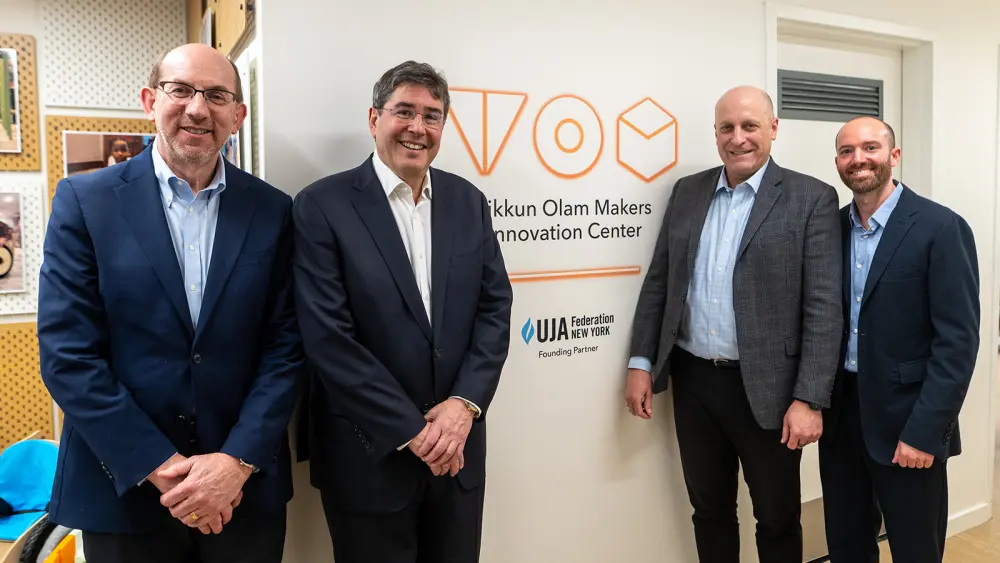
Tikkun Olam Makers (TOM), an international nonprofit venture of assistive technology, announced the opening of its New York Innovation Center (TOMIC NYC), with a $750,000 grant from UJA-Federation of New York to help launch the initiative.
The new headquarters will expand TOM’s ability to design and distribute affordable, open-source assistive technologies, while expanding and deepening partnerships with universities, schools, hospitals, rehabilitation centers and disability organizations.
Located at the Shefa School, a pluralistic Jewish day school for children with language-based learning disabilities, near Columbus Circle in Midtown Manhattan, TOMIC NYC will serve as a hub for innovation in assistive technology and volunteer engagement for people with disabilities, the elderly and other vulnerable populations, serving New York City, the tristate area, and communities across New York State and nationwide.
As part of the launch, TOM and UJA-Federation announced their intention to distribute 250 specialized mobility devices (wheelchairs) for toddlers with disabilities. The wheelchairs can be manufactured with household 3D printers.
“TOMIC NYC enables us to greatly expand our capacity to serve the most deserving individuals and their families. Our motto is affordable and accessible for anyone, anywhere. We are proud to partner with UJA-Federation of New York, a longtime partner who deeply appreciates our mission,” said Gidi Grinstein, founder and president of TOM. “Our inspiration comes from the late Rabbi Lord Jonathan Sacks, who said, ‘To heal a broken society, build things together.’ His teaching is our inspiration.”
“Tikkun Olam Makers NYC shows how Israeli innovation, grounded in Jewish values, can make a meaningful difference for New Yorkers with critical needs,” said Eric S. Goldstein, CEO, UJA‑Federation of New York.
Founded in Israel in 2014 by the Reut Group, TOM has more than 1,200 open-source solutions in different phases of development and has operated in the United States, Israel and more than 30 other countries.
TOM crowdsources engineers, designers and creators to co-create open-source, affordable and accessible solutions for people with disabilities and other vulnerable populations. The designs of these solutions are deposited in the online TOM Portfolio, so they can be downloaded and manufactured by anyone, anywhere, using 3D printers and other simple tools.
In New York, TOM has engaged six university campuses, including New York University, Columbia University, Parsons School of Design, Yeshiva University, Touro University and Cooper Union, and partnered with institutions such as Columbia University Irving Medical Center’s Weinberg Family Cerebral Palsy Center, the Adaptive Design Association, iHOPE school and Central Synagogue.
These partnerships led to the design of dozens of innovative solutions and to the distribution of hundreds of affordable products, including wheelchairs for toddlers, often at no direct cost to users.
TOM originated in Israel; its first innovation center is in Tel Aviv.