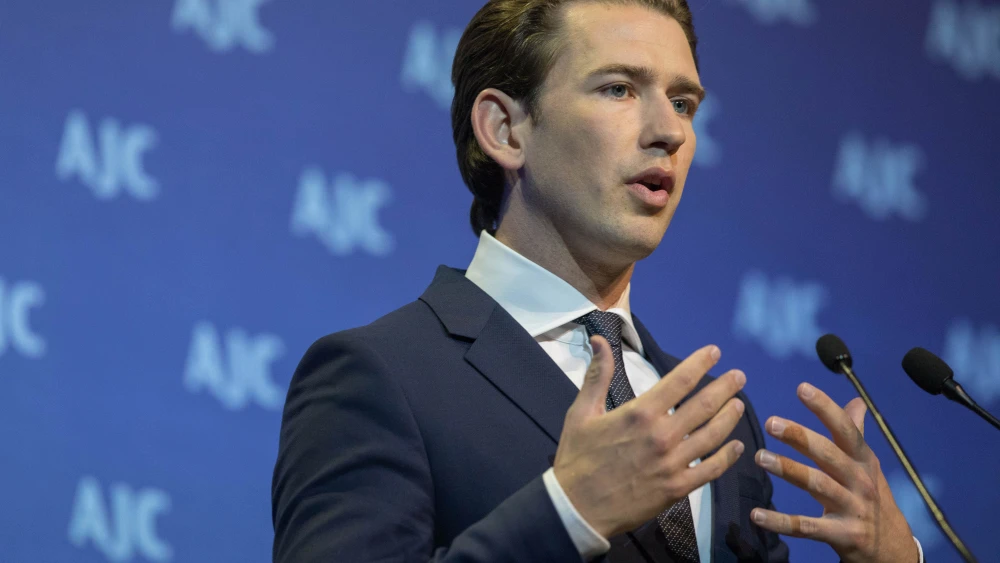
Austrian Chancellor Sebastian Kurz has seen long and difficult days since forming his second government at the beginning of January this year.
Shortly after forming a coalition that set a precedent in Europe—between his own conservative party and Austria’s Green Party—COVID-19 hit the country. Now it’s back, worse, requiring a nationwide shutdown.
On Monday evening, shortly before the lockdown began, an Islamist terrorist attack was carried out in the heart of historic Vienna that ended with at least four dead and some 20 wounded, some seriously. Despite the emergency situation, and under the shadow of an ongoing investigation to determine whether the terrorist, who was killed, was operating alone or was part of a cell, the chancellor on Tuesday found time to give an interview to Israel Hayom.
“The terrorist attack in Vienna, which is clearly an Islamist terrorist attack, is not an isolated incident, but part of a series of many attacks carried out against Europe,” said Kurz.
“This was an assault on our democracy, on our basic values, on the European lifestyle. We will not let these terrorist acts threaten us. We will hunt down anyone who lent their hand to this attack and bring them to justice,” he continued.
Q: Can we rule out an anti-Semitic motive for this attack?
A: We cannot rule out the possibility that the attack was anti-Semitic. We know that it was an Islamist attack. The attacker swore allegiance to ISIS and the attack began right in front of a synagogue. No Jews were hurt, but the starting point of the attack, right in front of a synagogue, doesn’t allow us to rule out an anti-Semitic motive.
Q: Based on the information you currently have, was a terrorist group behind it?
A: All night after the attack special forces conducted house-to-house searches, and 14 people in the attacker’s circle of acquaintances were arrested. In the next few days, we’ll know if a bigger group was behind the attack and whom he had contact with. I want to thank [Israeli] Prime Minister Benjamin Netanyahu, who not only expressed his condolences but also promised the full cooperation of the Israeli authorities and intelligence services.
Q: The attacker was put in prison for trying to join the Islamic State. Do you think it was right to shorten the attacker’s prison sentence?
A: Now we need to look into what happened.
Q: President of France Emmanuel Macron is preparing to fight political Islam in his country. Should all the E.U. adopt and implement that plan?
A: ... It’s important not only to fight terrorism, but also the ideology behind the terrorism. We should fight political Islam, or radical Islam, which is an ideology of deep hatred for our free way of life.
Q: How closely are Austria and Israel working together in the fight against terrorism?
A: We have great cooperation on the political level, and also with various authorities. I am very thankful for the support Israel gives us in this area, and for putting its knowledge about the issue at our disposal.
Q: What do you see as a bigger threat: Islamist terrorism or COVID?
A: The COVID pandemic is an enormous challenge for the entire world, including the nations of Europe. For us, in Austria, it’s been the main issue for months. The pandemic has caused an economic crisis in many countries. But right now our thoughts are with the victims of the attack, and we’ll do everything to find and capture those who were behind it, and punish them.
Q: Many see this week’s U.S. presidential election as fateful for the world. What does it mean for you?
A: The results of democratic elections are always important, and the bigger democracies are, the more important they are to the rest of the world. But right now in Austria, we have bigger concerns, and we’ll focus on them.
This article first appeared in Israel Hayom.