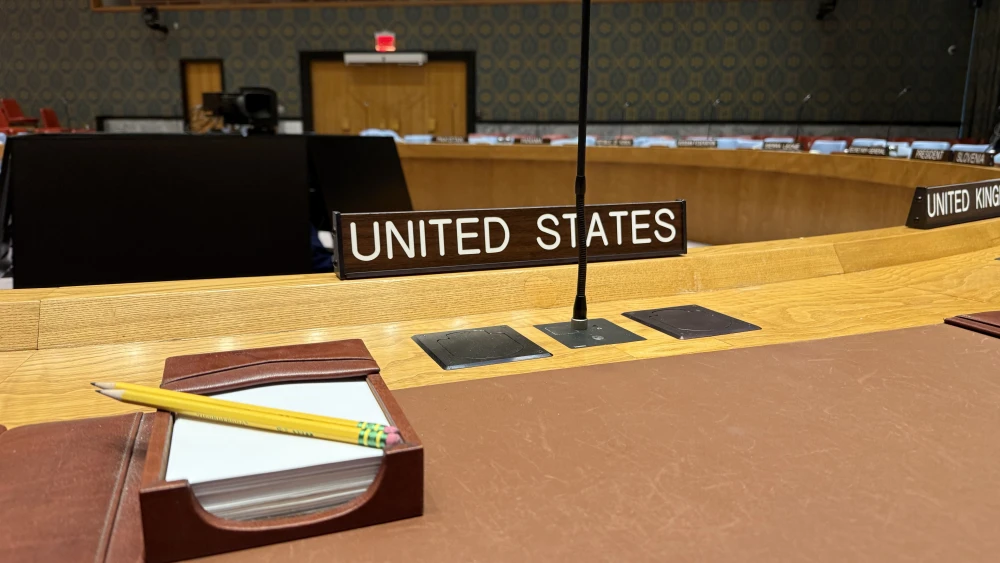
The United Nations Security Council, which includes the Arab representative Bahrain, voted 13-0 on Wednesday to condemn Iran for its strikes on its Gulf neighbors. The vote, from which Russia and China abstained, was a highly unusual rebuke of the Islamic Republic by Arab states.
Just before the vote, Mike Waltz, the U.S. ambassador to the global body, told reporters that “the atrocities that we’re seeing, the deliberate attacks on civilian infrastructure, on ports, on airports, on energy production facilities, on hotels, on resorts across the Gulf is unacceptable.”
“It’s disgusting, frankly, and I, for one, am proud to see Bahrain lead its neighbors in condemning these actions,” the U.S. envoy said.
The resolution, which the Gulf Cooperation Council drafted, won support from 135 U.N. member states—a record-high, according to Loraine Sievers, co-author of “The Procedure of the UN Security Council” and former chief of the U.N. Security Council secretariat branch.
During the Security Council meeting, Waltz said that he wanted to be “perfectly clear and polite that there has been some misrepresentation here today.”
“The accusation that this resolution put forward by the Kingdom of Bahrain, supported by every member of the GCC, and I see all of them here today, and supported by 135 countries, the most co-sponsors of a U.N. Security Council resolution ever, was somehow manipulated by one or two countries is laughable,” the U.S. envoy said.
“We urge Iran to hear the voice of the council, of this resolution that saw no opposition today and of the entire international community,” Waltz said. “But more importantly, we urge Iran to listen to its own brave people and stop the indiscriminate attacks on civilians across the Middle East.”
Danny Danon, the Israeli ambassador to the United Nations, said after the vote that the “Islamic regime is firing on the countries of the region out of desperation, because it understands that the world has already recognized its true face.”
“The regime in Tehran is trying to export terror and destruction, but even the Security Council is running out of patience with Iranian aggression,” Danon said.
The measure “condemns in the strongest terms” Iran’s “egregious attacks” on Bahrain, Kuwait, Oman, Qatar, Saudi Arabia, the United Arab Emirates and Jordan since the outbreak of its war against the United States and Israel.
Tehran has repeatedly hit sites throughout the Gulf with missiles, insisting that it is striking military targets where U.S. interests lie. Washington and Jerusalem have said that it is deliberately targeting civilians.
The resolution says that the Islamic Republic attacked “residential areas” and “civilian objects,” resulting in civilian casualties.
It demands that Iran cease all attacks and threats against its neighbors immediately and condemns actions and threats to close crucial waterways in the region, including the Strait of Hormuz.
Mohamed Abushahab, ambassador of the United Arab Emirates to the United Nations, told reporters before the vote that Iran “deliberately targeted civilians and civilian infrastructure” in his country, “including commercial ports and airports as well as residential neighborhoods.”
The Islamic Republic killed six people and injured 120, representing 25 nationalities, the envoy said.
“Through its indiscriminate strikes, Iran has sought to spread terror among our community, but our people have defied them, enduring the attacks with remarkable resilience and unity,” Abushabab said.
He added that Iran fired on the United Arab Emirates despite Abu Dhabi being “crystal clear that our land, airspace and territorial waters would not be used to attack Iran.”
Russia drafted an alternative resolution condemning the violence of the war without naming any of the parties. It sought to offer it as a neutral document that could garner wide support, but Moscow’s measure failed to gain traction and got only four votes of support, well below the necessary total.
Two council members, including the United States, voted against it, and nine members abstained.
Vassily Nebenzia, the Russian ambassador to the global body, said that discussing attacks in the region “in isolation of the root causes of the current escalation, specifically the aggression of the U.S. and Israel against Iran, is impossible.”