


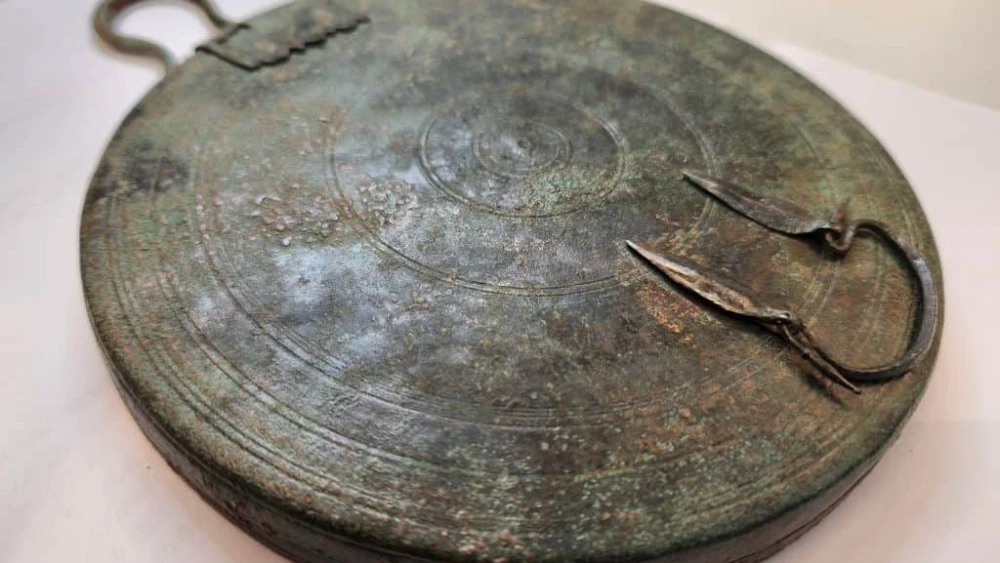
A 2,300-year-old tomb of a courtesan, including among other things a well-preserved bronze mirror, has been uncovered on a major Jerusalem thoroughfare, offering rare evidence of the Hellenistic period in the city, the Israel Antiquities Authority announced on Wednesday.
The burial cave, which was discovered on a rocky slope aside Hebron Road and near Kibbutz Ramat Rachel, included the cremated remains of a young woman alongside a box mirror in a perfect state of preservation, the state-run archaeological body said.
“This is, in fact, the earliest evidence in Israel of cremation in the Hellenistic period,” according to Guy Stiebel from the Department of Archaeology and Ancient Near East Cultures at Tel Aviv University.
A number of bent iron nails and the rare folding bronze mirror box were discovered next to the woman’s charred bones.

“This is only the second mirror of this type that has been discovered to date in Israel, and in total, only 63 mirrors of this type are known around the Hellenistic world,” said Liat Oz, who is directing the excavation on behalf of the Israel Antiquities Authority. “The quality of the production of the mirror was so high that it was preserved in excellent condition, and it looked as if it was made yesterday.”
“Bronze mirrors like the one that was found were considered an expensive luxury item, and they could come into the possession of Greek women in two ways: as part of their dowry ahead of a wedding, or as a gift given by men,” the researchers said.
The researchers suggest that the mirror belonged to the deceased, who was a companion of a senior Hellenistic military staff member or a Hellenistic governmental official during a campaign in the Land of Israel.
The box mirrors were usually decorated with engravings or magnificent reliefs of idealized female figures and goddess figures—particularly that of Aphrodite, the goddess of love.
“The most stimulating question arising from this discovery was: What is the tomb of a Greek woman doing on the highway leading to Jerusalem, far from any site or settlement of the period,” Stiebel said.

“This is an example of the combination of archaeology and research at its best,” said Eli Escusido, director general of the Israel Antiquities Authority. “The study of a seemingly simple object leads us to a new understanding and a narrative that opens a window for us to a forgotten and vanished ancient world.”
The results of the study will be presented and the rare mirror shown at a conference on New Studies in the Archaeology of Jerusalem and Its Region on Oct. 11-12, being held via Zoom and the Israel Antiquities Authority website in conjunction with Tel Aviv University and the Hebrew University of Jerusalem.



