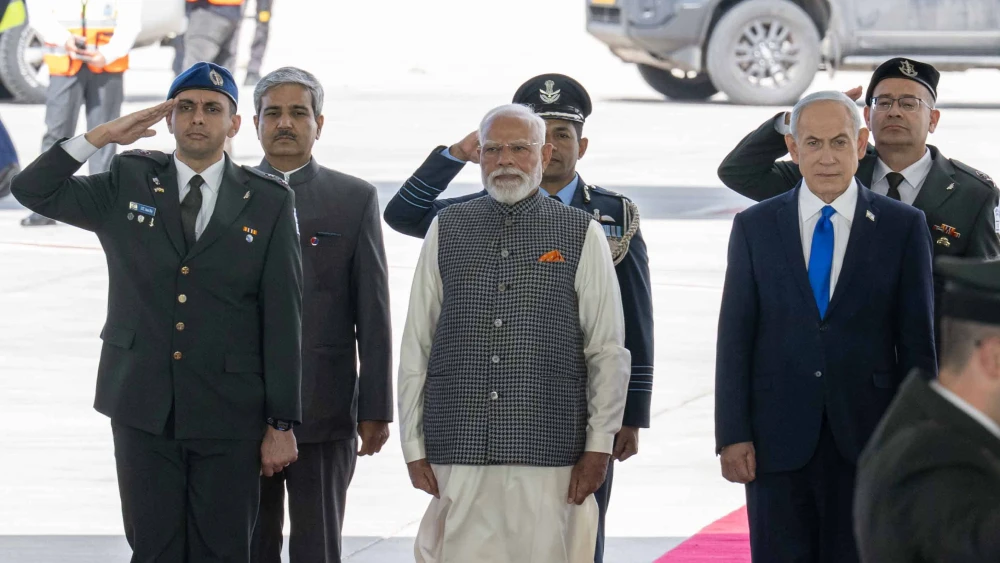
Indian Prime Minister Narendra Modi arrived in Israel on Wednesday for a two-day trip at the invitation of Prime Minister Benjamin Netanyahu. It is his second official visit to the Jewish state.
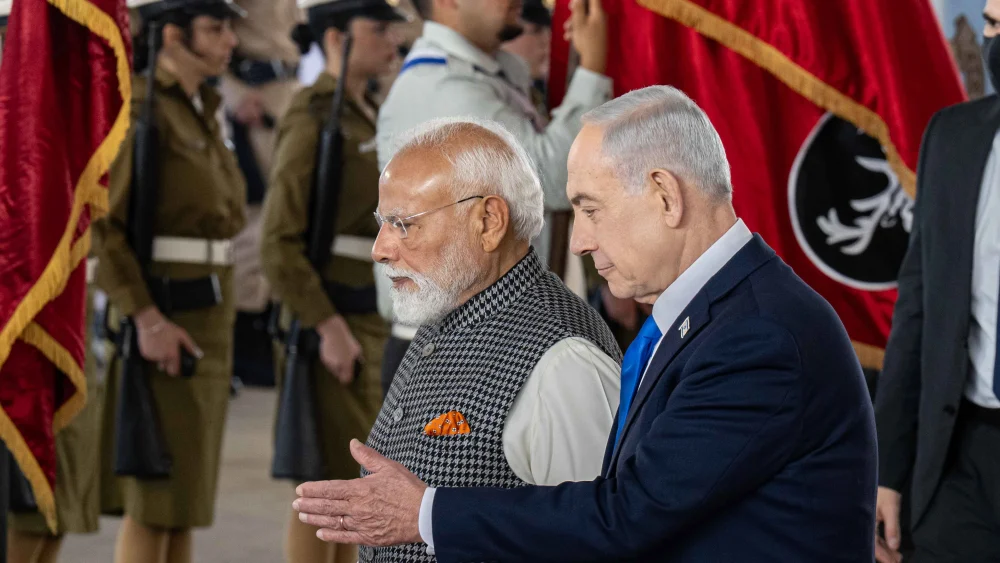
Netanyahu greeted Modi with a warm handshake, saying, “This is a bond of true friendship.” Modi last visited Israel in July 2017.
The trip will include the signing of a series of strategic agreements to boost security and economic cooperation between the two countries.
Israeli Prime Minister Benjamin Netanyahu and his wife Sara received Modi at Ben Gurion International Airport with an honor guard and military band.
The Indian premier has shifted his country’s foreign policy to a pro-Israel stance from what had historically been a pro-Palestinian one. Israel and India only established full diplomatic relations in 1992.
Following the Oct. 7, 2023, Hamas attack on Israel, Modi banned anti-Israel protests in the Muslim-majority region of Kashmir.
Netanyahu has said Modi’s visit is part of Israel’s broader vision to build alliances to counter both Shi’ite and Sunni Muslim radicalism.
Netanyahu told a Cabinet meeting on Sunday, “The intention is to create an axis of nations that see eye-to-eye regarding the reality, challenges and goals against the radical axes—both the radical Shi’ite axis, which we have struck very hard, as well as the emerging radical Sunni axis.”
Netanyahu also said that he considered himself “personal friends” with his Indian counterpart: “We speak frequently on the phone and visit one another. I have visited India, and Modi has visited here.”
“The fabric of this relationship has grown tighter,” said Netanyahu. “He is coming here so we can tighten it further through a series of decisions related to strengthening the cooperation between our governments and countries, including economic, diplomatic and security cooperation.”
Modi tweeted on Sunday, “Thank you, my friend, Prime Minister Netanyahu. I fully agree with you on the bond between India and Israel as well as the diverse nature of our bilateral relations.”
“India deeply values the enduring friendship with Israel, built on trust, innovation and a shared commitment to peace and progress,” he said. “Looking forward to our discussions during my upcoming Israel visit.”
According to officials, Modi’s visit is poised to usher in “a new phase” in bilateral relations, with discussions centered on advanced technology, trade, strategic cooperation, artificial intelligence and quantum computing.
Modi will address Israel’s Knesset on Wednesday evening. It is a first for an Indian leader.
On Thursday, Netanyahu and Modi will visit Yad Vashem, where they will place a wreath in the Hall of Remembrance. The leaders will then hold an extended meeting at the King David Hotel, during which previously signed agreements will be formally exchanged.