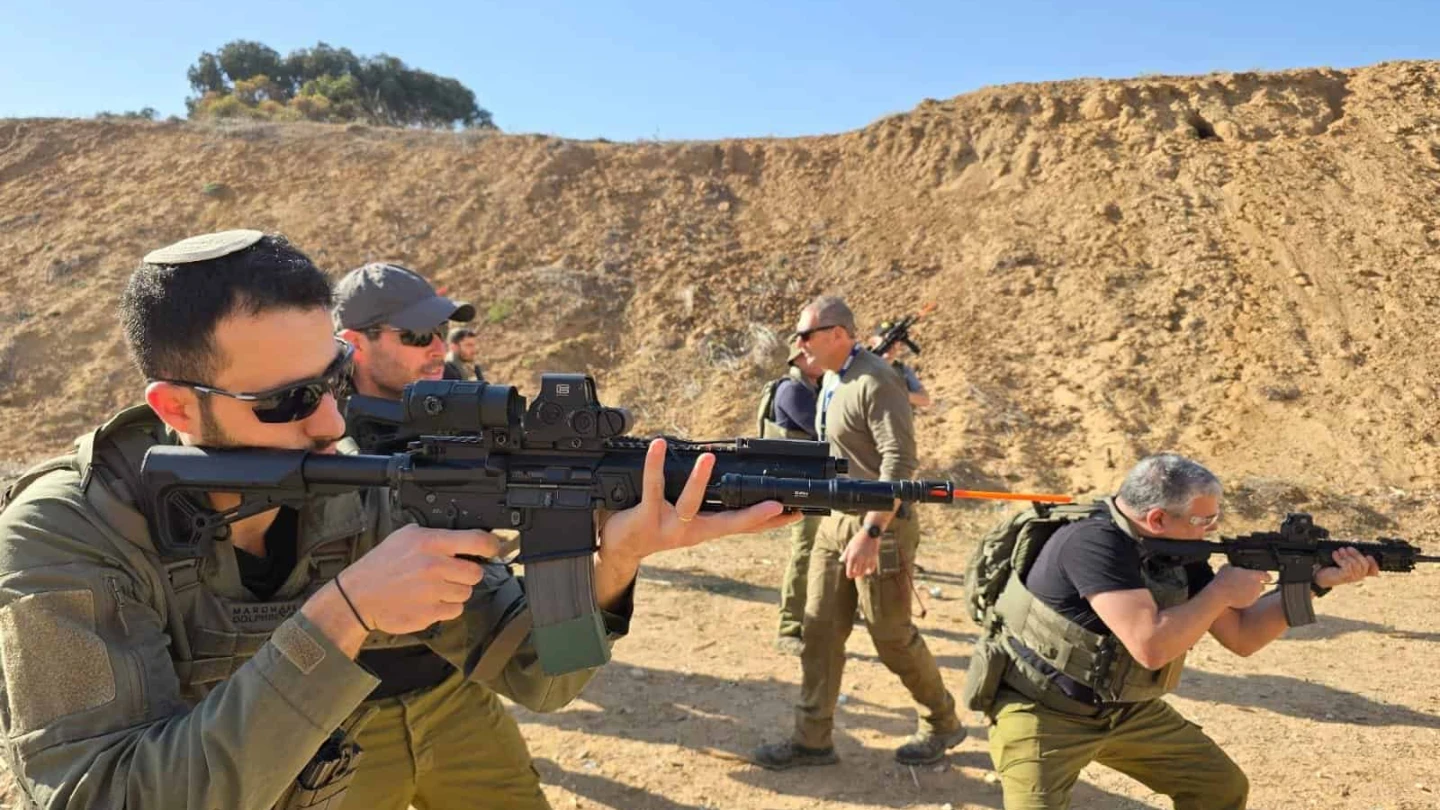
The defense establishments of the United States and Israel initiated formal discussions in recent days aimed at transforming their longstanding relationship from a traditional military assistance model into a fully reciprocal, technology-driven mutual defense partnership.
According to an Israeli Defense Ministry statement issued on June 5, the talks are centered on a new security cooperation framework to replace the existing MOU (Memorandum of Understanding), which is set to expire in 2028. The Israeli team is led by Defense Ministry Director-General Maj. Gen. (res.) Amir Baram, working in close coordination with Israeli Ambassador to the United States Yechiel Leiter. The U.S. team is led by Counselor of the Department of State Daniel Holler and U.S. Ambassador to Israel Mike Huckabee.
The new framework is aimed at boosting the IDF’s qualitative military edge through expanded joint investment in research, development and co-production.
It aims to gradually transition from aid to a completely reciprocal partnership, according to the Defense Ministry.
Meanwhile, legislative efforts in Congress were underway, according to a June 2, 2026, report published by Zero Hedge, aimed at permanently solidifying and deepening the defense relationship. The House of Representatives’ version of the 2027 National Defense Authorization Act includes a provision known as Section 224, titled the “United States-Israel Defense Technology Cooperation Initiative.”
The legislation proposes laying the groundwork for expansive bilateral research and development, joint ventures and weapons co-production across critical technological sectors, including artificial intelligence, quantum computing, directed energy and autonomous systems, reportedly seeking to effectively intertwine the military arsenals and data systems of both nations in a pact-like arrangement.
Gen. Charles Wald (U.S. Air Force, ret.), former deputy commander of U.S. European Command and now a distinguished fellow at the Washington-based Jewish Institute for National Security of America, told JNS in recent days, “I think the ideal situation in the Middle East would be the United States and Israel do have a defense pact.”
Israel, he noted, is likely more reluctant to sign on to such a pact because of concerns that it could be used to veto future Israeli action, but he doubted such a scenario would play out.
“I think a stronger defense pact would be a good idea,” Wald said.
He advocated for a multilateral mechanism that would eventually incorporate broader regional partners.
“My vision for the Middle East would be that … there’s a mutual defense pact with all the GCC (Gulf Cooperation Council) countries that are friendly with Israel and the United States,” Wald said.
He added that the immediate priority should be establishing a formalized, integrated air defense network involving Israel, the United States and the GCC that would be capable of protecting the region.
Regarding the decision to launch negotiations two years before the expiration of the current memorandum, he connected the timeline directly to domestic political considerations in Washington.
“I think there’s a concern that if the Democrats come into power, which wouldn’t be as likely. So I think they’re trying to do it now before a change of administration, if you will,” Wald said.
Wald also cited initiatives such as the U.S. Golden Dome collaboration, which requires cooperation with Israel, adding, “Israel has a really high capacity for advanced technology and the United States could benefit from that. And so I think the sharing of a technological approach would be a really good idea.”
He characterized this synergy as a powerful force multiplier that leverages shared intellectual and intelligence capital, allowing Israel to serve as a primary regional power center safeguarding American interests while U.S. attention shifts toward the Pacific.
“I think it’d be really in our benefit,” he said, adding that this would enable “a collaborative approach to the Middle East where it wouldn’t have to be the United States always coming over there because the Pacific region bears watching.”
Col. (res.) Dr. Eran Lerman, vice president of the Jerusalem Institute for Strategy and Security, who previously served as deputy director for foreign policy and international affairs at the National Security Council in the Israeli Prime Minister’s Office and held senior posts in IDF Military Intelligence for more than 20 years, told JNS that rgued that, historically, there has been less need for a formal U.S.-Israel defense treaty because of the close strategic relationship and existing congressional commitments to Israel’s security.
“Over the years, there were strong reasons to argue that a formal treaty of alliance with the United States—which Ben-Gurion yearned for but never achieved—has become of less importance, given the various aspects of the congressionally mandated status of Israel—the SPA, the Special Partnership Act—which distinguishes Israel from all other Major Non-NATO Allies, of which there are many, and the obligation to maintain Israel’s Qualitative Military Edge.”
However, he added, “With Prime Minister Netanyahu now openly in favor of gradually reducing and ultimately eliminating the U.S. financial aid package—FMF, Foreign Military Financing—a suggestion I made in a JISS paper more than a year ago—there may be more merit in a formal relationship.”
While recognizing the shifting financial landscape, Lerman remained cautious about potential constraints on sovereign defense choices.
Given Israel’s need to retain its freedom of action, Lerman argued, what would be needed is “not so much a Senate-ratified treaty but rather close operational cooperation with the U.S. military, i.e., CENTCOM, joint military research and development, and a commitment of both the administration and Congress to ensure technological superiority against all comers.”