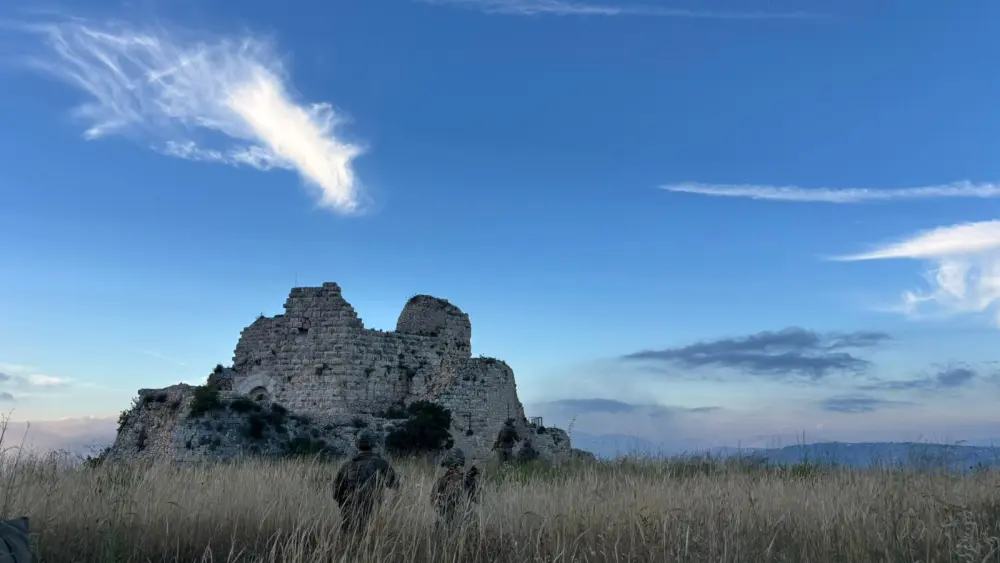

The capture of the strategic Beaufort Ridge by Israeli ground forces, announced by the Israeli Defense Forces on Sunday, after a multi-decade absence, marks a fundamental shift in the campaign against Hezbollah. Israeli forces captured the historic site, as well as the Talat Ali al-Taher ridge, after crossing the Litani River.
Lt. Col. (res.) Tal Beeri, head of research at the Alma Research and Education Center, who previously served for 20 years in the IDF Intelligence Directorate, told JNS that the capture of these positions alters the operational balance of power across the entire sector. The physical presence of Israeli forces on the high ground places them in a position to actively disrupt the movement of enemy assets emerging from deep staging grounds, according to Beeri.
“This is a strategic area controlling the Nabatieh area from the northwest and the Marjayoun area from the northeast, into which flow, among other things, arrival routes—reinforcements and supply—of Hezbollah from the area north of the Litani and the southern Beqaa regions.”
The restored Israeli presence, therefore, significantly disrupts Hezbollah’s operations.
“Beyond the symbolic and perceptual achievement, control in this geographic space severely harms the organization and activity of Hezbollah in the Nabatieh area, which constitutes a significant center of gravity from the perspective of Hezbollah in Southern Lebanon,” Beeri explained.
Col. (res.) Dr. Jacques Neriah of the Jerusalem Center for Security and Foreign Affairs, who is a former deputy head of assessment in IDF Military Intelligence, noted on Monday that until now, there has been an absence of a green light from Washington to attack the strongholds of Hezbollah in the Dahiyeh stronghold of Hezbollah in Beirut and the Beqaa Valley.
Shortly afterward, however, Prime Minister Benjamin Netanyahu and Defense Minister Israel Katz announced what appears to be a change in this policy, saying in a joint statement that due to Hezbollah’s ongoing violations of the ceasefire, they have instructed the military to strike terror targets in Dahiyeh.
“Israel is focusing on harming the Shi’ite base in Southern Lebanon [Jabal Amel, the heart of the Shi’ite historical narrative] while focusing on two main cities, Tyre and Nabatieh,” Neriah assessed.
He raised questions regarding the burden of holding these newly seized territories without the assistance of domestic allied forces, noting that the absence of a Lebanese partner force changes the logistical math for the IDF General Staff.
“In contrast to the past, Israel does not have the SLA [South Lebanon Army] today and therefore the burden of holding the territory will be great and will require at least two divisions on a permanent basis,” Neriah argued.
“As long as Israel will not act against Hezbollah in Beirut and the Beqaa, we will not see the weakening of the power of the organization, a weakening that would allow the release of the Lebanese government from the suffocation of Hezbollah,” Neriah added. “It must not be forgotten that the fate of the Lebanese front depends on an agreement that will or will not be reached between Iran and the U.S.”
To protect northern Israel
On Sunday, Defense Minister Katz stated, “Forty-four years after the battle of heroism on the Beaufort, a battle which claimed the lives of the best of our sons, soldiers of the Golani Brigade, IDF fighters, returned, and at their head the Golani Brigade, to the summit of the Beaufort and raised on it anew the flag of Israel and the flag of Golani.”
The defense minister confirmed that the advance represented an authorized expansion of the war’s objectives, executed under direct political and military directives to establish a buffer zone to protect northern Israel.
“In accordance with the instruction of Prime Minister Netanyahu and my instruction, the IDF expanded the maneuver in Lebanon, crossed the Litani River and captured the Beaufort ridge—a ridge that constitutes an strategic controlling point vital for the defense of the residents of the Galilee and for the preservation of the security of our forces,” he said. “Twenty-six years after the withdrawal from the security zone in Lebanon, the flag of Israel returns to wave on the summits that overlook the communities of the Galilee.”
The IDF confirmed on Sunday that it had launched a coordinated offensive encompassing the Beaufort Ridge and the Wadi al-Saluki area in Southern Lebanon.
The primary objective of the synchronized push is to dismantle entrenched terrorist infrastructure and eliminate Hezbollah cells, effectively removing “direct threats to the communities of the Galilee Panhandle and Metula, as part of ongoing efforts to strengthen operational control in Southern Lebanon,” the military stated.
Before the entry of infantry and armored units, the Israeli Air Force conducted a wave of precision strikes on Hezbollah targets, accompanied by artillery and tank fire, and engineering activities, to enable the operation.
“The IDF is operating near Nabatieh, a significant Hezbollah stronghold in Southern Lebanon, and is prepared to expand the offensive as required,” the military said.