
The current situation in Gaza illustrates Hamas’s dual strategy: steadfast pursuit of its political demands and continued military buildup, aimed at strengthening its power while waiting for regional developments.
Senior security officials say Hamas is waiting for changes in the region, especially related to Iran. During this time, the group aims to recover economically and rebuild its military strength.
These assessments build on earlier analysis and indicate that Hamas is preparing for the next military confrontation with Israel. Hamas assumes that refusing to disarm could eventually prompt a U.S. “green light” for Israel to forcibly seize the Gaza territory it now controls, estimated at nearly 50% of the Strip.
Against this backdrop, Hamas is expected to prolong negotiations with the “Peace Council.” It is adopting an Iranian-style approach, buying time and setting preconditions to undermine U.S. President Donald Trump’s 20-point plan.
Despite growing pressure, Hamas refuses to disarm, viewing its weapons as essential for survival and political standing. This position is reflected in its rejection of the Peace Council’s plan, which included disarmament as a prerequisite for progress in reconstruction and for Israeli withdrawal. The council’s High Commissioner, Nikolay Mladenov, said disarmament is the only way forward. Hamas and other armed groups in Gaza strongly rejected the proposal.
At the same time, Hamas continues to set clear conditions for any future arrangement, foremost among them a full withdrawal of IDF forces from all areas of the Strip, particularly those defined as the “yellow line.” From Hamas’s perspective, any continued Israeli presence constitutes a violation of Palestinian sovereignty and a direct threat to its ability to rebuild its strength. Hamas leaders told mediators they will not consider disarmament unless they get clear guarantees of a complete Israeli withdrawal.
A Hamas delegation led by Khalil al-Hayya visited Cairo and finished on April 3, 2026. They met with senior Egyptian officials and representatives of Palestinian factions. Hamas-affiliated media say the delegation made several demands and suggested changes. These include ending what it calls “Israeli violations,” fully enforcing the ceasefire, and clarifying the expansion of Israeli-controlled areas. Amid these ongoing developments, the confrontation with Iran, along with disputes over the operation of a new technocratic committee tasked with governing Gaza, is delaying the implementation of the second phase of the ceasefire agreement. Under this phase, Hamas is expected to relinquish control and disarm.
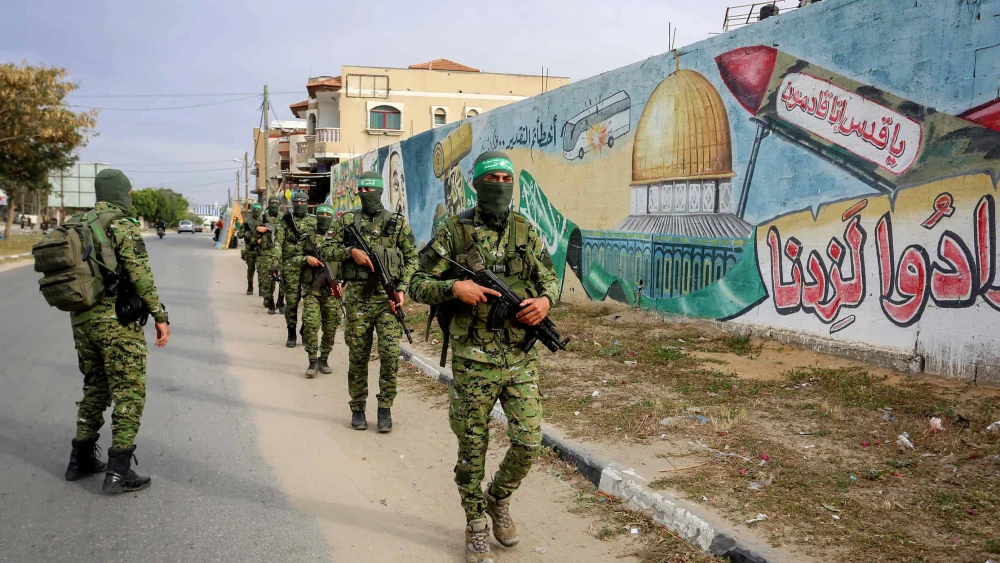
Despite the stalemate, mediators continue efforts to persuade Hamas to demilitarize, but the organization remains firm and is closely watching regional developments. Hamas uses the situation to tighten its control, security sources say. Its forces act forcefully against critics, suspected collaborators, and militias supported by Israel. Confidence grows, seen in the presence of its armed forces on the streets. At the same time, Hamas strengthens civilian rule by expanding police, monitoring markets, keeping ministries active, and giving out aid.
Israeli security officials say Hamas is using humanitarian aid to get more money and increase control. The group reportedly takes aid, sells it in local markets, and uses the money to recruit new members or upgrade its weapons. Hamas continues to build its military, trying to smuggle in weapons, sometimes via Egypt. It is also developing its own weapons, recruiting, and training new fighters faster. The group is also repairing damaged infrastructure.
Alongside these recovery and buildup efforts, it is important to note that Hamas has not abandoned armed resistance.
Hamas carries out attacks against the Israel Defense Forces. These include using explosives, anti-tank fire and guerrilla warfare. The goal is to wear down Israeli forces and maintain a fighting image. Meanwhile, IDF forces act in “yellow line” areas. They search for militants, destroy weapons and try to stop attacks. They also target operatives breaking the ceasefire.
Hamas also runs an information campaign. It shares stories of humanitarian distress in local and international media, even as many goods are entering the Strip.
Further reflecting regional dynamics, another indication of the organization’s connection to the wider arena is the postponement of its internal leadership elections until the end of the year. This delay is due to internal disagreements, including disputes over figures associated with the pro-Iranian camp. The race for head of the political bureau pits Khaled Mashal, representing the global Muslim Brotherhood current, against Khalil al-Hayya, who is identified with Iran. This development reflects Tehran’s influence on decision-making within Hamas and the organization’s preference to wait for greater clarity in the regional situation.
Security officials say that as long as Israel and the United States focus on Iran and Hezbollah, Hamas will keep its hold on Gaza. This remains true despite Israeli strikes, international pressure and complaints about rising costs and failing services.
In conclusion, Hamas is pursuing a dual strategy of delay and consolidation: it is strategically waiting for developments, particularly with Iran, while simultaneously reinforcing its military capabilities and governance in Gaza. The organization aims to ensure it remains a key player, even in the event of a formal transfer of authority to a civilian body after the conflict.
Senior security officials say Israel will face major political and security problems after the war with Iran, not only in Lebanon but also in Gaza. They warn that Hamas, like Hezbollah, is complex and hard to dismantle. Disarming Hamas will be very tough, and Israel should prepare for a long struggle in Gaza, where war began on Oct. 7, 2023.
Originally published by the Jerusalem Center for Security and Foreign Affairs.