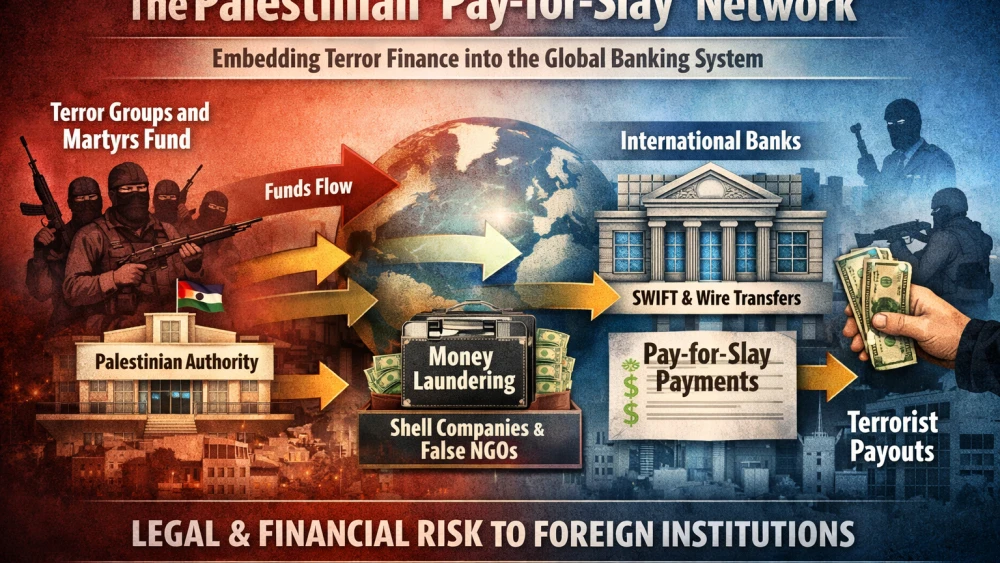

The subject of cross-border terror financing has plagued the international community for decades. The phenomena prompted the 1999 International Convention for the Suppression of the Financing of Terrorism, the establishment of international bodies such as the United Nations Counter-Terrorism Committee Executive Directorate and the Financial Action Task Force, and the adoption of national legislation.
For decades, the Palestinian Authority and the Palestine Liberation Organization have been global innovators in inciting terror and hold the dubious title of developing and implementing the most comprehensive terror-rewarding “pay for slay” policy, disbursing hundreds of millions of dollars annually to reward terrorists for acts of terror.
Unsatisfied with having pioneered an unprecedented system of rewarding terrorists on such an enormous scale, the P.A.-PLO decided to export the “pay for slay” policy around the globe.
While the P.A.-PLO again claimed in early 2025 to have abandoned the policy, persistent reports disproved the claim. Most recently, Israeli and U.S. authorities issued official reports noting that, in 2025 alone, the P.A.-PLO paid terrorists over $200 million.
Revelations by Palestinian Media Watch show that terror reward payments extend beyond local borders and are an international issue. PMW reports that recipients in both Jordan and Lebanon confirmed receipt of their payments, demonstrating the cross-border nature of the payments.
The receipt and handling of terror reward payments place recipient banks in a potentially disastrous situation and could expose them to civil liability.
Infects Jordanian banks, not PA banks
Legislation passed by Israel in 2016, adopted in Judea and Samaria in 2020, outlawed terror-related rewards. As a result, P.A. banks closed 35,000 accounts.
While P.A. banks recognized the risks of facilitating such payments, foreign banks may not realize that the P.A.-PLO’s “pay for slay” policy exposes them to significant financial and legal dangers.
Jordan may not object to the P.A.-PLO using its banks to pay terrorist rewards, as it does not consider Palestinian attacks on Jews to be terrorism.
As Jordan noted, in 2001, when it joined the International Convention for the Suppression of the Financing of Terrorism, Jordan “does not consider acts of national armed struggle and fighting a foreign occupation in the exercise of the people’s right to self-determination as terrorist acts within the context of paragraph 1(b) of article 2 of the convention.”
However, since some Jordanian banks, particularly the largest, Arab Bank, have a presence in the United States, the P.A.-PLO’s use of these banks to implement the “pay for slay” policy contaminates them.
Is the Turkish banking system also contaminated?
In exchange for releasing Israelis kidnapped by Hamas and other Gazan groups on Oct. 7, 2023, Israel released thousands of terrorists, including murderers. Many now live in Turkey, including at least one who killed American citizens, and continue to receive P.A.-PLO “pay for slay” payments.
As a result, the Turkish banking system, like several Gulf states, has begun managing “pay for slay” payments from the P.A.-PLO.
How to avoid the spread of ‘pay for play’
In 2017, Israel designated the PLO’s financial arm, the Palestinian National Fund, as a terrorist organization because of its role in implementing the “pay for slay” policy. P.A.-PLO officials admit that the P.A. funds payments to terrorists, often using the PLO, which is subject to little regulation and oversight, as a conduit.
In September 2018, the first Trump administration ordered the closure of the PLO offices in Washington, after it was determined that they no longer served the purpose of promoting peace. The Palestinian leadership expected the Biden administration to reopen the offices, but that never materialized.
The most effective way to ensure that the P.A.-PLO’s malignant terror reward payments don’t contaminate U.S. and European banks is for the U.S. Treasury to follow Israel’s lead and designate the financial arm of the PLO as a terror organization.
Originally published by the Jerusalem Center for Security and Foreign Affairs.