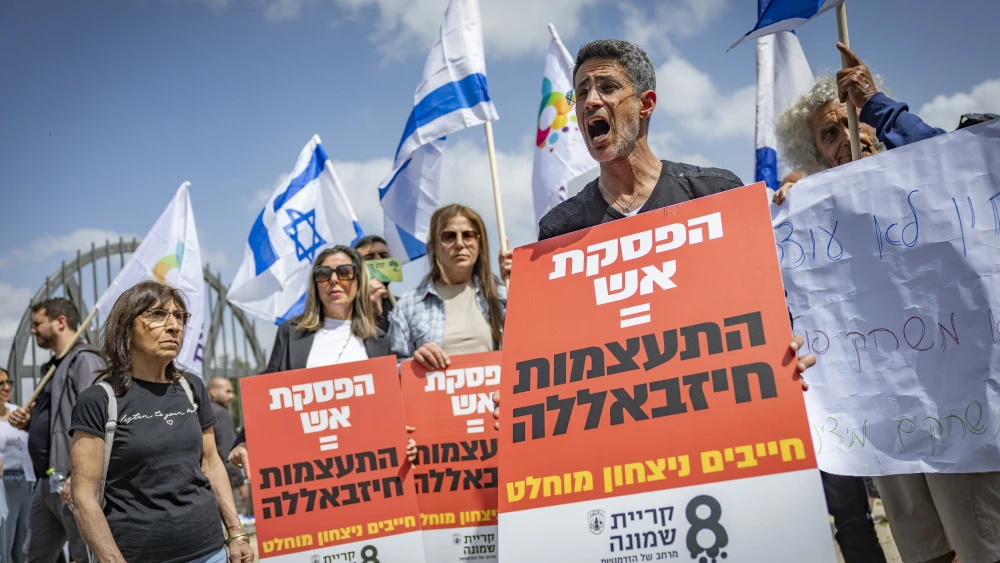
The mayor of Kiryat Shmona, Israel’s northernmost city and a frequent target for Hezbollah missile and rocket attacks, protested with dozens of other residents on Sunday outside the U.S. Embassy in Jerusalem against the ceasefire with the terrorist group.
Mayor Avichai Stern made the trip to the capital following Prime Minister Benjamin Netanyahu’s announcement on Thursday that Israel would cease hostilities with the Iranian proxy amid attempts by U.S. President Donald Trump to reach a ceasefire agreement with Tehran.
The municipality arranged 10 buses to bring residents to the protest in Jerusalem. Schools did not open on Sunday, and most other municipal services were unavailable as part of a partial strike.
Netanyahu had said that the fighting against Hezbollah would continue regardless of the talks between Iran and the U.S., which launched on Feb. 28 a joint military operation with Israel against Iran. Netanyahu, on March 29, said in a filmed statement that in the north, his government is “determined to fundamentally change the situation.”
In a statement, the mayor’s office called the ceasefire a “false quiet” that would fail to deliver fundamental change.
“For over two years, our children have suffered from instability, evacuation, and prolonged stay in shelters, without any security solution on the horizon. The agreement that is taking shape, under American leadership and Iranian initiative, serves as a political achievement for the Lebanese government ahead of the elections this May. We are not anyone’s pawns,” the statement also said.
Kiryat Shmona is an impoverished border city with a predominantly Sephardi population. The ruling Likud party received 49 percent of the vote in the last election.
In February, Netanyahu held the weekly cabinet meeting in Kiryat Shmona and said there, “We are bringing an immediate plan for the rehabilitation, development and growth” of three areas in the Upper Galilee.
The new plan will mean “grants for businesses and residents, more resources for housing, industry, medicine, transportation and academic institutions—and that’s only during the first phase,” said Netanyahu.
His government has pledged new funding to the tune of $181 to turn the nearby Tel Hai College into a university partly within Kiryat Shmona, and to reopen the city’s airport following more than 20 years of disuse.
Roughly a third of Kiryat Shmona’s pre-war population of approximately 26,000 people have not returned since being evacuated in 2023, according to the municipality. Israel evacuated more than 60,000 civilians from the border area in October 2023, when Hezbollah began targeting it in solidarity with Hamas. In September 2024, Israel killed Hezbollah leader Hassan Nasrallah, among other commanders, and eliminated many of its capabilities.
On March 2, Hezbollah joined the fighting against Israel alongside Iran, which Israel and the U.S. struck on Feb. 28 to prevent Iran from achieving nuclear weapons and to neutralize it as a regional threat. Israel had killed hundreds of Hezbollah terrorists before the ceasefire took hold on April 15.
The March 2 resumption of hostilities marked the end of an earlier ceasefire, which Hezbollah had agreed on in November 2024. Its terms forbade it from maintaining a presence south of the Litani River, formalizing what was widely seen as one of the Shi’ite terror group’s worst defeats. Israel had enforced the ceasefire’s terms with frequent of strikes in Lebanon, according to the Israeli military, targeting attempts to reestablish Hezbollah’s infrastructure.
Following March 2, Israel deepened its deployment inside Lebanon, establishing a security buffer along lines similar to the ones it had maintained from 1983 to 2000. The Shi’ite villages in the security buffer, which had served as Hezbollah fortresses, have been drastically reduced and significantly depopulated, according to reports from Lebanon.