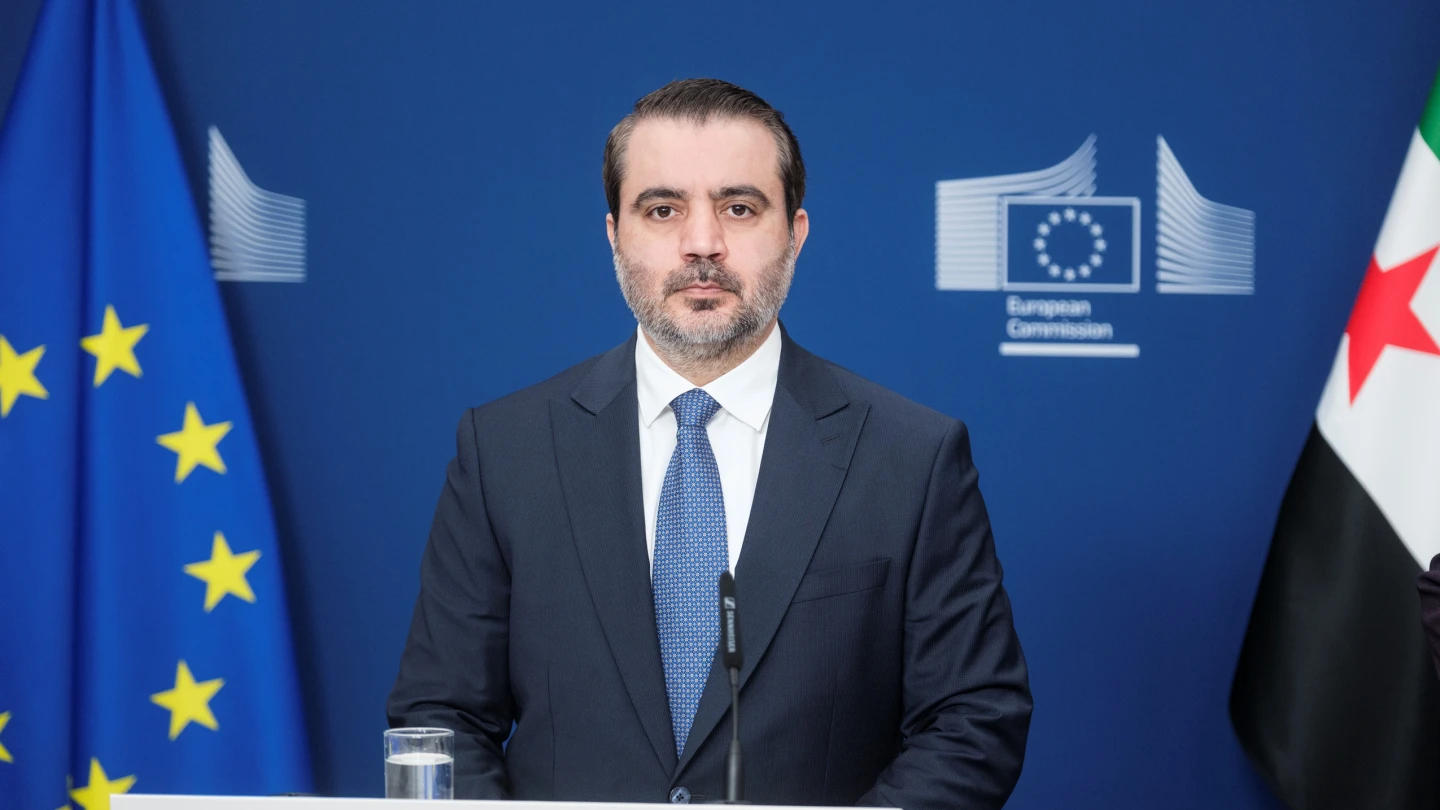
Hungarian Prime Minister Viktor Orbán and his Fidesz Party, which have ruled for 16 years, went down to defeat against the Tisza Party led by 45-year-old newcomer Péter Magyar.
Before the April 12 election, some warned that an Orbán defeat would bode ill for Hungarian-Israel relations and the safety of the Central European country’s Jewish community, of which Orbán was a staunch defender.
Speaking to prominent members of the Jewish community, JNS found that most were optimistic. They pointed to Prime Minister-elect Magyar’s remarks in his first press conference on Monday when he said Hungary’s policy of “zero tolerance” for antisemitism would continue.
“It was a really positive message to the Jewish community. Everybody in our community wanted to hear that,” Kalman Szalai, secretary of the Action and Protection Foundation in Budapest, which protects and promotes Hungarian Jewish identity, told JNS.
“As a community leader, I can tell you that the community is optimistic and trusts that the last 15 years of progress in Hungary will continue,” he said.

Andras Buchler, an executive board member of the Federation of Hungarian Jewish Communities, said of Magyar’s remarks: “It was unquestionably a reassuring comment; the fact that he’s raising this issue at his very first international press conference. That was more than encouraging for many of us. He sees us as a living, active, vibrant community.”
The question for the Jewish community is whether the same zero-tolerance policy can be maintained in the new administration. “For many, the security that we felt under during the past 14 years was, without question, hugely important. There were no atrocities. There were no attacks at all,” Buchler told JNS.
The community was encouraged by the Tisza’s Party’s outreach during the election. Though not publicized, Magyar and his team “visited synagogues and consulted with rabbis. It sent a strong signal,” he said.
Yet, despite its physical security, the Jewish community “didn’t feel truly at peace,” Buchler said. This was due to the harsh political rhetoric over the last few years, in which certain groups were singled out for attack, whether left-wingers or migrants.
“Whenever the political language allows masses of people to hate certain groups, then the language of hatred is out there. Who knows if it could be turned against the Jews? Even though it was never used against us during these years, it still wasn’t a comfortable feeling,” he said.

Adam Daniel Breuer-Zehevi, a former Hungarian diplomat who served in China and is now editor-in-chief of Hungary’s only Jewish television station, Heti TV, told JNS that the “zero tolerance” against antisemitism claim was always “nonsense.”
He pointed to the annual “Day of Honor” celebrations in Budapest’s Castle District, the latest in February, when neo-Nazis marched in Arrow Cross and SS Uniforms.
“No one in Hungary actually believed [the zero-tolerance claim], but to maintain a close relationship with the government, the Jewish organizations pretended that that was the case,” he said.
He acknowledged, however, that the incoming government’s promise to encourage a free press will likely mean more anti-Israel sentiment in the media. “Up until now, that was not allowed under Orbán. The media did not allow any antisemitic remarks because it was all owned by the government.”
The question as to what the Hungarian Jewish community thinks about the election is a generational one. Those over the age of 50 are scared because the outgoing government protected the Jews. Those under 40 never believed that to be the case and are “overjoyed” at the election results, which they see as a victory for democracy, Breuer-Zehevi said.

Agnes Selmeczi-Vonnak, a staple of the community known as the “Yiddishe Mama,” runs a Facebook group of several thousand Jewish women known as “Team Jiddische Mame.” She told JNS she’s happy about the change in government.
For her, the most important thing is that Magyar keeps Orbán’s immigration policies in place. (Maygar has said that he will.)
“As long as he does not let the Islamists into Hungary, and he acts normally toward Israel. The immigration issue is so important. This is mostly the only reason that we still feel kind of safe in Budapest, that it is not full of non-working Muslim men,” she told JNS.
“Also, as long as his ministers are doing their homework on the Middle East, not just swallowing the mainstream info line, I’ll be OK with him,” Selmeczi-Vonnak added.
Relations expected to be more ‘pragmatic’
Magyar, in his Monday press conference, referred to Hungarian-Israeli ties as a “special relationship.” In an introductory call with Benjamin Netanyahu on Wednesday, Magyar invited the Israeli prime minister to participate in a ceremony commemorating the 70th anniversary of the 1956 Hungarian Uprising. Netanyahu, in turn, invited Magyar to a government-to-government (G2G) meeting in Jerusalem.
Buchler said the memory of 1956, when Hungary attempted to throw off the communist regime and Soviet occupation, is an important part of Hungarian identity. To invite Netanyahu to the event is “amazing.”
Daniel Nemes, an influencer in the Hungarian Jewish community, told JNS that he doesn’t expect anything materially to change for Jews in Hungary, noting that Magyar is right-wing and formerly an Orbán insider. (Nemes described himself as “left-liberal,” but said internationally, progressive governments have spelled trouble for Jewish communities.)
Although the local community won’t be affected, Nemes predicted there will be an erosion in Hungary-Israel relations. Magyar commented at the press conference that he intends to restore Hungary’s membership in the International Criminal Court at The Hague, which Orbán abandoned over the court’s arrest warrants for Netanyahu and former Israeli Defense Minister Yoav Gallant.

Under Orbán, Hungary also blocked anti-Israel initiatives from the European Union. Magyar indicated that he would not offer blanket protection for Israel, saying that his government will evaluate E.U. actions on a case-by-case basis.
Breuer-Zehevi agreed, saying that “we expect the government to be slightly less pro-Israeli when it comes to European Union sanctions because it is more important for the Hungarians to get E.U. funds. They won’t have the option to stand next to Israel on every single matter.”
Both Breuer-Zehevi and Buchler said Hungary-Israel relations will become more “pragmatic.”
“The previous era, which was very comfortable from an Israel-Hungary diplomatic point of view, was defined by close personal ties between the two leaders. I think that this special relationship will remain, but based more on shared interests,” Buchler said.
None disputed that Orbán contributed to the Jewish community’s security. Buchler and Szalai said that in their view, his greatest contribution was reforming Hungary’s political right by removing from it the antisemitic elements that had been part and parcel of the movement in the past.
“The Hungarian right-wing has changed significantly, moving away from the earlier antisemitism of the 20th century toward dialogue and friendship with Israel and the Jewish community,” Szalai said. “It’s definitely Orbán who completely changed the right-wing parties on this issue.”
“He mostly eradicated the anti-Israel narrative from the political right,” said Buchler. “I think it will take many years to understand the importance of what Orbán did.”