
In recent months, several indicators have suggested that Iran is in the midst of a mass push to reconstitute its ballistic missile arsenal.
Western intelligence services have identified a sharp increase in the flow of dual-use materials into the country, most notably sodium perchlorate, a chemical that can be converted into ammonium perchlorate, the oxidizer used in solid-fuel ballistic missiles. CNN investigators have tracked 10 to 12 recent shipments from Chinese ports to Bandar Abbas, a central node in Iran’s missile production architecture, totaling more than 2,000 tons of fuel material. These transfers represent one of the largest documented movements of dual-use materials into Iran in recent years.
Jeffrey Lewis, director of the East Asia Nonproliferation Project at the Middlebury Institute of International Studies in Monterey, Calif., assessed that the scale of these shipments reflects Tehran’s desire to rapidly rebuild its production base. “Iran needs much more sodium perchlorate now to replace the missiles expended in the war and to increase production,” he told CNN in a recent interview, adding that he expects additional deliveries as Iran seeks to rearm.
According to Lewis, 2,000 tons of sodium perchlorate would be enough for roughly 500 missiles, significant, but still short of what Iran requires to restore its pre-war goal of producing about 200 missiles per month.
However, Maj. (res.) Alexander Grinberg, a former officer in the IDF Military Intelligence research department and an Iran expert at the Jerusalem Institute for Strategy and Security, said that the reports of dual-use chemical shipments were misleading and overinterpreted the significance of the influx.
“The shipment of the dual-use materials is a hint that they are rebuilding, but there is a lack of precise information, and Iranian agents have an interest in making it seem like the significance of this sort of shipment is greater than it is in reality,” Grinberg told JNS. “There is a long way from these chemicals to full ballistic missiles; it doesn’t mean in any way that war is imminent.”
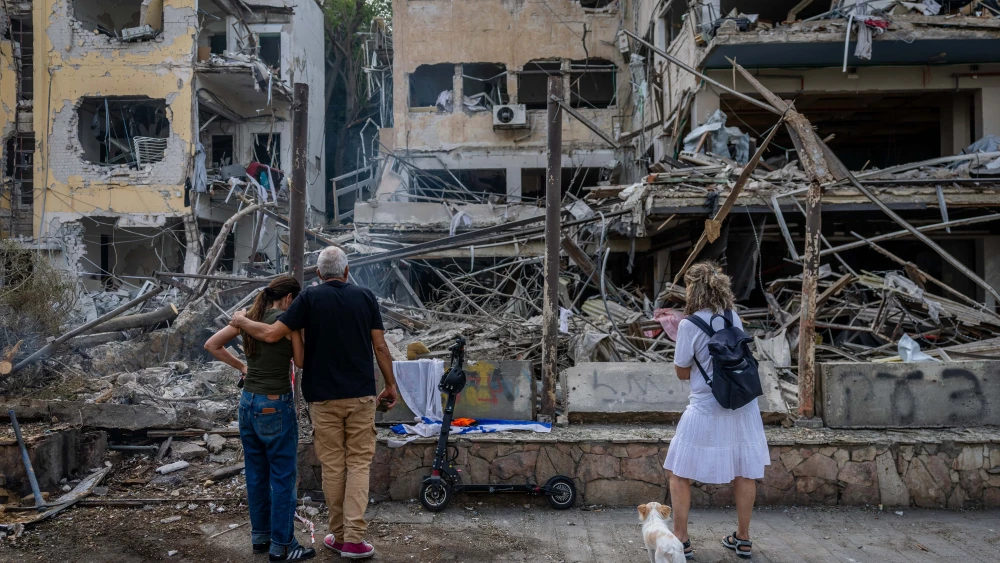
Satellite imagery shows that Iran has moved quickly to reconstruct key solid-propellant facilities destroyed in Israeli strikes. Several production halls are being rebuilt, including structures that previously housed the mixers used to convert chemical inputs into solid rocket fuel. Those mixers were among Israel’s primary targets during the 12-day “Rising Lion” operation in June, because they are essential for manufacturing high-energy propellant used in medium- and long-range missiles, including systems that could carry nuclear warheads.
However, Grinberg challenged this assessment, saying that it is wrong to put too much weight on the satellite images. “There are some photographs from missile and nuclear sites showing that there is activity, but that doesn’t definitively prove anything about the pace of missile production,” he said. “It’s not surprising to see that there is some rebuilding going on after a site is blown up, but that doesn’t necessarily mean that the capacity is rebuilt.”
Washington in range
Before fighting broke out in June, Israeli intelligence estimated Iran held roughly 2,700 missiles. Officials now believe the Islamic Republic has already restored at least half of that stockpile and is working to expand it beyond pre-war levels.
This renewed industrial effort coincides with a major push to expand the range of Tehran’s missile arsenal. Iranian lawmakers and commanders have recently promoted a policy of “ballistic missiles without limits,” with senior officers stating that Iran will extend its range “to any necessary extent.”
Recent reports from Iranian opposition groups suggest that Tehran has been quietly expanding the range and capability of several missile families for several years, but has recently put many of these long-term projects into overdrive. The Shahab-6 (“Meteor-6"), a new model still in the testing phase, is the most ambitious manifestation of Iranian attempts to expand their missile range. In early November, the state-affiliated Tasnim News Agency claimed Iran’s newest intercontinental ballistic missile was “almost ready for service” with a 10,000-kilometer (6,200-mile) range, putting Washington, D.C. in range.
Even with the new technological push, there is debate over how quickly Iran can extend its missile reach. Iranian Kurdish opposition groups have claimed that Tehran can expand the range of existing systems beyond the current 2,000-kilometer (1,250-mile) threshold, but cannot yet move beyond 5,000 kilometers (3,100 miles) without several more years of development.
Regarding the Shabab-6’s 10,000-km.-range capacity, Western analysts caution that reaching ICBM-class distances requires sophisticated multi-stage propulsion, advanced reentry-vehicle technology, and survivability at extreme speeds, capabilities Iran has yet to demonstrate publicly.
“It makes no sense that Iran would be able to develop capabilities like this. This would be a huge leap ahead of what they currently have, and on a basic level, there is no logic for developing a missile with this range if you do not have a nuclear warhead,” Grinberg said. “Using a missile like this with a regular warhead is like putting an M4 rifle on a supersonic jet.”
A recent U.S. Department of War report confirmed this assessment, warning that Iranian space and missile programs are “inherently dual-use and indistinguishable in early stages.”
The report added that Iranian officials have linked their long-range ambitions to the country’s maturing space-launch program, which includes the Simorgh, Qased and Qaem-100 launch vehicles. According to the Department of War, these systems give Iran multi-stage launch experience directly relevant to future long-range missile design.
Israeli and U.S. sources reported the scale of the June barrages forced both countries to expend large numbers of interceptors, a strain of which Iran is well aware. The Foreign Policy Research Institute, a think tank based in Philadelphia, concluded that “U.S. and Israeli defenses were stretched thin and vast numbers of interceptors were needed to defend against Iran’s ragged retaliation.”
At the same time, Iran saw many of its launchers and storage sites destroyed in Israeli strikes, along with disruptions to its command-and-control network. Behnam Ben Taleblu, a senior fellow at the Washington-based Foundation for Defense of Democracies, told The War Zone that those losses are shaping the Islamic Republic’s next steps.
“Iran also has learned about its vulnerabilities, and it is seeking to build back better, as safely as possible,” he said, warning that Tehran’s rebuilding pace “may outpace the rate and the speed at which Israel is rearming to defend itself.”
Dire straits
However, analysts say Iran is not seeking an immediate large-scale confrontation.
“The situation in Iran is in dire straits,” Grinberg said. “All the formal and informal Islamic Revolutionary Guard Corps channels admit that they were caught with their pants down in June. All an attack from Iran would do is give Israel a perfect casus belli. The Iranians may be rebuilding their missiles, but they have done nothing to restore their air defenses, so Israel can just repeat the same pattern of attack with no ability for Iran to thwart it.
“All the Iranian signaling is more similar to someone telling his friend to ‘hold me back’ than to an actual threat,” he added.
Grinberg further observed that much of the recent reporting in Western media about Iranian preparedness for a military confrontation with Israel was more likely Iranian messaging being fed to Western sources than an accurate representation of reality.
A recent report by The New York Times quoted Ali Vaez, director of the Iran Project at the International Crisis Group, a Brussels-based think tank, who said that Iran’s factories were “working 24 hours a day,” and that if another war broke out, “they hope to fire 2,000 at once to overwhelm Israeli defenses, not 500 over 12 days.”
Grinberg explained that Vaez’s known ties with the regime in Tehran cast significant doubt over the veracity of his assessments. “I expect that there is a very primitive influence campaign run by Iran that is being recycled in American media. This clearly serves Iranian interests of signaling their bellicosity, but it is closer to propaganda than reality,” Grinberg said.
Iranian opposition figures offer a more pointed assessment. Aref Al-Kaabi, president of the Executive Committee of the State of Ahwaz, an Iranian dissident group, said the regime has begun “rearranging its cards for confrontation,” asserting that “the country is preparing for a full-scale war.”
Several reports have indicated that Tehran has continued deploying ballistic missile launch platforms along the Iraqi border, across Iranian Kurdistan, and Khorramshahr-4 launchers on the eastern shore of the Gulf since the end of the “Rising Lion” operation.
Israeli officials have indicated that Jerusalem views these developments as confirmation that the previous round of fighting is not truly over. Security officials told the country’s Channel 12 broadcaster that they see the June conflict as an “unfinished” job and are preparing for renewed fighting.
Nuclear concerns add urgency to Israel’s planning. Israeli officials believe Iran’s highly enriched uranium, enough “to make 11 nuclear weapons,” has either been buried under rubble or moved to a secure location. Uncertainty over its status is intensifying Israeli expectations of another confrontation. One unnamed senior official went further, telling the Kan public broadcaster that Israel’s goal is to topple the Iranian regime before the end of U.S. President Donald Trump’s term.
If war resumes, Israeli officials expect it to be larger and more prolonged. A security source told Channel 13 that “Israel will respond much more aggressively” and is preparing for hostilities lasting “far longer than 12 days this time.”
Israeli officials say they are monitoring Iran closely. “Every day we check whether the Iranians are crossing any red lines or preparing something that could escalate the situation,” a senior defense official told Channel 13. “If they cross the red lines we set for ourselves, we will act without hesitation to stop the threat.”
These concerns are driving a rapid multibillion-shekel investment in warning systems, intelligence capabilities, air defenses and offensive strike platforms. Officials caution that another confrontation is “almost inevitable,” and warn that delays in procurement will leave Israel unprepared. The urgency has fueled a bitter dispute between the Defense and Finance ministries over the 2026 state budget, reflecting widespread belief that war with Iran is not a distant possibility, but an approaching reality.