There is a campaign sweeping through the salons of Western celebrity culture, the halls of international NGOs and the streets of European cities. Celebs sign open letters. Nobel laureates lend their names.
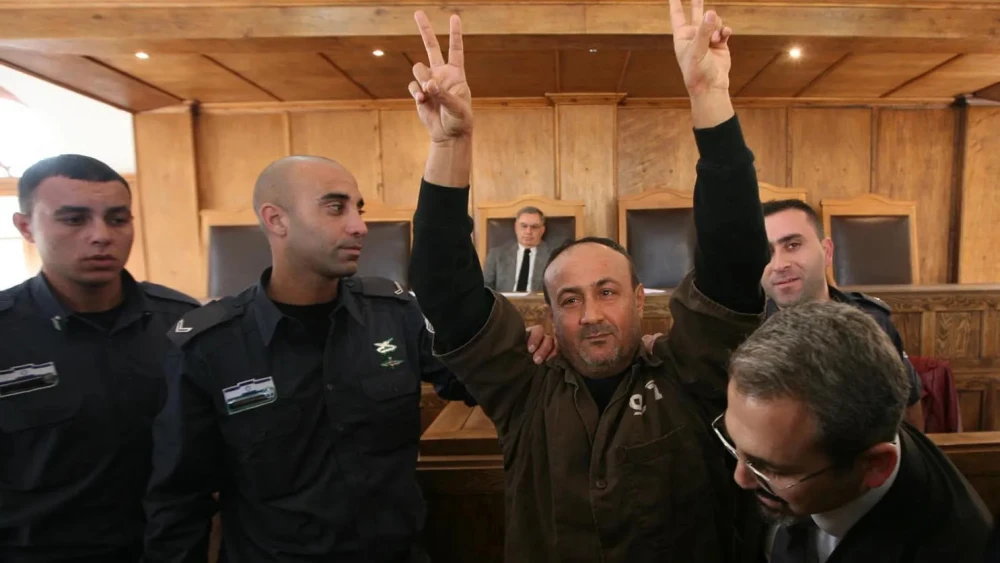
The message is seductive in its simplicity—free Marwan Barghouti, Palestine’s Nelson Mandela, a unifying moderate, a man of peace, imprisoned by an oppressive state. It is one of the most audacious historical fabrications of our time, and the world is falling for it.
Let us be precise about what is actually being demanded. The international community is being asked to release a man convicted of five murders, for which he was sentenced to five life terms plus 40 years by a court of law.
Barghouti was celebrated for planning and directing attacks during the Second Intifada in the early 2000s that resulted in the deaths of Israeli civilians. This is not a miscarriage of justice being corrected. It is a calculated attempt to reshape public memory.
The Mandela comparison is an insult to history
The campaign’s core tactic is to liken Barghouti to South Africa’s Nelson Mandela. It began symbolically at Robben Island, with notable figures such as Desmond Tutu and Jimmy Carter offering support. This imagery is powerful but entirely dishonest.
Mandela was imprisoned for opposing racial segregation, later renouncing violence to lead his nation through a peaceful transition. Barghouti was convicted of planning terrorist attacks that killed Israeli civilians at a restaurant, gas station and hiking trail.
He has consistently endorsed armed resistance from prison and refused to renounce violence. Comparing Barghouti to Mandela degrades Mandela, not the other way around.
The parallel also avoids the central question: What, exactly, would Barghouti do if released?
Supporters claim he would negotiate peace, but Barghouti’s record includes orchestrating violent operations during the Second Intifada and publicly endorsing armed resistance, using political language to legitimize such acts. The mixture of a militant leader who adopts the rhetoric of statehood is not a path toward resolution, but the core of the ongoing problem.
The Barghouti clan: A family business built on blood
The campaign asks us to focus narrowly on Marwan. Doing so requires ignoring what the Barghouti name actually represents, an extended family network whose members have, across multiple fronts, made Palestinian statehood harder at every turn.
Consider the full picture. Abdullah Barghouti is the Hamas master bomb-maker responsible for the Sbarro pizzeria massacre in Jerusalem in 2001, which murdered 15 people, including seven children, and a string of other attacks that killed dozens of Israeli civilians. He sits in an Israeli prison serving multiple life sentences. No celebrity open letters for him. The optics are harder to manage when the victims are children eating pizza.
Then there is Omar Barghouti, co-founder of BDS, the global Boycott, Divestment and Sanctions movement, the man who has built a career telling universities, artists and corporations around the world to sever ties with Israel. He was born in Qatar. He was raised in Egypt. He is not a Palestinian refugee by any stretch of the definition.
He holds Israeli permanent residency, obtained voluntarily through marriage, and lives comfortably in Acre, inside Israel. He obtained his master’s degree from Tel Aviv University, the same institution he campaigns to have the world boycott, and pursued his PhD there while the university protected his academic freedom and shielded him from students who petitioned for his removal.
In 2017, the Israel Tax Authority arrested him for hiding approximately $700,000 in undeclared income, speaking fees and a technology executive’s salary concealed in bank accounts in Ramallah and the United States, while he enjoyed the residency rights, healthcare and civil liberties of the state he had devoted his life to delegitimizing.
This is not resistance. It is parasitism dressed as a principle. Omar Barghouti has constructed a global movement demanding that others sacrifice economic ties with Israel while he personally exploits every benefit that Israeli society and law affords him. The hypocrisy is not incidental. It is structural, and it tells you everything about the moral foundation on which the broader campaign rests.
And now we have Arab Barghouti, Marwan’s son, appearing via video link at solidarity conferences in Marseille, flanked by Sinn Féin politicians drawing spurious comparisons to Bobby Sands and the Irish hunger strikers. The dynasty perpetuates itself. The next generation is being groomed not for diplomacy, not for governance, not for the hard work of building institutions that Palestinians desperately need, but for the performance of victimhood on the international stage, the romanticization of imprisonment, and the cultivation of grievance as an identity.
What the campaign actually achieves
Proponents of Barghouti’s release argue that he is uniquely positioned to negotiate a settlement, that he commands respect across secular Fatah and Islamist Hamas, that he could unify Palestinian factions, and that he represents a path out of the current catastrophe. This argument deserves to be taken seriously and then rejected on its merits.
Palestinian political culture has for decades been organized around the elevation of resistance over governance, of symbolic defiance over institutional competence, of the prisoner and the martyr over the administrator and the builder.
It is precisely this culture, nurtured and embodied by figures such as Marwan, that has repeatedly led the Palestinian people to the brink of statehood and then pulled them back from it. For example, the rejection of the solution offered by then-Israeli Prime Minister Ehud Barak at Camp David in 2000; and the offer by then-Prime Minister Ehud Olmert in 2008. Again and again, maximalism and the romance of armed struggle have trumped the possibility of a state.
Releasing Barghouti and crowning him the savior would not break this cycle. It would consecrate it.
There is also something deeply troubling about the global left’s appetite for this campaign. Celebrities who would never sign a letter celebrating a convicted murderer in any other context enthusiastically do so here, because the framing—colonialism, apartheid and resistance—activates a moral reflex that bypasses factual scrutiny.
The victims of Barghouti’s actions, the Israeli civilians murdered in the attacks he orchestrated, are edited out of the narrative entirely. They have no names in the open letters. No celebrities tweet about them. Their deaths are, in the accounting of the campaign, simply the acceptable cost of resistance. Calling that justice requires a very particular kind of moral blindness, one that has become, in certain circles, a badge of honor.
Iran’s real agenda: Not liberation, but Islamization
There is a final deception embedded in all of this, and it is the most consequential one. The Islamic Republic of Iran, the regime that authored the anti-Zionism “apartheid” framework at the 1997 Tehran Organization of Islamic Cooperation summit, which funds Hamas and Islamic Jihad, that chaired the U.N.’s drafting committee to redirect a conference against racism into a conference against Israel’s existence, has never been invested in Palestinian freedom. It has been invested, systematically and deliberately, in the Islamization of the Palestinian cause.
This distinction matters enormously. Palestinian national identity is not inherently religious. The Palestinian national movement was historically secular, led by leftists, Christians and Arab nationalists alongside Muslims. Fatah leader Yasser Arafat was corrupt and often catastrophically wrong, but his vision of Palestine was not a theocratic state.
The Iran-backed project has spent decades working to erase that secular tradition, replacing it with the language of religious warfare, martyrdom and permanent jihad. Hamas, Iran’s primary Palestinian client, does not want a Palestinian state alongside Israel. It wants the elimination of Israel as a precondition for any political settlement.
Iran funds that project not because it cares about Palestinians living in dignity, but because a permanent conflict on Israel’s borders serves Iranian regional strategy and gives the regime a cause around which to organize the Muslim world, as Ayatollah Ali Khamenei demonstrated so clearly in Tehran in 1997.
Those who have suffered most from this project are Palestinians themselves. Gaza under Hamas governance is not a society being prepared for statehood. It is a population being managed as a permanent front line, its civilian infrastructure instrumentalized as cover for military operations, its young men recruited into a cause that promises them martyrdom rather than a future.
When Iran speaks of Palestinian liberation, it means liberation from the possibility of compromise, from the possibility of coexistence, from any political settlement that would actually deliver a Palestinian state and end the conflict that Iran requires for its own regional influence and domestic legitimacy.
The Free Marwan campaign, consciously or not, serves that same project. Barghouti’s appeal is that he is presented as a bridge between Fatah and Hamas. Seen from Tehran, that is not a moderate position. It is the ideal one—a figure who can launder the Islamization agenda in the language of Palestinian nationalism, who can make the international left feel that armed resistance is progressive rather than theocratic, who can extend Iran’s reach into the West Bank just as Hamas has extended it into Gaza.
The real tragedy
The genuine tragedy in all of this is what the Barghouti myth costs the Palestinian people. Every year spent celebrating imprisoned militants is a year not spent building the civil institutions, the rule of law, the economic infrastructure and the culture of compromise that a viable Palestinian state would require.
Every international dollar channeled into the Free Marwan campaign is a dollar not spent on Palestinian hospitals, schools or governance reform. Every young Palestinian taught that Arab Barghouti appearing at a conference in Marseille represents their future is a young Palestinian being failed by his leadership class.
Marwan Barghouti is not Palestine’s Mandela. He is the embodiment of a political culture that has sacrificed Palestinian welfare on the altar of permanent resistance. His family is not a dynasty of liberation but a case study in how violence, hypocrisy and the manipulation of Western guilt can be packaged and sold as heroism.
And behind the campaign to free him stands a theocratic regime in Tehran that does not want Palestinians to be free. It wants them to remain, permanently, a weapon.
Originally published by the Jerusalem Center for Security and Foreign Affairs.