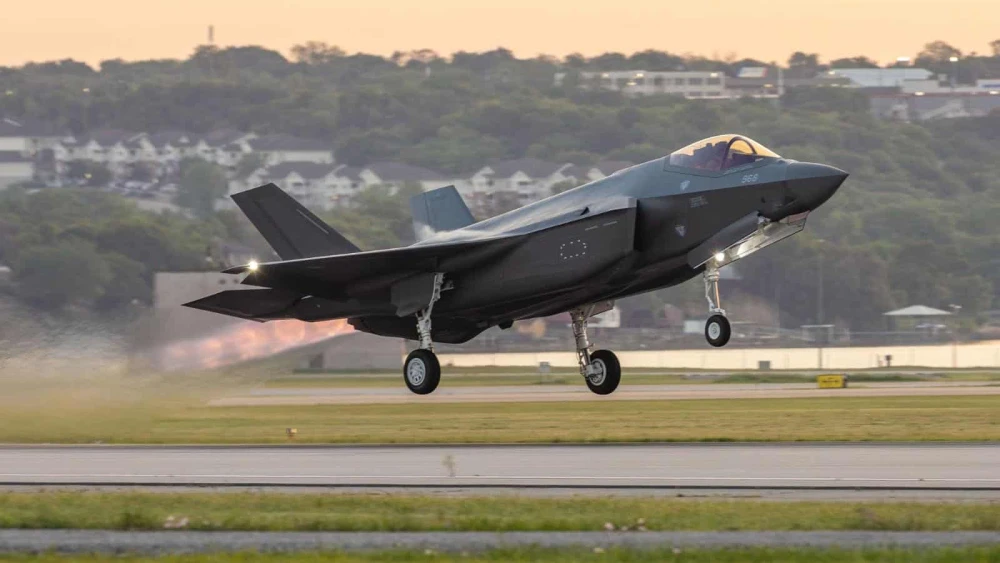

The Israeli Air Force’s F-35I “Adir” (Hebrew for mighty) stealth fighter jet has emerged as a central component of the successful air campaign against Iran.
An Israeli security source told JNS that the jet’s contribution to the success of “Operation Rising Lion” against Iran had been critical. “The Adir played a key role in the campaign, mainly thanks to its ability to create a battle picture in a league above everyone else, and it is, in fact, an airborne intelligence center,” the source stated.
The Lockheed Martin-produced F-35 is designed as a network-centric warfare platform. The aircraft’s advanced sensors and data-fusion capabilities allow it to gather vast amounts of intelligence on enemy ground and air activities, including radar and command-and-control sites, and then securely share that real-time data with other assets in the strike package, such as F-15 and F-16 jets.
This ability to map the threat environment in real time and guide other platforms makes it a critical tool for dismantling Iranian targets. Israel operates two squadrons of the stealth fighter, and in June 2024, signed a deal to buy a third squadron, for an eventual total of 75.
Meanwhile, a Western observer argued that Israel’s long-serving F-15 jet is highly suited to long-range strikes in Iran, noting that the F-15 carries significantly large ordnance because it has two engines.
In November 2024, the Israeli Defense Ministry signed a deal with Boeing to purchase 25 advanced F-15 jets, which will be equipped with state-of-the-art Israeli technologies, including long-range enhanced capabilities, increased ability to carry payloads and other abilities, the Defense Ministry said at the time of the deal.
A critical factor shaping any long-range Israeli air operation is the fleet of refueling tankers. “Israel uses Boeing 707 aircraft of the oldest models,” the Western observer noted, referring to the IAF’s aging fleet of 707 “Re’em” tankers.
A recent press release from Israel Aerospace Industries (IAI) noted the Israeli Air Force’s and IAI’s maintenance work on these planes, stating that they had conducted “more than seven hundred aerial-refueling operations” during Operation Rising Lion, transferring millions of liters of fuel.
Separately, a July 3 report in the Eurasian Times detailed that the U.S. had been highly impressed by new Israeli-developed external fuel tanks for the F-35 jets. However, it is not known whether these are actually operational in the IAF as of yet.
These tanks are, according to the report, designed to hug the aircraft’s frame, extending its range significantly without the major impact on its stealth profile that standard external drop tanks would cause. The Western observer noted that such additions could increase the jet’s range by 20 to 30 percent.
In addition to the F-35s, F-15s, and F-16s, Israel’s fleet of unmanned aerial vehicles achieved what the Defense Ministry described on July 1 as an “unprecedented reach, with continuous long-distance deployment logging thousands of flight hours and executing over 500 strikes and interdictions within Iran.”
These included the remotely-crewed aircraft IAI-made Heron (Shoval) and Heron TP (Eitan) operated continuously for thousands of flights, as well as Elbit-made Hermes 900 UAVs.
“UAV operation minimized risk to combat pilots while conducting missile launcher hunts, saving numerous lives and preventing extensive damage to the State of Israel,” the Defense Ministry stated. “Combined with the Swords of Iron War, UAV missions accounted for 60% of total Air Force flight hours, and 50% of all IDF strike operations.”
This percentage is certain to grow in favor of UAV operations over those of manned aircraft as technologies continue to mature, and UAVs become faster and carry even more sophisticated capabilities onboard.