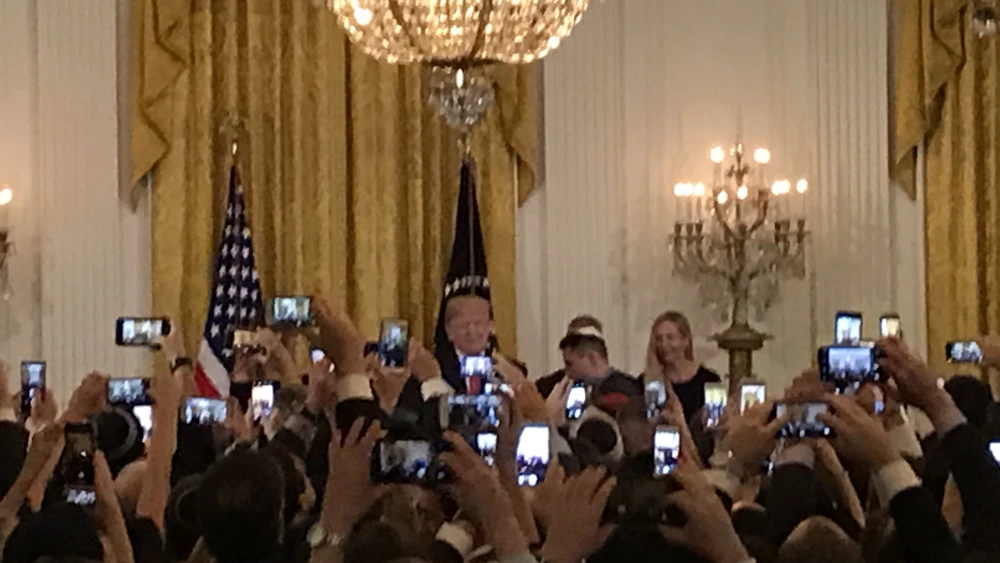
WASHINGTON–Ten months after losing their daughter Meadow in the mass shooting at Marjory Stoneman Douglas High School in Parkland, Fla., Andrew Pollack and his family stood alongside U.S. President Donald Trump as he lit the menorah on the fifth night of Hanukkah, being celebrated on Thursday at the White House with two parties.
“Mr. President, despite the pundits and so-called experts who said you couldn’t, you have retaken Washington for the American people,” said Pollack. “You are the greatest friend that the Jewish people have ever had in the White House—not only because you recognized Jerusalem as the capital of Israel and followed through on your promise to move the embassy to Jerusalem, but because you understand the spirit of Hanukkah within your heart.”
“We have to keep fighting because the safety of our children and the future of our country depend on whether we honor the true spirit of Hanukkah, by staying true to our traditions and to keep on winning,” added Pollack.
Thank you President @realDonaldTrump and @FLOTUS for having me and my family as the guests of honor at the White House Hanukkah Party. One of the greatest honors of my life.#HappyHanukkah pic.twitter.com/QqckkhGe0P — Andrew Pollack (@AndrewPollackFL) December 7, 2018
Trump expressed his sympathy for Pollack’s loss. “We promise to hold the memory of beautiful Meadow and every Parkland victim in our hearts forever,” he said.
After the menorah-lighting, supervised by Rabbi Avraham Friedman of Chabad of Coral Springs, Fla., the crowd sang “Maoz Tzur” (“Rock of Ages”), which is recited after lighting every night of Hanukkah.
Attendees singing “Maoz Tzur” at the second #Hanukkah party at the @WhiteHouse, following the lighting of the menorah by @AndrewPollackFL, who lost his daughter in the Parkland school shooting in Feb. (Apologies for the angle during the first six seconds.) pic.twitter.com/Yki9EGLfZU — Jackson Richman (@jacksonrichman) December 7, 2018
In attendance were Vice President Mike Pence, Treasury Secretary Steve Mnuchin, Food and Drug Administrator Scott Gottlieb and Deputy Attorney General Rod Rosenstein.
“Al HaNissim” (“For the miracles”) being sung at the second @WhiteHouse #Hanukkah party (Credit: @jacksonrichman) pic.twitter.com/P2StgzSGjO — Jewish News Syndicate (@JNS_org) December 7, 2018
At the earlier Hanukkah reception, Trump recognized eight Holocaust survivors, remarking they had experienced “evil beyond description.”
At both ceremonies, Trump mentioned the deadliest attack in American Jewish history at Tree of Life*Or L’Simcha Synagogue in Pittsburgh, where 11 Jewish worshippers were shot dead by a lone gunman during Shabbat-morning services on Oct. 27.
He said that in the shooting’s aftermath, “we reaffirmed our solemn duty to confront anti-Semitism everywhere and that we “must stamp out this vile hatred from the world.”