A majority of countries have made no progress on Holocaust art restitution over the last quarter century, a report released on Monday shows.
Twenty-four of 47 countries surveyed have made minimal to no progress in art and cultural property restitution, compared to only seven countries that have made major progress in the field.
The report, “Holocaust-Era Looted Cultural Property: A Current Worldwide Overview,” was authored by the World Jewish Restitution Organization (WJRO) and the Conference of Jewish Material Claims Against Germany (Claims Conference).
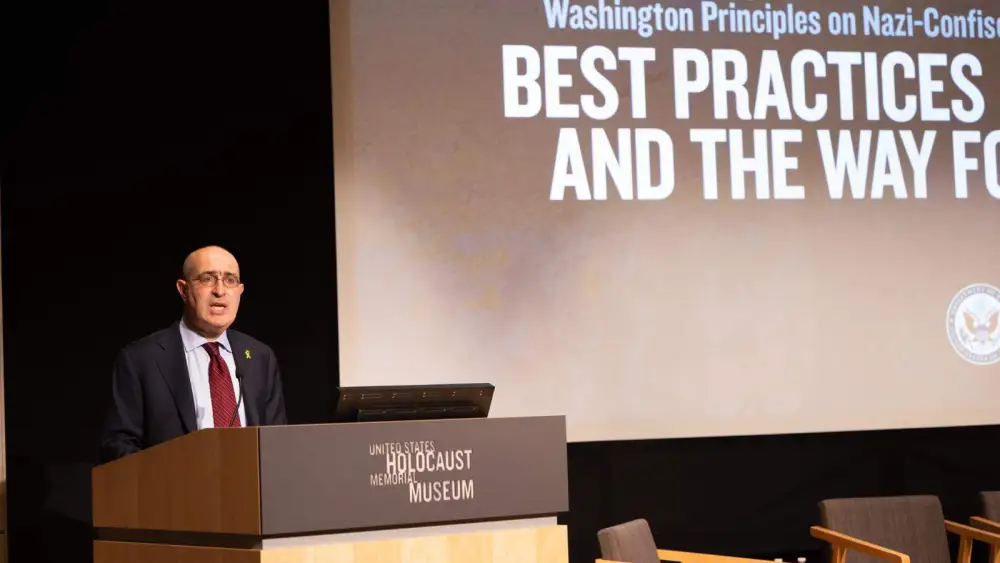
It was released at an event held together with the U.S. State Department at the United States Holocaust Memorial Museum in Washington.
The seven countries that have made “major progress” since a landmark conference on the issue in Washington in 1998 are Austria, the Czech Republic, France, Germany, the Netherlands, the United Kingdom and the United States.
The two dozen countries that have made “little or no progress” are Albania, Australia, Belarus, Bosnia and Herzegovina, Brazil, Bulgaria, Cyprus, Denmark, Estonia, Finland, Ireland, Latvia, Lithuania, Malta, Moldova, Montenegro, North Macedonia, Portugal, Romania, Russia, Spain, Turkey, Ukraine and Uruguay.
“Of the millions of works of art and cultural property stolen by the Nazis, countless objects still have not been returned to their owners,” said U.S. Secretary of State Antony Blinken in a video address. “Today, too many governments, museums, dealers, galleries, and individuals still resist restitution efforts … while heirs confront staggering legal and financial barriers as they go up against opponents whose resources vastly outmatch their own.”
Gideon Taylor, president of the World Jewish Restitution Organization, said, “This report underscores the critical need for advancement in art and cultural property restitution.
“We urge other countries, as well as museums, auction houses, dealers and private possessors to join us in ensuring justice and that rightful owners and their heirs are reunited with their cultural treasures,” Taylor said.
Colette Avital, who survived the Holocaust in Romania and is chairperson of the Center of Organizations of Holocaust Survivors in Israel, said, “For us Holocaust survivors, [these] works of art are part of our cultural heritage, part of our lives, part of our past.
“They are the silent witnesses of the lives and loves of individuals, families and communities who were murdered cruelly and whose memories we cherish,” said Avital, a former member of Knesset for the Labor Party.
The Nazis looted about 20% of the art in Europe, and more than 100,000 items have not been returned to their rightful owners.