Newsletter
Newsletter Support JNS

Art meets science: Is that a field of flowers or the brain of a mouse?

“I wanted to show that science can be beautiful,” said Anat Har-Gil, who created the exhibit four years ago, now on permanent display at the Technion-Israel Institute of Technology in Haifa.

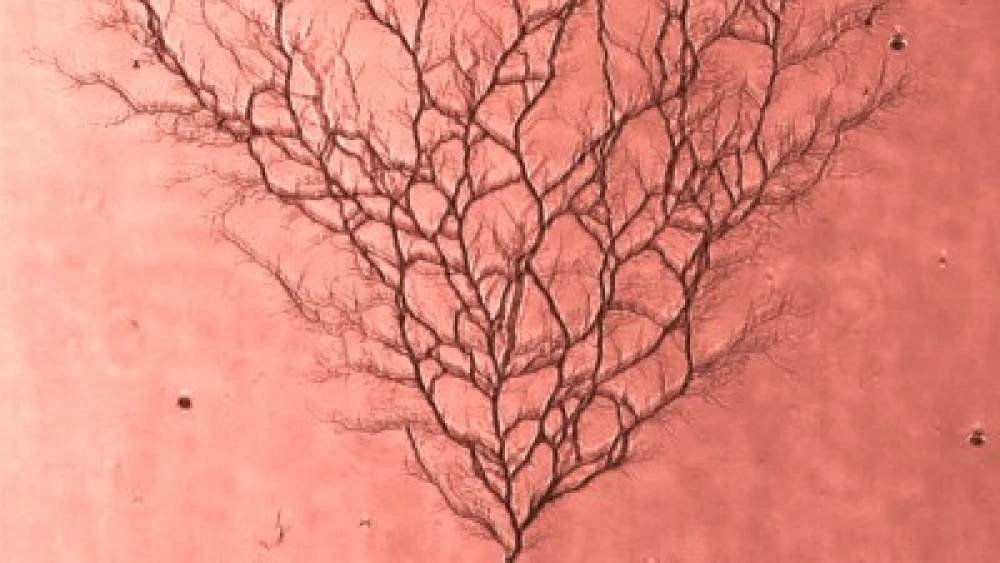
Micro- and nano-fluidic channels in polydimethylsiloxane (PDMS) photographed through an epifluroescence microscope. By Merav Karsenty and Nadya Ostromohov from the Microfluidic Technologies Laboratory headed by assistant professor Moran Bercovici at the Technion Faculty of Mechanical Engineering.

An exhibit by the Technion-Israel Institute of Technology in Haifa exemplifies that beauty is in the eye of the beholder.

“LABSCAPES: Views Through the Microscope” showcases the work of renowned researchers at Israel’s leading institute of science and technology. It consists of “landscapes from the lab,” Anat Har-Gil, who created the exhibit four years ago, told JNS at this week’s annual AIPAC Policy Conference, which, in addition to speeches and dialogue, incorporated this exhibit and others as part of its offerings.

The exhibit includes contributions from Dan Shechtman, who won the 2011 Nobel Prize in chemistry; Mordechai Segev, 2014 winner of the Israel Prize, the country’s highest cultural award; and researchers Nadya Ostromohov and Merav Arsenty.

The images display features of individual bacteria, the ridges of a particle of clay, the smoothness of a single droplet of mist and even the twisted helix of DNA. The pictures were taken through the world’s most advanced microscopic imaging systems, capable of magnifying items 10 million times greater than can be seen by the naked eye.

Micro- and nano-fluidic channels in polydimethylsiloxane (PDMS) photographed through an epifluroescence microscope. By Merav Karsenty and Nadya Ostromohov from the Microfluidic Technologies Laboratory headed by assistant professor Moran Bercovici at the Technion Faculty of Mechanical Engineering.

Har-Gil, a member of the Technion’s computing and information systems department, who has studied art, computer programming and curating, said she sought to combine all three, inspired after visiting biology professor Yoram Reiter’s lab, where she saw an image of what she thought was a field of flowers but was really the brain of a mouse.

It took her a year to work with researchers and use their images to create her project.

“I wanted to show that science can be beautiful,” said Har-Gil. “I wanted people to see something nice, and to be curious and to ask themselves ‘What is it?’ And to read and to be surprised it’s something else.”

In order to not misrepresent the researchers’ works, while each picture comes with a title encompassing anything but about the specific image, the scientific descriptions remained below the titles, all part of a collaborative effort between Har-Gil and the scientists.

No scientists she asked declined, saying they were happy to help.

Half of the images she acquired were in black and white, while the other half were in color. While she added color to some of the images, she said she did not alter them whatsoever.

“No manipulation,” she asserted, adding that “art can be anywhere.”

LABSCAPES: Views Through the Microscope” is a permanent exhibit at the Technion campus.

“There’s no reason that the process can’t be dramatically accelerated,” Dan Schnur, a political science lecturer, told JNS.
Katie Wilson, who promised when she was running for mayor to turn off cameras, said that she made the decision after an intelligence briefing from local and federal law enforcement.
“It is troubling that a stadium supported by taxpayer dollars would openly subsidize an event led by an artist known for pushing this dangerous, hateful rhetoric, especially with Florida having one of the largest Jewish populations in our country,” Sen. Rick Scott stated.
Toronto’s police chief said that there will be more barricades and officers in an effort to prevent a repeat of last year’s “gauntlet of hate” near the walk.
Mika Hackner of the North American Values Institute told JNS that “particular attention should be paid to the ‘local institutions’ tasked with carrying on” the foundation’s programs.
The House Armed Services Committee rejected Rep. Ro Khanna’s amendment to delete section 224 from the annual defense bill, which calls for increased cooperation between the U.S. and Israel.