Newsletter
Newsletter Support JNS

Israeli premier to IAEA director: Israel reserves right to act against Iran

During visit by IAEA director-general Rafael Grossi, Israeli Prime Minister Naftali Bennett stresses the ‘urgent’ need to mobilize the international community to halt Tehran’s nuclear project.

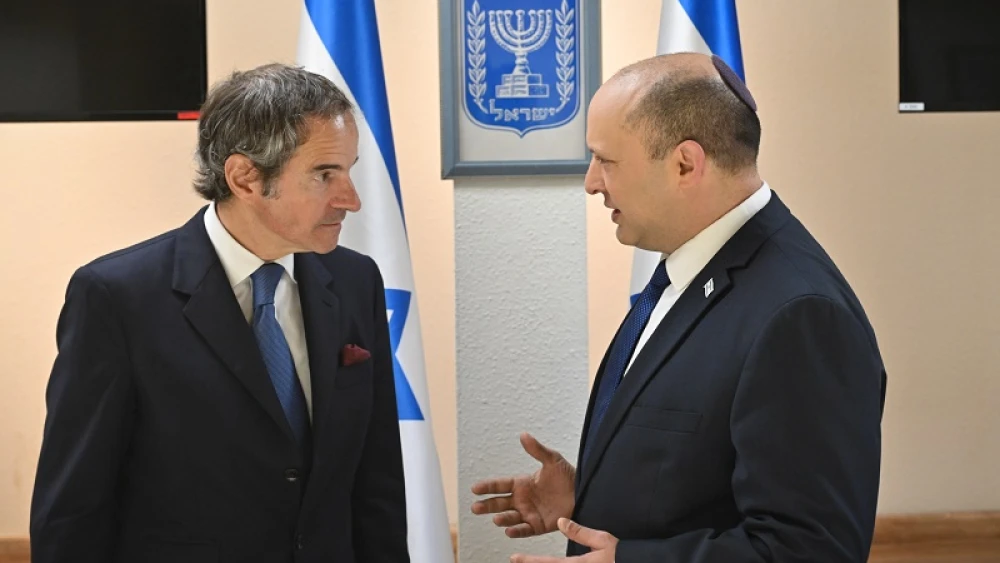
IAEA Director General Rafael Grossi (left) meets in Israel with Israeli Prime Minister Naftali Bennett, on June 3, 2022. Photo by Kobi Gideon, GPO.

Israeli Prime Minister Naftali Bennett met with International Atomic Energy Agency director-general Rafael Grossi on June 3, following Grossi’s arrival in Israel the previous evening, according to a statement from Bennett’s office.

Following their meeting, Grossi departed for Vienna.

Bennett conveyed to Grossi Israel’s “deep concern” regarding Iran’s ongoing march toward achieving nuclear weapons and deception of the international community, the statement said.

The prime minister emphasized the “urgent” need to mobilize the international community to take action against Iran, “using all means,” the statement continued.

He stressed Israel’s support for the IAEA carrying out its mandate vis-à-vis Iran in a “professional and independent way,” as well as the importance of the IAEA Board of Governors delivering a “clear and unequivocal” message to Iran.

“While Israel prefers diplomacy in order to deny Iran the possibility of developing nuclear weapons, it reserves the right to self-defense and to action against Iran in order to block its nuclear program should the international community not succeed in the relevant time frame,” said Bennett, according to the statement.

An aerial strike in Gaza eliminated a sniper operative who also worked as a photojournalist for the Qatari outlet; his brother, also linked to Hamas and Al Jazeera, was killed in April.
The Jerusalem gathering presents a 12-forum blueprint to fight antisemitism, reshape policy and strengthen the Jewish state’s security and global standing.
The move comes after the ICC’s governing body suspended the British barrister from continuing in his role as chief prosecutor.
While Washington celebrates a 60-day ceasefire extension, Jerusalem sees its core security interests sacrificed, with Hezbollah preserved on the northern border and strains in the U.S.-Israel alliance.
The proscribed expressions would include swastikas, tattoos and performative Nazi gestures, with exceptions for education and journalistic purposes.
The second JNS International Policy Summit gathers over 200 security experts, politicians, diplomats, legal scholars, policy experts and journalists to discuss the most important issues facing Israel and the Jewish people.