Reps. Jared Moskowitz (D-Fla.) and Tom Kean Jr. (R-N.J.) introduced the Remembering American Hostages Act of 2025, which would require federal sites to display the hostage and wrongful detainee flag on “key historical dates,” including Oct. 7, and “raise awareness of the ongoing fight against wrongful detention.”
The bill, introduced on Tuesday, specifies the dates that bookended the Iranian hostage crisis, Nov. 4 (1979) and Jan. 20 (1981), as well as the date that ISIS killed journalist James Foley (Aug. 19) and Oct. 7, the “date of Hamas’s unprovoked attack on Israel in which more than 240 people, including 12 Americans, were taken hostage,” the congressmen stated.
“Each day we fly this flag is a reminder of those who have been unjustly taken hostage and a reminder to the world that America doesn’t forget its own,” Moskowitz stated. “This bipartisan effort will ensure that the hostage and wrongful detainee flag remains a visible symbol of our nation’s commitment to bring Americans home and to honor those who never made it back.”
Kean stated that “at its heart, this legislation is about remembrance, unity and our unwavering support for Americans unjustly held abroad.”
“For the families of American hostages, like my constituent Sarah Moriarty, who have endured unimaginable hardship and loss of their loved ones, we stand with you,” the New Jersey Republican stated. “Flying the hostage and wrongful detainee flag is a powerful symbol of our nation’s commitment to bring every American home and to never forget those who have suffered in captivity.”
The representatives said that the bill expands the list of federal sites where the flag would be flown, “including U.S. embassies, consulates, passport offices and key federal departments.”
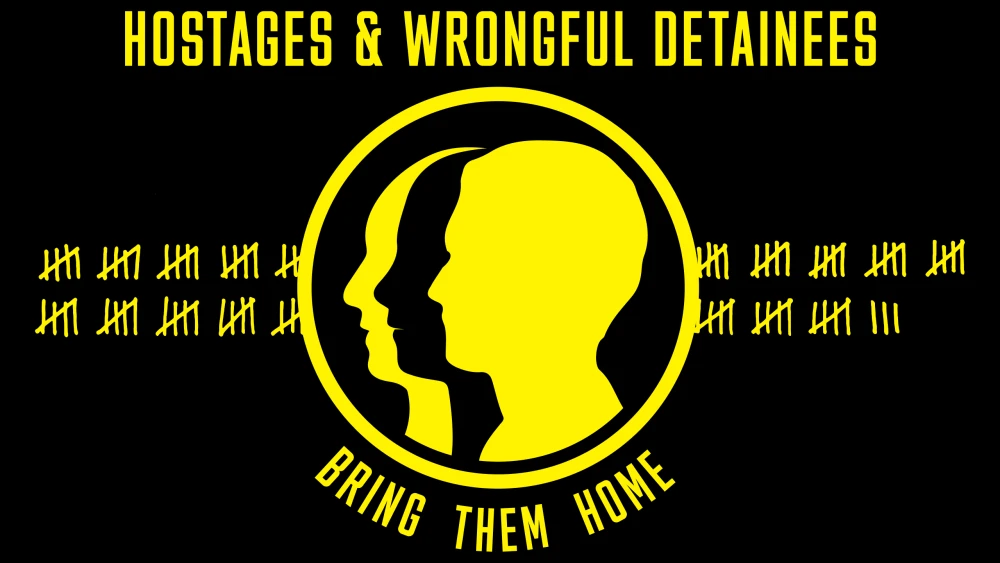
The hostage and wrongful detainee flag “symbolizes the commitment of the United States to recognizing and prioritizing the freedom of citizens and lawful permanent residents of the United States held as hostages or wrongfully detained abroad,” according to the U.S. State Department.
“The flag’s yellow and black color theme draws from the Iran hostage crisis when the yellow ribbon became an iconic symbol of the hope for the hostages’ safe release,” it states. “The flag’s central emblem contains three abstract faces in profile, emphasizing and personalizing the human struggle while encapsulating gender, racial and ethnic diversity. Two rows of tally marks appear in the background in irregular font, evoking chalk or scratches on a prison wall.”
The marks “figuratively mark days spent in captivity and the parallel counting and suffering by families and loved ones,” the State Department says. “Running the length of the flag, the tally mark’s unending count reinforces the flag’s call to action scrolled below: ‘bring them home.’”