


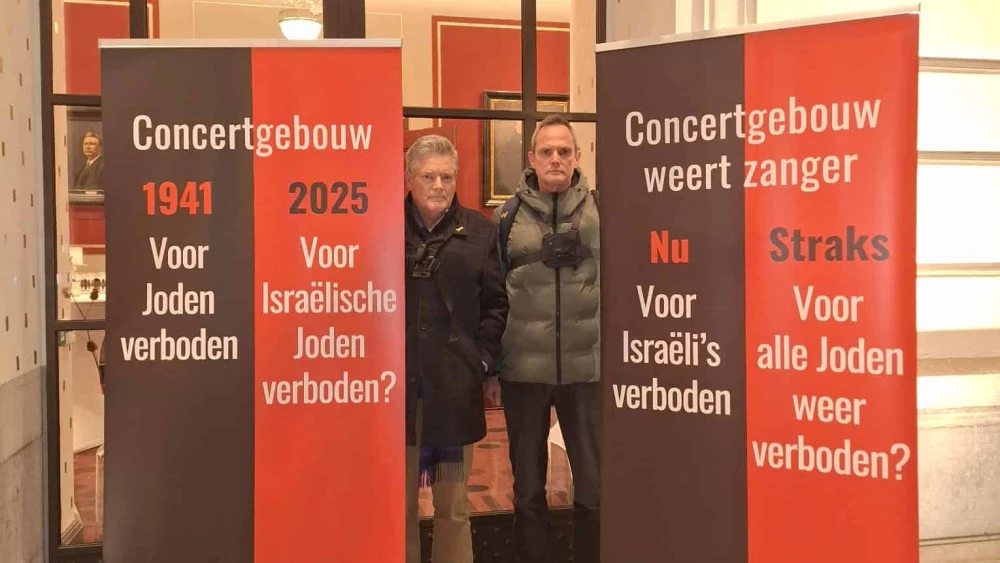
Leaders of Dutch Christian Zionists protested on Thursday in Amsterdam against the Royal Concert Hall’s decision to cancel a Chanukah concert because it features a cantor who serves in Israel’s army.
Separately, France’s culture minister, Rachida Dati, condemned calls to boycott the Israel Philharmonic and prevent that orchestra from performing in Paris on Thursday at the seat of its local counterpart.
Dati tweeted “welcome” to the visiting orchestra, saying, “Nothing justifies boycotting culture right now,” and adding, “Antisemitism has no pretext.” It was a response to calls for a boycott by anti-Israel groups, whose activists police feared would try to disrupt the concert.
Regarding the boycott action in Amsterdam, Amichai Chikli, Israel’s minister for Diaspora affairs and combating antisemitism, on Tuesday wrote to Femke Halsema, the city’s mayor, asking her to condemn the Royal Concert Hall’s decision. “Silence now would be complicity,” Chikli warned her. Amsterdam, he added, “must not remain silent while its institutions single out Jews and contribute to the isolation of a small and already vulnerable community.”
Pieter van Oordt and his brother Roger, two leaders of the Christians for Israel movement in the Netherlands, arrived at the Royal Concert Hall on Wednesday and Thursday with banners that recalled the institution’s firing of its Jewish staffers in 1941, to protest the current leadership’s decision to cancel the Channukah concert held there annually because of the Israeli cantor, Shai Abramson.
One banner read: “Royal Concert Hall: Jews banned in 1941, banned for Israeli Jews in 2025.” Another read: “Banned for Israeli Jews now, soon banned for all Jews?”
Since Oct. 7, 2023, several Dutch venues have banned Jewish and Israeli speakers at events, including last month’s elections event organized by the Center for Information and Documentation in Israel, which is Dutch Jewry’s pro-Israel lobby group.
“The Royal Concert Hall’s boycott action stands out because of its cultural prominence. It’s a symbol,” Roger van Oordt, the previous director of Christians for Israel, told JNS.
He added that Christians for Israel is considering joining the legal action launched against the Royal Concert Hall by the Chanukah Concert Association, which organizes the annual celebration at the building.
Oscar Hammerstein, a prominent Dutch-Jewish jurist, has called on his countrymen to boycott the Royal Concert Hall unless it reverses its ban.
Hammerstein also presented on X a document he said shows that the grandfather of the current director of the Royal Concert Hall, Simon Reinink, was the official who on Nov. 23, 1940 signed an order that terminated the employment of a Jewish professor from Leiden University.
The fired professor was Eduard Maurits Meijers, the founding father of the current Dutch civil code, the Nieuw Burgerlijk Wetboek. The document presented by Hammerstein was signed by Hendrik Jan Reinink, then the secretary-general of the education ministry under German occupation, and Simon’s grandfather.
“Eighty-five years later, history repeats itself in chilling fashion: Once again, Jews are being excluded—this time not from the university, but from the Royal Concert Hall, the house of music, where they wished to celebrate Chanukah,” Hammerstein wrote.


