When their Jewish husbands began vanishing from the Lower East Side tenements in Manhattan in the early 20th century, many wives didn’t even bother going to the police. Instead, they turned to Abraham Hochman—a Jewish psychic, who claimed he could locate runaway spouses.
The Torah forbids performing magic explicitly on pains of death. But many Jews have ignored that prohibition for centuries, according to the new YIVO Institute for Jewish Research exhibit “Jews Are Magic.”
Eddy Portnoy, academic advisor at YIVO and curator of the exhibit, told JNS that one can understand practices in various times and places based on laws that are created or passed in response to that behavior.
“When you have something saying you can’t go to someone who uses divination, or a witch, or consults spirits, or a wizard, or a necromancer,” someone who talks with the dead, “that means this is something people were doing,” he told JNS.
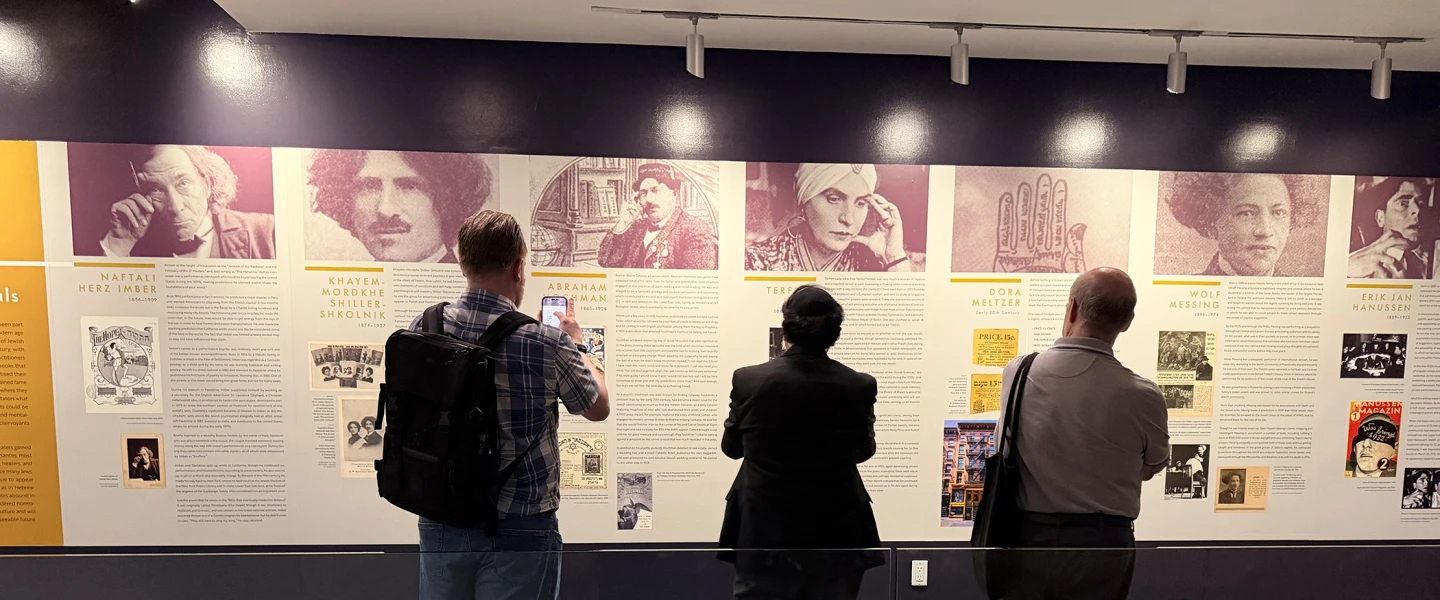
Hochman is one of several figures addressed in the show, which is about “occult practices from palmistry to professional psychics” and is on view until Dec. 31.
The exhibit includes rare books, handwritten amulets, letters, photographs and manuscripts to explore a lesser-known part of Jewish history—one in which ordinary Jews sought help from psychics, miracle workers and practitioners of folk magic in addition to rabbis and doctors.
The exhibit is less about the supernatural than about human behavior, according to Portnoy, who studies Jewish culture and history.

“Traditional religion isn’t doing it for them. Doctors aren’t working either,” he told JNS, during a walkthrough of the exhibit in the Center for Jewish History in Manhattan. “So they take that extra step and believe what appears to be the unbelievable.”
“What we’re showing here is the Jewish variant” of a near-universal human phenomenon, he said.
“All cultures have this aspect of the occult,” he told JNS.
The exhibition opens with a familiar concept today: the evil eye.
Long before modern medicine or psychology offered explanations for misfortune, many Jewish communities understood the world to be populated by unseen forces, and demons, angels, spirits and malevolent influences were often seen as part of everyday life, Portnoy told JNS.
“The evil eye is sort of the most common and most prevalent malefactor in Jewish life,” he said. “Even in the Talmud, it says that 99 out of 100 deaths are caused by the evil eye, so people understood this to be real and they had to protect themselves against it.”
Whether they understood the evil eye literally or symbolically, Jews believed in such forces, which generated an entire ecosystem of protective practices.
Visitors to the exhibit can view amulets designed to ward off danger, handwritten charms intended to protect mothers and newborn children and printed segulot, Jewish spiritual remedies, promising health, success or protection.
Some of those traditions are still practiced today. Many Jews wear a red string, often associated with Kabbalah, which originated as a protective device against the evil eye.

There is also a common custom of responding to praise with “ptoo, ptoo, ptoo,” in an attempt to ward off harmful spiritual forces believed to be invited in by excessive admiration.
Far from disappearing, many of these practices remain common in some Orthodox and Mizrahi communities, according to Portnoy.
One practice known as bleigiessen, or lead pouring, is still practiced by some Haredi communities. Practitioners melt lead over boiling water and interpret the resulting shapes to determine whether someone has been affected by the evil eye.
If the results suggest an affliction, additional remedies may be prescribed. One Chassidic man from Borough Park, who declined to give his name, told JNS that the custom remains common in his Chassidic neighborhood in New York.
Similar practices appear throughout the exhibition. A series of “lot-casting” books, known in Yiddish as goral bicher, functioned as elaborate fortune-telling systems. Users selected a question, such as “Will I get married?” or “Will I have children?” or “Should I pursue this business opportunity?”
They then followed a series of calculations involving grains of wheat, drops of wax, biblical figures, astrological symbols and other references to arrive at a final answer.
A question that appeared in an older edition of the volumes asked, “Will my son find favor in the eyes of kings and nobles?” That question disappeared from later editions after kings largely ceased to be important in the daily lives of ordinary Jews, Portnoy told JNS.
The exhibit also examines Jewish occult personalities, who built careers around providing insights into the unknown.
One such figure is Naftali Herz Imber (1856-1909), best known as author of the poem “Hatikvah,” which later became the Israeli national anthem.
Official biographies generally describe Imber as a poet and Zionist thinker, but he had a parallel career as a clairvoyant, who accurately predicted natural disasters, the creation of a Jewish state in Palestine and the future use of solar panels.

“He was a poet, and he was an excellent poet,” Portnoy told JNS. “But he had this sideline, where he called himself the Mahatma and worked as a clairvoyant.”
Hochman, a performance psychic, is also highlighted in the exhibit. He became a celebrity on the Lower East Side in the early 20th century thanks to his unique specialty: locating missing husbands.
The neighborhood’s crowded immigrant neighborhoods were generally marked by poverty, instability and tight, uncomfortable living quarters. Jewish men, overwhelmed by the circumstances, often disappeared, abandoning wives and children, who then came to Hochman desperate for answers, Portnoy said.
Newspaper accounts described crowds lining up each day outside his office hoping he could reveal the whereabouts of their missing spouses.
“Your average tenement apartment is 300 square feet,” Portnoy said, “and your average family is six people. There’s no bathroom in the apartment. The bathroom is down the hall or in the backyard of the building.”
These Jews, often working 14- to 16-hour days, led a miserable existence,” he told JNS. “So men sometimes just disappeared.”
Portnoy told JNS that the exhibit grew organically from years that he spent encountering and studying the figures and artifacts that eventually made their way into the show.

“People always ask me that when I do exhibits, and I never keep track,” he said. “The reality is that I’ve known about some of these people for many years, but when it came time to actually create the exhibit, it probably took a couple of years of research and then design work.”
Despite their claims to special knowledge, no figures in the exhibit presented themselves as prophets of the messianic era, Portnoy told JNS.
“The purpose of these people was to serve common people, who had problems or difficult issues to wrangle with,” he said. “Those people were their clientele.”
The exhibit also includes a section devoted to phrenology, the now-discredited theory that personality traits could be determined by examining the shape of a person’s skull.
Another section focuses on an even stranger discipline called “nasology,” the view that a person’s character could be determined from the shape of his or her nose.
Nasology actually began as a joke, according to Portnoy.
“It was totally spurious. It’s fake,” he told JNS. “And yet it became real to a lot of people.”
The phenomenon is his favorite in the exhibit, he said. “It is just so compelling,” he told JNS.
The exhibit concludes with several editions of “Sefer Raziel HaMalach,” one of the most influential books in practical Kabbalah, attributed to the angel Raziel.

First compiled during the medieval period and expanded over centuries, the text combines discussions of angels, astrology, gematria, protective formulas and mystical knowledge.
One edition even promised that owning the book would prevent a house from burning down. (One can purchase pocket-sized copies of the work for that reason in Israel, among other places.)
Many people apparently took the claim seriously. Portnoy, however, does not.
What draws him to the subject as a whole is not the supernatural itself but what belief in it reveals about the people who embraced it.
“I’m a Litvak,” he quipped, referring to the stereotype of Lithuanian Jews as rationalists who are traditionally suspicious of mysticism.
“One of the interesting issues is the self-help aspect of the occult,” he told JNS. “People have problems or issues that need solving.”
“That you can determine something through a spell, a charm or a person with special skills,” he said. “I just find that such an interesting aspect of the human psyche.”