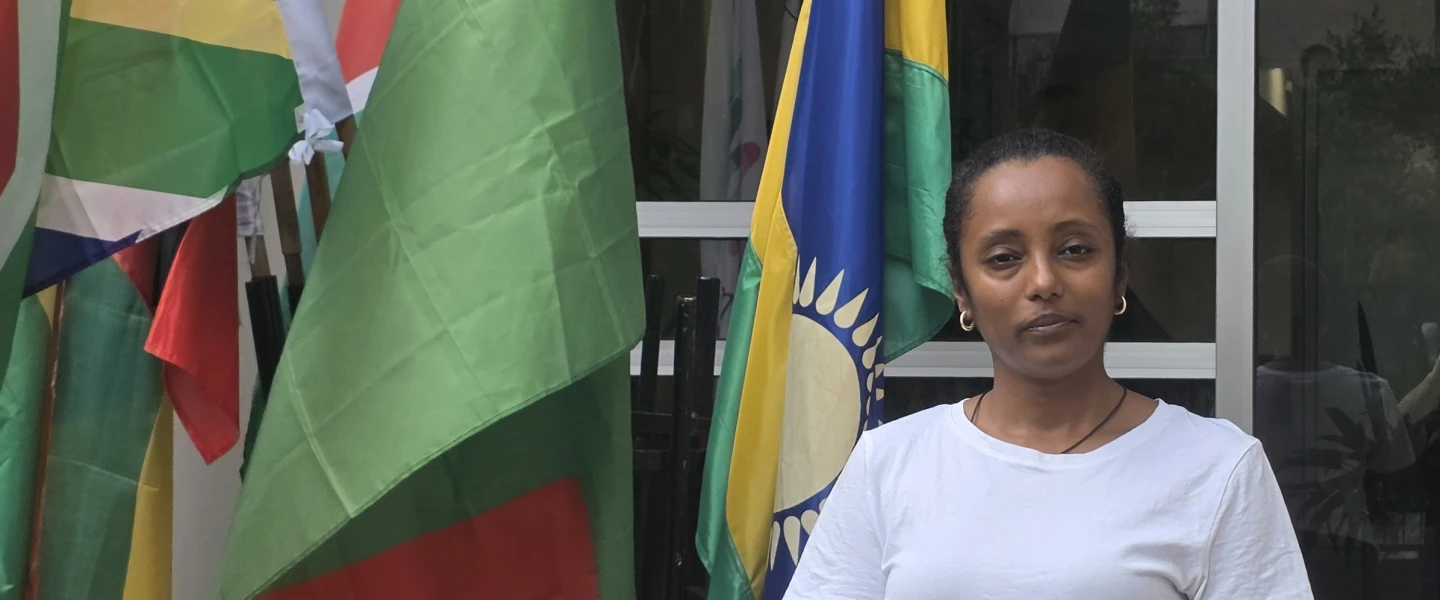
The outbreak of war in Israel seemed inevitable when Maedot Assefa, a mother of two from Ethiopia, began packing her suitcase for a two-week innovation seminar based in Haifa.
She decided to fly to Israel anyway.
“The program has a very good reputation, and getting accepted is very competitive. I figured we’d be safe. I wasn’t going to pass up the opportunity,” Aseffa, a 40-year-old business entrepreneur, told JNS last month at the training center of MASHAV, Israel’s Agency for International Development Cooperation under the country’s Foreign Ministry.
The interest by hundreds of trainees who’ve come to Israel even after the outbreak of regional war on Oct. 7, 2023 is a testament to the value that the Jewish state’s international aid arm has created since its creation in 1958. It also highlights Israel’s attractiveness in parts of the world where necessity trumps hostile narratives.
Hostilities did break out during Assefa’s visit – on the first day of the two-week innovation program she attended with about 20 others from several African countries. As rockets from Iran headed to Israel, the visitors were taken to the MASHAV facility’s shelters. “We felt like our hosts knew what they were doing. There was zero panic,” Aseffa recalled. Ultimately, the rockets resulted in little disruption to the program.

MASHAV hosts hundreds of foreign visitors annually, including at their International Agricultural Training Center in Kibbutz Shfaiym near Netanya. Additionally, MASHAV’s Haifa center, the Golda Meir MASHAV Carmel International Training Center, hosts delegations for seminars and events focused on issues such as innovation, leadership, education and sustainability, all with a focus on promoting gender equality.
Participants in MASHAV’s programs in Haifa usually pay their own travel fare but get full room and board at MASHAV’s Haifa facility, which has a dormitory (participants typically share a room) and an in-house canteen. MASHAV also covers all other expenses connected to the program.
Asseffa’s enterprise, Store251, is an online store that markets handmade products from 150 small workshops across Ethiopia. Producers, she said, often lack the resources and internet access to sell online, severely limiting their clientele. Store251 platforms those micro businesses, which ship their products thanks to recent overhauls in the local postal service, Ethiopost, she said.
She visited Israel to gain insights into how to start marketing abroad, and to achieve her business’s growth goal of marketing 500 producers by 2029. Among the seminar’s highlights for Assefa, she said, was the visit to Check Point Software Technologies, an Israeli cybersecurity company headquartered in Tel Aviv, with solutions precisely for businesses like hers.
But what impressed her most about Israel’s high-tech scene, she said, wasn’t any specific product, firm, or idea, but rather, “the culture of mentorship that exists here, where even senior professionals will show junior ones the ropes in a very informal way, without hierarchy. It’s very impressive and something that’ll stay with me,” she said.
Kebby Sianachilubwa, an executive for a Zambian firm called K.B.S, which deals with optimizing logistical systems, said that what impressed him most was what he called “Israel’s yallah spirit,” referencing the Arabic-language word that means “let’s go,” and that he said encapsulates Israelis’ can-do approach to problem-solving.
None of this was new to Rogerio Bessa, a participant from Angola.
He had lived in Israel for six years as a boy because his father had served here as a diplomat. Having lived through the Second Lebanon War in Israel, he was familiar with the local wartime protocol. “I wasn’t worried for a second,” he said. “One thing Israel can do very well is handle an emergency.”
Currently, Bessa, 30, advises the president of the National Association of Young Entrepreneurs of Angola (ANJE.) His nonprofit group helps small businesses and entrepreneurs navigate government bureaucracy and receive state funding.
Bessa said he was interested in what he learned during the seminar about Israel’s blue economy—a term that refers to solutions and practices connected to sustainable human activity in the oceans and other large bodies of water.
“It blew my mind,” Bessa said following his meeting with representatives of the Israeli National Center of Blue Economy in Haifa. Israel’s desalination project, which now provides 80% of the country’s drinking water, was another highlight, Bessa noted, adding that Angola has experienced deadly droughts in recent years.
The governments of Angola, Ethiopia, and Zambia are among the many African nations that have resisted Arab pressure and political agitation to downgrade relations with Israel because of its conflict with the Palestinians.
“It’s just not an issue where I come from,” said Assefa. “When I said I’m going to Israel, people wanted to know if it’s safe, and if I would see where Jesus lived. I don’t think the politics plays a large role in the minds of people in my society,” she said.
The situation is different in South Africa, whose government initiated the disputed lawsuit against Israel for genocide at the International Court of Justice.
This was of no concern to Litha Dalindyebo, a waste-management professional from South Africa who’s also a member of the AbaThembu royal family of the Eastern Cape region. His family, one of the principal Xhosa royal houses, was an early opponent of apartheid and has enough political capital to chart its own course, irrespective of the policies of the ruling African National Congress, he said.
“Look, the benefits of artificial intelligence, which are on display everywhere in Israel, are not something South Africa can ignore,” said Dalindyebo, who shares a last name with the king of the AbaThembu tribal kingdom.
All of the participants interviewed for this article said they would return to Israel when the opportunity presents itself.
Shachar Re’em, the director of MASHAV’s Carmel training center, said that while MASHAV is an arm of Israeli Foreign Ministry, “what we do here, in our courses, is not about geopolitics. It’s about creating a home for people to share knowledge and know-how, focused on real-life issues that affect millions globally.”
Nuria Levy, head of training development at MASHAV’s Carmel center, said participants tend to act as word-of-mouth ambassadors for Israel.
“These professionals witness a lot of amazing things on the program. They talk about it to people in government, the private sector, and this creates positive perceptions,” said Levy, who led the program together with program director Melina Konigheim.
Although Israelis had a lot of valuable experience to share, they also had many things to learn from the diverse participants at MASHAV’s activities, who come from across the world, including Latin America, Africa, Eastern Europe, Asia and the Pacific, said Re’em.
Bessa, the Angolan visitor, connected Israelis he met during his visit with a friend of his back home who recycles cooking oil from restaurants for its conversion to bio-fuel—a practice that is not widespread in Israel.
Assefa, from Ethiopia, also has a suggestion for improvement in the Startup Nation.
“The work pace here is amazing,” she said. “The innovation, the entrepreneurship. I wonder, though, whether here in Israel you have the social support structure we have in Ethiopia: Asking a colleague how they’re doing—really. Taking the time to find closeness. Maybe that’s something Israeli startups can work on?”