The way Reuven Fenton sees it, the greatest misconception that Americans have about the Israeli elections extends well beyond whether Israelis love or hate Prime Minister Benjamin Netanyahu or blame him for Oct. 7.
“Obviously that’s a huge part of it, but there’s a lot more,” the veteran New York Post reporter, who also pens novels, told JNS in Tel Aviv on Tuesday minutes before the exit polls were released.
Fenton was in town to report on the elections for the benefit of Post readers in New York and beyond. “Being here, you realize how much more complicated the picture is,” he told JNS.
He was part of a delegation of reporters that the Foreign Press Club organized. The journalists met voters with a range of perspectives about the prime minister.
“You meet people who think Netanyahu has been an extraordinary wartime leader, something no American I know would dare speak out loud, but still want him gone,” Fenton told JNS. “You meet others, who hold him responsible for Oct. 7 but don’t see a credible alternative.”

“And you meet people, particularly in the north, whose overriding concern isn’t Netanyahu at all but whether their communities have a future and whether their children can safely grow up there,” he said.
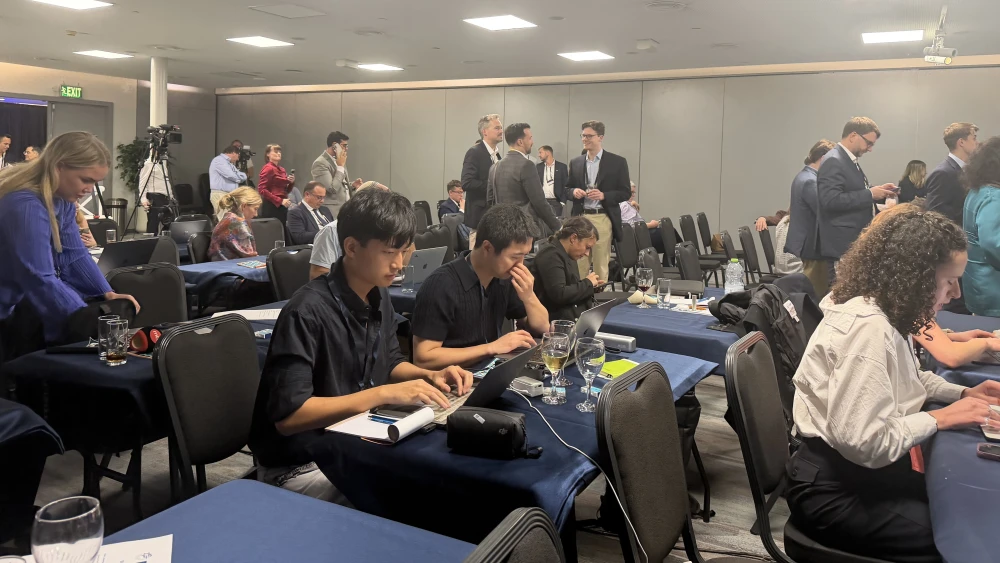
Fenton spoke to JNS at the Israel Press Club’s election-night event at Expo Tel Aviv on Tuesday night. The club hosted the gathering, which was part conference and part filing center, with the German foundation Konrad-Adenauer-Stiftung and the Israel Council on Foreign Relations.
The setting was calm for much of the evening, until the first exit polls came out. Journalists schmoozed with diplomats over food and drinks and listened as political analysts, diplomats and former lawmakers talked about some of Israel’s most pressing issues driving the election.
Shortly before 10 p.m., attendees were encouraged to take a break and grab a drink before the exit polls were released.
During that break, Nicole Lampert, a veteran London-based freelancer for the Daily Mail, Telegraph and Jewish Chronicle, told JNS that she came to Israel to cover the election, because “the conversation in England is completely different.”
“It’s a different reality,” she said. “We keep talking about the two-state solution as if it exists.”
Many in England “think that if Israel leaves the settlements, then there’ll be a two-state solution,” she told JNS. “That’s not true.”
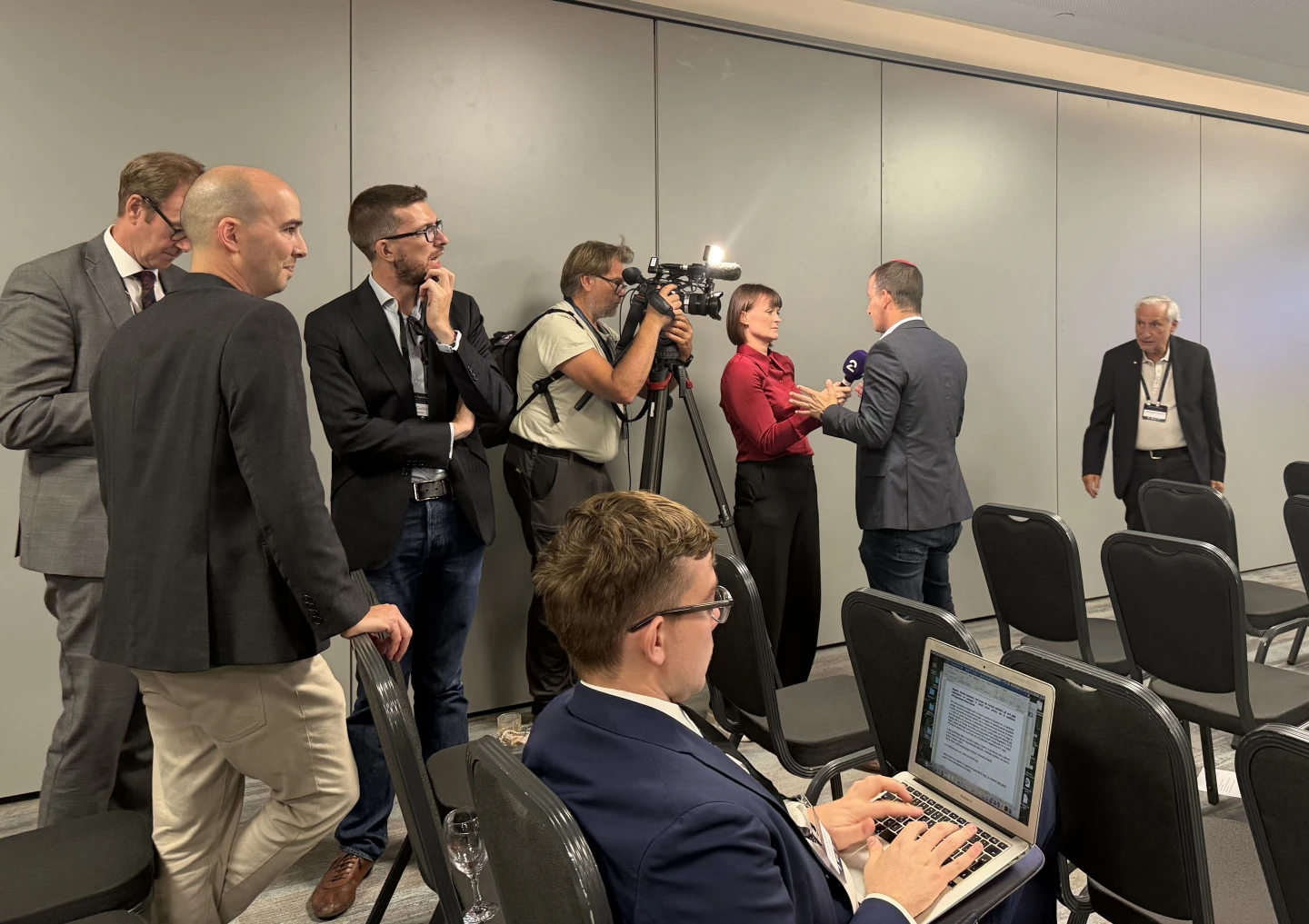
Lampert was talking to JNS when an announcement flashed across each of four televisions, each displaying a different Israeli news channel, on a wall. All the journalists, and the diplomats and experts, crowded around the screens with bated breath.
What followed was less revelation than a chaotic mix of opinion, confusion and a rush to understand, and then communicate, what had just transpired.
“Remember what I told you at the beginning of this night,” Attila Somfalvi, an Israeli journalist and political commentator who served as the event’s moderator, said at the microphone, amid the chaos.
“I said everything that we are saying here is going to change,” he said. “The narrative is going to change.”
Several journalists crowded around political analyst Udi Tenne, who was on hand to explain the results. Exit polls showed Netanyahu’s Likud party winning the most seats, though Somfalvi said that the prime minister’s coalition had been “crushed.”
“Is this a loss for Netanyahu?” several reporters asked Tenne.
As Tenne tried to explain, more gathered around, determined to understand.

“Could Netanyahu remain prime minister despite his bloc’s projected losses?” they wanted to know. “Would Gadi Eisenkot, chairman of the opposition Yashar party, consider joining a unity government with Netanyahu? Could Arab parties help the opposition form a governing coalition?”
For reporters trying to explain the outcome to readers abroad, the competing projections across Israel’s news channels and rapidly changing expert interpretations in the room raised as many questions as they answered.
Fenton told JNS that covering the elections on the ground showed him how much more complicated the political picture was than it appeared to be from the United States.
“I think the best way to cover this election fairly is to resist the temptation to fit every Israeli into some neat political category,” Fenton said.
“Our political framework in America is so different from that in Israel, and it’s a huge mistake to impose ours on theirs,” he said. “You have to listen to people, including people whose views challenge your own assumptions, and understand why they believe what they believe.”
Noa Hoffman, another London-based journalist, told JNS that coming to Israel is the only way to “get a really comprehensive and accurate understanding of what’s driving voters in the election.”


It also helped Hoffman, who is Jewish, see “how all the different issues we talk about in Europe are actually manifesting on the ground itself, rather than in the European imagination,” she said.
“Something I found so interesting from visiting the polling stations and speaking to voters and asking them was that I didn’t know there was a very strong working-class Mizrahi pull towards Netanyahu and the Likud,” she told JNS.
“That was really interesting to see in person—that it was a very sort of class-based appeal that he had,” she said. “I thought that was so interesting.”
For Fenton, covering Israel from New York can make it easy to fall for “accepted truths” like “genocide,” “militants” and “occupation.”
Those words “get repeated so often that they sort of become accepted truths that you bring to your reporting almost unconsciously, even if you’re someone who’s generally sympathetic to Israel,” he told JNS.
“The danger is that you start writing through the prism of those assumptions rather than the reality on the ground,” he said.
“That’s why it’s so important to actually come here, to talk to Israelis, to visit the communities that were devastated on Oct. 7, to hear firsthand what people have lived through and what they’re still living with,” he told JNS.
“There’s something about standing in those places and looking people in the eye that cuts through all the noise,” he added. “It reminds you that behind all these slogans and political arguments are real people and real horrors that can get lost when you’re reporting from places like New York.”