


KIBBUTZ HAMA’APIL, Israel—Man’s best friend may soon become a revolutionary M.D.
A New Jersey-based medtech company founded in Israel is training beagles to detect cancer from breath samples.
The aptly named startup, SpotitEarly, seeks to target the world’s second-leading cause of death by merging innate animal intelligence—the canine’s extraordinary sense of smell—with artificial intelligence.
Beagles have one of the most powerful senses of smell in the animal kingdom.
While human beings have about 5 million scent receptors, beagles possess about 250 million, making them top-notch sniffers.
Founded by a group of tech entrepreneurs and former IDF canine commanders, the company is pioneering a non-invasive method for cancer screening by using beagles to analyze breath samples and improve early detection of the disease.

“We took on a mission to use the ability of dogs and transform it into a marketable product that can save many lives through early detection,” Udi Bobrovsky, co-founder and COO of SpotitEarly, told JNS.
The joint human-canine venture envisions people breathing into a high-tech mask similar to an N95, ordering it online and then sending it back to the company’s laboratories for canine analysis.
A clinical trial last year showed 94% accuracy in the dogs’ detection of lung, breast, prostate and colorectal cancers, Bobrovsky said, with two follow-up studies now underway.
The biotech company plans to launch its estimated $250 cancer screening test in the second half of 2027, with its initial focus on breast cancer.
‘If anyone can detect it, they can’
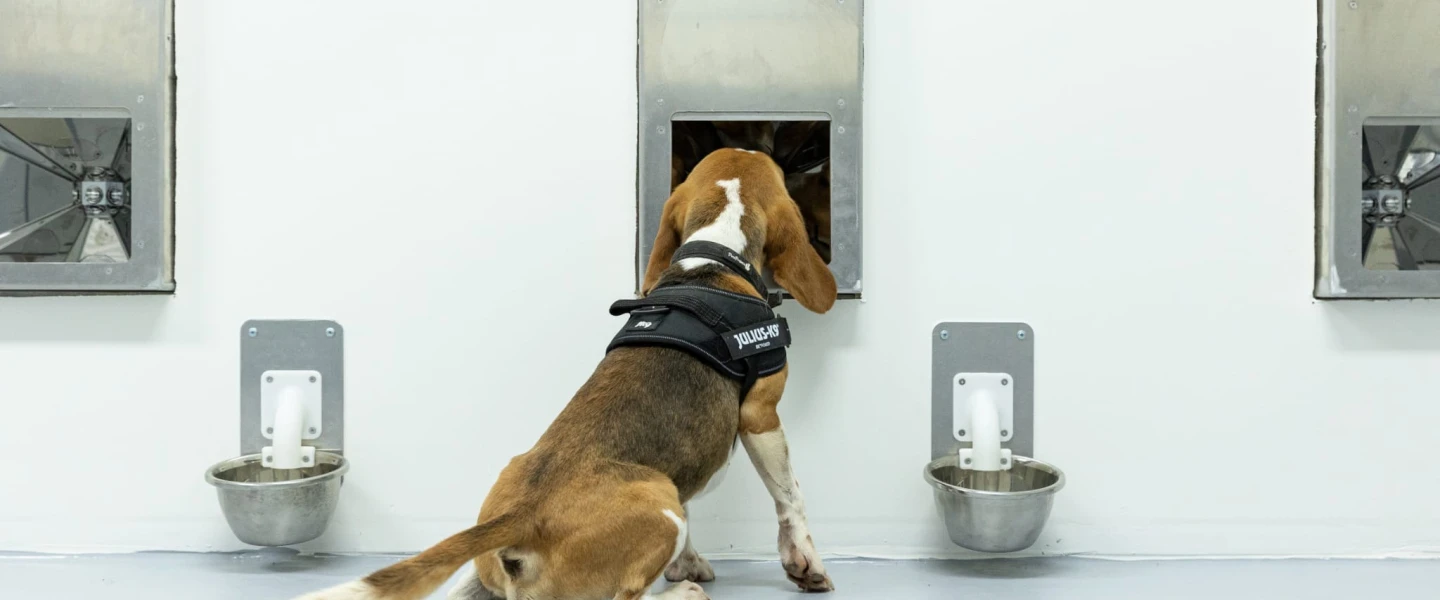
The dozen beagles—male and female, ranging in age from 2 to 4 and a mix of Floridians, Europeans and native Israelis—eagerly rush into the laboratory testing room one at a time with their handler at the central Israeli kibbutz that serves as ground zero for the company’s R&D.
They begin screening six different samples and are closely monitored from a separate room by technicians and staff.
Happy at their work, they inspect each specimen to sniff out the cancer odor—which even their handler does not know the location of—and are sometimes, but not always, rewarded with a snack if they get it right.
“The scent of dogs is absolutely extraordinary and is unmatched by all the AI technology in the world,” said Irit Gazit, the company’s canine production manager, who has worked with dogs for three decades. “If anyone can detect it, they can.”
The company’s dog handlers are former Israeli soldiers from the elite canine unit.
“This is a type of dream job,” said Ehud Cappon.



