Noa Cuickerman was proud to be Jewish, but she still felt nervous about going to synagogue.
She felt like she had nobody her age to interact with there. At school in Singapore, she and her twin sister were the only Jewish students in their grade. The city had a close-knit Jewish community, but she had never quite found her place in it.
“I didn’t have many Jewish friends, even at synagogue,” she said. “It wasn’t that I was any less proud to be Jewish. I simply hadn’t experienced what it felt like to truly belong to a Jewish community of people my own age.”
In Shanghai, Aidan Edrei, 17, knew what it was to watch that circle grow smaller. Born in Israel, he moved to China at age 3 and grew up attending Hebrew school on Sundays, celebrating holidays at Chabad and having Jewish and Israeli classmates and teachers.
After COVID, many of those families left. By his count, around eight Jewish teenagers now live in Shanghai.
“Luckily, our rabbi, rebbetzin and community are incredibly supportive, but I’ve never had a big group of Jewish friends who just get it without needing an explanation,” he said.
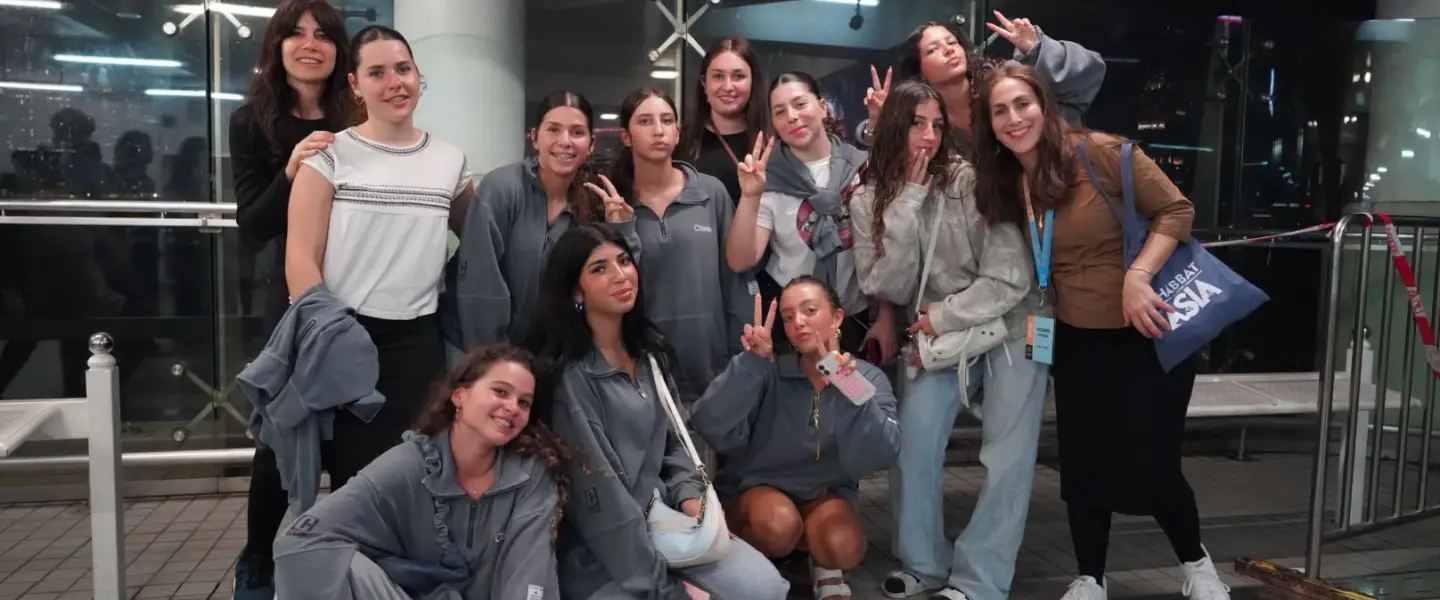
Cuickerman and Edrei were among 100 teen leaders who, last month, traveled to Hong Kong for the first CTeen Asia Leadership Summit. On Oct 15.-19, they gathered from 17 chapters around Asia, arriving from communities in China, India, Japan, Singapore, South Korea, Taiwan, Thailand and Vietnam.
At dinner on Thursday night, Edrei looked around the table.
“I remember sitting at the dinner table, looking around in awe because I’d never seen so many Jews my age in one place,” he said. “We connected over the usual teenager stuff like school, sports, university and hobbies. But there was also an unspoken understanding and respect for each other, just because we shared a Jewish identity. I felt like I belonged with people I’d only just met.”

Having to explain
Edrei said he has never faced antisemitism at the international school he attends in Shanghai. But friends do not always understand when he tries to explain a Jewish holiday or tradition, and he sometimes feels like an outsider.
Another Shanghai participant, Jonathan, known as Yonny, described classmates forgetting he is Jewish, even after knowing him for years. At lunch, they still offer him food he cannot eat because he keeps kosher.
“Judaism was not necessarily looked down upon in my school, but people would completely forget that I’m Jewish, and it’s a really strong part of my identity,” he said.
Now 17, Yonny moved to Shanghai from Israel when he was 2 months old. He attended a Jewish kindergarten near Chabad before entering a non-Jewish school. Maintaining his Jewish identity, he said, has required an ongoing effort.
“I felt like all the Jews were just in Israel or in America, and I had no idea that there could be anyone practically in the exact same situation as me.”
In Hong Kong, he met Talia, who had grown up in Guangzhou for 12 years.
“She has the exact same story as me,” he said.
Edrei, who DJs and produces house and tech house music, found other teenagers who did the same. On bus rides and at Hong Kong Disneyland, they shared songs and talked about favorite artists. He met Jewish teenagers from Mumbai.
“I wasn’t even aware they had a Jewish community there!” he said.
Some participants at the CTeen Leadership Summit attend Jewish schools, and their classmates and closest friends are Jewish.
“Growing up in Shanghai, that’s something I’ve never had, and I was the slightest bit jealous of them,” Edrei admitted,
Easing the isolation
Rabbi Mendy Kotlarsky, chairman of Chabad’s global networks, including CTeen and the International Conference of Shluchim, had hoped the weekend would ease the isolation some of the teens felt.
“A teen can grow up the only Jewish student in their school, in a city with almost no Jewish peers,” he said. “In Hong Kong, they found out they’re part of something much bigger and can be themselves no matter where they go.”
CTeen is Chabad’s international Jewish teen network. In many of the cities represented at the summit, Kotlarsky said, the Chabad center is the only Jewish address, supporting entire families as well as their children.
“So whatever a teen is going through, it comes to the same door,” he said.

A Shabbat with friends
Edrei kept Shabbat fully for the first time that weekend. He put away his phone and became so absorbed in making friends that he lost track of time.
“Everyone was so proud (and loud) about being Jewish,” he said. “Whether we were at Chabad, Disneyland, hiking Victoria Peak or shopping at a mall, people were singing songs and dancing in circles, without caring who was watching.”
For Cuickerman, it was the Havdalah ceremony that ended their shared Shabbat experience which stuck in her mind. Around her were teenagers she had befriended over the weekend, sharing a ceremony she had known all her life.
“Growing up, I’d never really had a group of Jewish friends to share these moments with, so being able to experience Havdalah with people I’d become so close to over the weekend meant a lot to me,” she said. “It made me realize how much I’d been missing that sense of community without even knowing it.”
The conversations continued on hikes and bus rides. Danieli, a participant from Singapore, recalled talking with a Hong Kong teenager about school pressures, self-discipline and what they wanted to do when they grew up.
Danieli had grown up with Jewish friends and a strong connection to Singapore’s Jewish community. He wears a kippah to his international school, which he described as full of people willing to ask questions before making judgments. When he hears anti-Israel remarks, he tries to offer his perspective respectfully.
“I feel really privileged compared with Jewish communities elsewhere,” he said.
In Hong Kong, he began thinking about what he could contribute.
“What purpose do I have in daily life?” Danieli recalled asking himself. “Not just to enjoy, not just to feel a sense of belonging: how to use those sources of energy and purpose to make it my responsibility to do something, to take action.”

Back at school
Before leaving, the teenagers wrote down resolutions. Danieli and his friends have since begun giving weekly Torah talks to their peers.
“All of us go to international school, so we don’t get much Jewish learning,” he said. “So maybe that one Dvar Torah is a way to keep up with the Jewish learning. It’s only the beginning. We don’t know if it’s going to last. We’re going to try, of course.”
Yonny committed to putting on tefillin daily. He had been doing so around three times a week, struggling to stay consistent. In a group chat, he and his friends share photographs of themselves wearing tefillin and encourage one another to keep going.
Kotlarsky compared the need for continued contact with the reason Chabad emissaries return to their annual international conference to spend time with colleagues who understand their lives.
“But one weekend isn’t enough,” he said. “These teens need the same thing. A place to come back to, and people behind them all year.”
He wants the teenagers to see themselves as capable of teaching and leading, drawing on the approach of the Lubavitcher Rebbe, Rabbi Menachem M. Schneerson, whose vision inspired CTeen.
“If you know aleph, teach aleph,” Kotlarsky said. “When a teen takes a lulav into their public school classroom and shakes it with their friends, they’re not just the only Jew in the room anymore. They’re the one bringing Judaism into it.”
Back in Singapore, Cuickerman now lights Shabbat candles each Friday, attends synagogue on Saturdays and takes a more active part in Jewish events. She has begun speaking with a teacher about establishing a Jewish society at school.
“I began to understand that Judaism was not simply something I believed in or practiced, but something that connected me to people all around the world,” she said.
Edrei returned to Shanghai questioning assumptions about his generation, including some of his own.
“I think that older generations (and myself included) sometimes get it wrong when they assume today’s Jewish teens are divided or disconnected from their identity and each other,” he said. “Especially with social media, COVID and everything that’s happened since October 7. But Hong Kong showed me the opposite: teenagers being proud of their identity, building friendships across cities and countries, and making newcomers like me feel at home.”