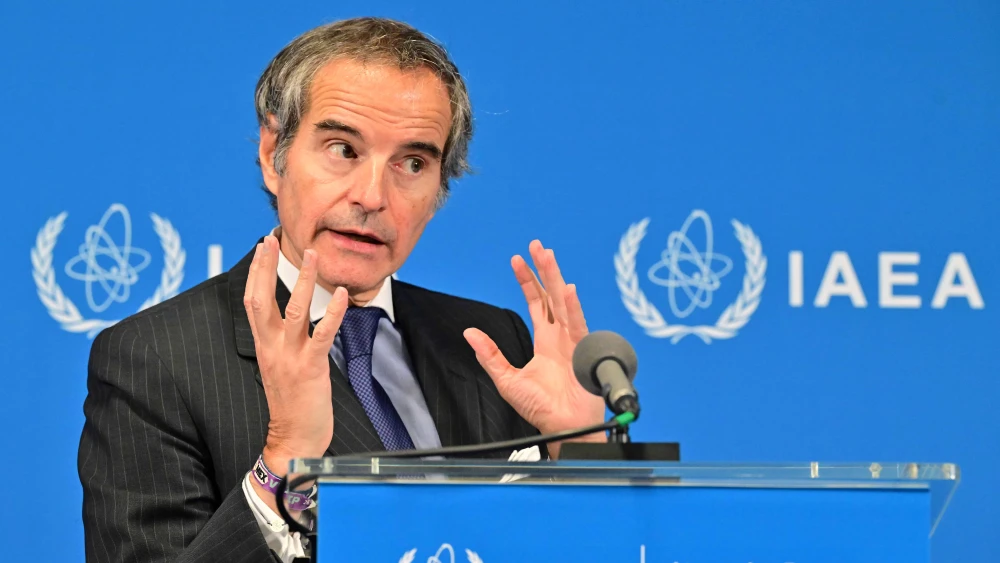
Tehran told the International Atomic Energy Agency that supervision over Iran’s nuclear program cannot restart as long as the Islamic Republic is under military threat by the United States, the Associated Press reported on Friday.
Iran’s remarks, which were made earlier this month, were forwarded to United Nations member states via a confidential report on Nov. 13 and obtained by AP.
The Islamist regime lamented the “series of persistent, explicit, and public threats by the President of the United States of America ... to commit further acts of armed aggression” against Iran “particularly targeting its nuclear facilities,” according to the report.
Inspections will not resume “until the root causes of the present situation are addressed and the essential requirements for normal safeguards implementation are restored,” Tehran added.
Three Iranian nuclear-related facilities were hit by the U.S. and Israeli militaries during the 12-day war (“Operation Rising Lion/Operation Midnight Hammer”) in June 2025. These sites have not been inspected by the IAEA since then.
The IAEA expressed its concern over the lack of information about the sites, and said this matter “needs to be rectified with the utmost urgency,” AP reported.
The confidential report also highlighted the U.N. nuclear watchdog’s “increasing concern” about Iran’s Isfahan Fuel Enrichment Plant, which it has never inspected. Tehran first informed the IAEA about the facility before the 12-day war began, according to AP.
The IAEA further said in its report that it “does not know” the site’s “exact location or whether it contains nuclear material.”
IAEA staff visited Iran only once since the war in June 2025, on Sept. 12-15, to inspect the Bushehr Nuclear Power Plant, which currently uses uranium from Russia enriched to the low-level of 4.5%.
The nuclear watchdog says that Iran has a stockpile of some 972 pounds of uranium enriched up to 60%, which is considered a short, technical step away from nuclear bomb-grade levels of 90%, the report said.
Rubio: No need for military action against Iran
Meanwhile, U.S. Secretary of State Marco Rubio on Friday echoed a similar message to that of President Donald Trump, saying that “there’s no [more] need for military action” against the Islamic Republic because “the economic pain that we are inflicting on that regime is so great.”
His comment was made during an address at the Federalist Society’s 2026 National Lawyers Convention in Washington, D.C.
Rubio stressed the importance of preventing Iran from developing nuclear weapons, even though the war was “unpopular.”
He further placed the root cause of problems in the Middle East on the “Shia clerics of Iran and their expansionist mentality. This is an extraordinary historic danger and one that cannot be ignored, because I know we think it’s half a world away, but nothing is half a world away anymore. Nothing is. It will reach eventually and threaten our country, and it’s a threat that has to be addressed, and it’s not easy to address these things because it’s not popular to address them.”
The secretary of state commended Trump for his decision to attack Iran, saying that ignoring the problem “would have been the easiest thing for the president to do, frankly—four years in office, leave it for the next person to worry about.”
Rubio continued that “victory is they can never have a nuclear weapon, one way or the other. If it means they don’t have the money for one or they don’t have the equipment for one, we can never allow ourselves to live in a world—or our children or any of you to inherit a planet—in which those people who have done these things have a nuclear weapon.”
Trump: Iran war ‘militarily is effectively over’
After a meeting with Qatari Prime Minister Sheikh Mohammed bin Jassim Al Thani in the White House on Monday, Trump told reporters that he believes the war in Iran “militarily is effectively over.
“We’re just keeping it the status quo,” the president said, according to AP.
He added that Tehran has been “decapitated” during the 40-day military confrontation with Iran that began on Feb. 28, but said he is still looking for a long-term solution to ensuring Iran’s nuclear program is defanged, the report added.