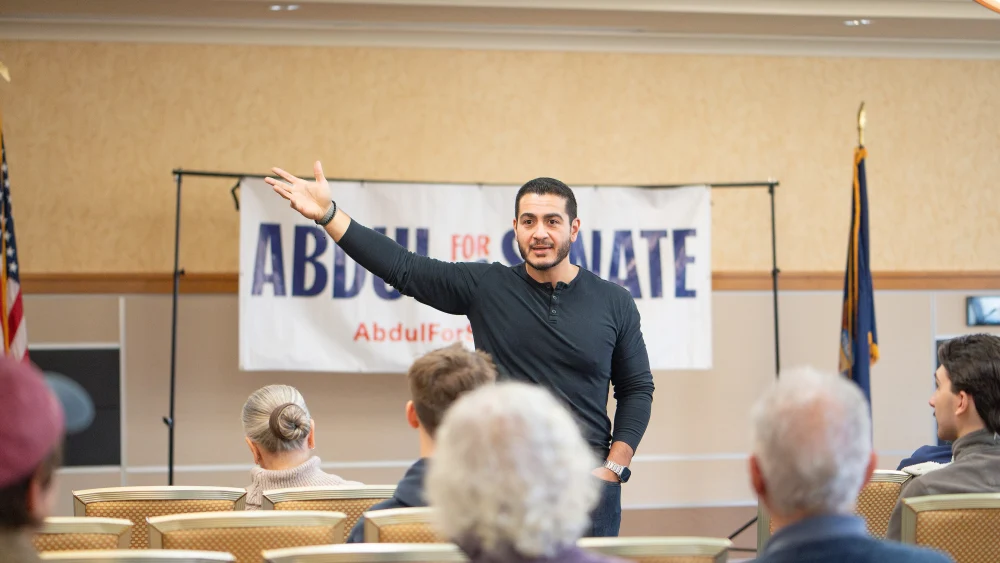
Former Republican congressman Mike Rogers led Dr. Abdul El-Sayed, the Democratic nominee for Senate in Michigan, by 54% to 41% among Michigan Jewish voters, who cast ballots on Election Day, according to a survey released on Friday.
Jonathan Schulman, executive director of the Jewish Majority, which sponsored the survey and which previously found that 57% of Jewish early voters went for Rogers, told JNS that “there could be a number of factors there.”
Democrats traditionally draw more early voters, while Republicans tend to perform better on Election Day, Schulman said. The survey did not ask whether Rep. Haley Stevens (D-Mich.) opting to endorse Rogers influenced voters.
“It would be nothing more than a guess to try and draw a causation there, which I don’t think is responsible,” he told JNS.
Mercury Public Affairs surveyed 883 Michigan Jewish voters by text message between Oct. 25 and Nov. 10. The reported margin of error was plus-or-minus 3.9 percentage points overall, and plus-or-minus 7.2 points for the Election Day subgroup.
Across the full survey, El-Sayed received support from 50% of Jewish respondents, compared with 43% for Rogers. Another 4% left the Senate contest blank, and 3% chose another candidate. Jocelyn Benson, a Democrat, received 69% support for governor, according to the survey.
“The more connected somebody was with the Jewish community, the less likely they were to vote for El-Sayed,” Schulman told JNS.
Among self-identified Jewish Democrats, who voted on Election Day and rejected El-Sayed, 98% said that they likely would have supported a different Democratic nominee, and 87% cited concerns about antisemitism as a reason for their decision.
“We’re seeing a Jewish community that is increasingly asking for the political parties to vie for their votes,” Schulman said.
“I think what people are looking for right now is to understand that there are politicians out there who are willing to do the hard thing, which is to call out antisemitism and anti-Israel views in their own party,” he told JNS.
Schulman said that Philadelphia’s response to a boycott targeting Jewish eateries last Sunday was a good sign for Jewish constituents. He noted the large crowds supporting the businesses and the response from elected officials across party lines.
“It’s really a sign that gives me hope, that says if we’re willing to be clear and express ourselves, then we can demand that our elected officials represent us as well,” he said.
Schulman told JNS that “ultimately, it will be a test of the senator-elect whether or not he can represent his entire constituency.”
“It’s incumbent upon the Jewish community in Michigan to engage with the senator-elect as it would with any other elected official, which is to say they should be clear, they should be open, they should not hide their perspective,” he said.
“How he responds to his constituency will probably be a major part of whether or not they decide to re-elect him,” Schulman told JNS.