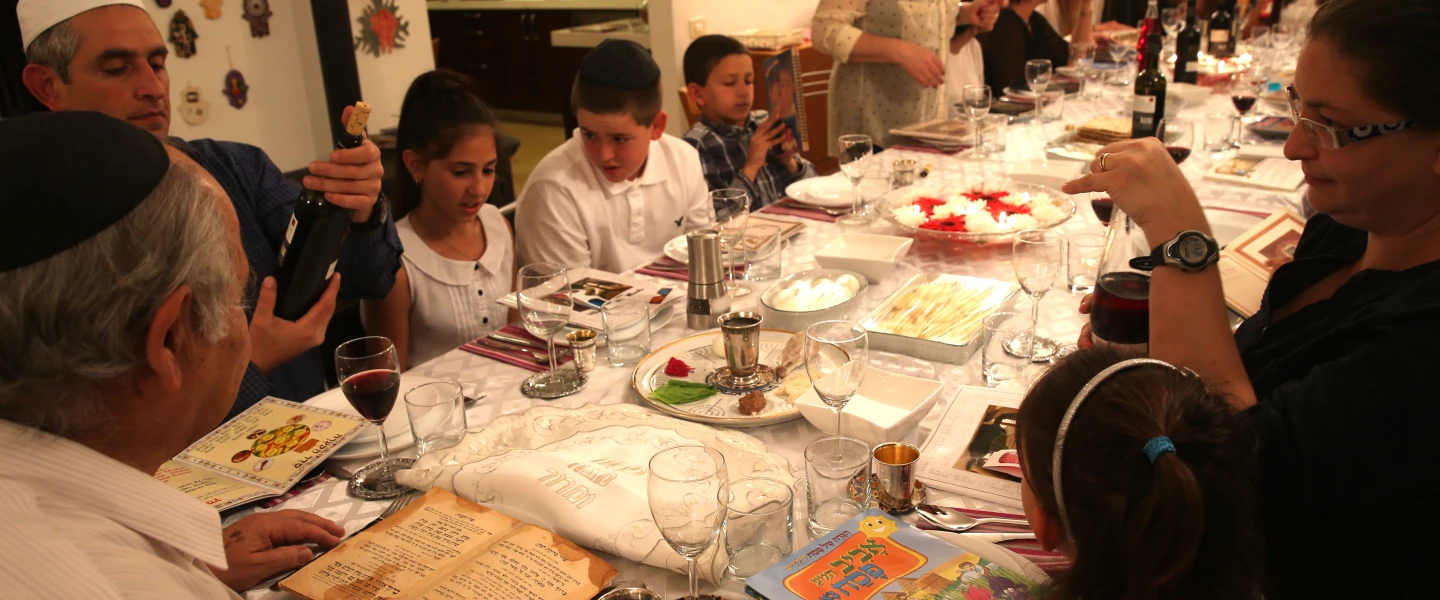
From generation to generation, we retell the story of the exodus from Egypt as if we were there ourselves to witness the splitting of the Red Sea.
And year after year—in fact, twice a year outside of Israel—we sing the songs of the Passover Haggadah. The same old, same old songs.
It’s easy to lose your focus at the seder table, or to doze off if your seder extends until the wee hours of the morning. We’ve all been there. It certainly doesn’t help if you’re bored with the songs, especially those that come when you’re just about ready to pack it in during Hallel and Nirtza.
But spicing up the seder singing doesn’t need to be a hopeless cause. For instance, my sister and I have a time-honored tradition of making sound effects that correspond with the animals and other characters that appear in “Chad Gadya,” and hand motions that enliven the motifs of “Echad Mi Yodea.” We look forward to our “performance” of these songs every year.
However, if sound effects or hand motions aren’t your style, the rich mosaic and international flair of Jewish culture provides plenty of opportunities for novelty in your seder singing.
“There are great variations in the songs, poems, and customs of the seder night and in the Haggadot themselves,” says Irit Rub, director of Keynote Department of Education and Outreach for the Israel Philharmonic Orchestra (IPO).
“There has always been a tendency to unify the texts, but the differences are beautiful,” she continues. “For example, in the Aleppo tradition of ‘Aram Tzuba,’ they do not recognize the practice of the afikomen. Or, did you know that the songs and poems in the Haggadot of Yemenite tradition are derived from the Jerusalem Talmud, while Ashkenazim more often feature those from the Babylonian Talmud?”
Rub polled the IPO’s members about the different tunes they know about or have used at their seder. Here’s a compilation of their outside-the-box Passover “playlist:”
Chad Gadya
- Ladino (Judeo-Spanish)
- Ashkenazi
- Teimani (Yemenite)
- Italian tradition (sung by in Aramaic, Hebrew, and Arabic by a women’s choir from Jaffa)
Mah Nishtanah
Dayeinu
1) Authentic version
2) Modernized Yemenite version
“A central part of our mission is to build bridges through music,” says Danielle Ames Spivak, executive director of the American Friends of the Israel Philharmonic Orchestra. “So, learning from the Israel Philharmonic Orchestra about Passover tunes and traditions is particularly apt, since the seder is also a connective touchpoint for the Jewish people, year after year.”
Indeed, we’re all part of one Jewish people, and our cultural diversity within provides us with a treasure trove of customs to share. Admittedly, it does take some willingness to step outside your comfort zone. As an Ashkenazi Jew myself, it’s not intuitive for me to sing in the Yemenite tradition. But maybe I’ll try it on for size this year, to spice up my Passover playlist.