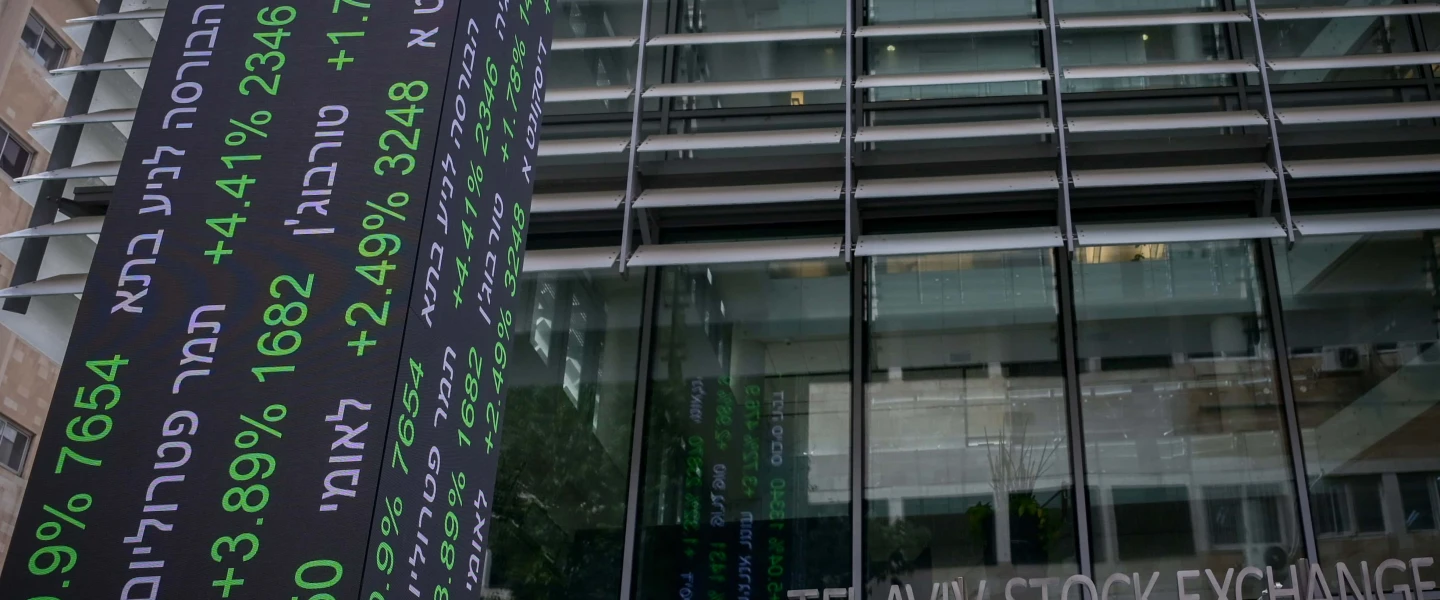
A week after Israel and the United States launched “Operation Roaring Lion/Epic Fury” on Feb. 28, the Tel Aviv Stock Exchange (TASE) responded with a surge.
On March 6, the TA-125 Index climbed to record highs exceeding 4,300 points, up more than 66% compared to the same time last year, while the Israeli shekel strengthened against the U.S. dollar. Between Oct. 7, 2023, and March 2026, the TASE climbed nearly 100%, outperforming the Nasdaq in 2025.
For investors and industry leaders, the rally reflects something broader than short-term market optimism. Experts say global markets are increasingly viewing Israel’s technology ecosystem as a strategic asset even during periods of conflict.

Yaniv Pagot, head of trading at the Tel Aviv Stock Exchange, said investors are already focused on the geopolitical landscape after the war.
“Most participants in the Tel Aviv Stock Exchange assume that the current war will be relatively short, and that the regional geopolitical environment will improve once the fighting ends,” Pagot said in a written statement provided to JNS.
Expectations of expanded normalization agreements and a reduced Iranian military threat are helping support the rally in Israeli equities, he added. Pagot noted that the TA-125 index has a relatively large defensive and energy component, sectors that have strengthened during the conflict.
In January, TASE announced that its trading days would shift to a Western-aligned Monday-to-Friday schedule. The change, according to Israeli insiders, represents a structural integration into the global economy that, like much of what Israel has built over the past two years, is happening because of the crisis—not despite it.

“We have already proven that Israel delivers, no matter the circumstances,” said Shai Liberman, managing director at Qualitest Israel & Europe, one of Israel’s largest software testing companies. “Over the past two and a half years, we have gone beyond expectations … Israel’s leaders are among the most resilient people in the world.”
The rise of defense tech and a battle-tested premium
While foreign investors may be unable to physically visit Israel and the skies remain unpredictable, capital flow is not.
One sector that saw record growth was defense tech, born from military necessity. Between July 2024 and April 2025, the number of defense tech startups jumped to 312 from 160, according to SNC, and defense tech startups alone raised more than $1 billion in 2025.
TASE-listed companies such as Elbit Systems (ESLT) and NextVision (NXTD) are considered the backbone of IDF tech, each posting triple-digit stock growth year-over-year. NextVision’s AI-stabilized cameras are now used by the IDF and dozens of foreign militaries, a commercial trajectory that illustrates a “battle-tested premium.”
“Every modern defense organization is, in essence, a major technology organization,” Liberman said. “In Israel, many of the world’s leading startups were born from the same military technology units. The deep integration between the defense system and the technology ecosystem has become one of Israel’s true superpowers.”
The dual-use nature of many defense technologies also attracts venture capital. Tools developed for military applications often transition into civilian markets such as cybersecurity, AI and advanced analytics.
“The battlefield is the lab,” added Menny Shalom, CEO of T3 Defense (DFNS), a Nasdaq-listed defense investment firm that acquires and scales defense companies in Israel, the United States, and Europe. “It actually shows you it works … Guys are actually making something that helps protect people.”
In early March, Israeli weapons optics company SmartShooter (SMSH) started trading on TASE at a valuation of 900 million shekels ($290 million), underscoring continued investor appetite for defense-linked technologies.
Startup Nation as a strategic asset class
Israeli high-tech funding rose to nearly $16 billion in 2025 (up from $12.2 billion in 2024), and M&A activity reached a record $74.3 billion in value, spread over some 150 deals. This was followed by the strongest February for venture funding since 2022.
Foreign giants are taking note. Google’s $32 billion acquisition of Wiz, its largest-ever deal and the biggest in Israeli history and set to close this week, was followed by Palo Alto Networks’ $25 billion acquisition of CyberArk, signaling sustained appetite for Israeli IP at the highest levels of global capital. NVIDIA, meanwhile, has become the country’s largest tech employer, with Israel accounting for roughly 20% of the chip giant’s global revenue.
Beyond those headline deals, the 2025 surge in mid-market defense acquisitions by firms like T3 Defense suggests the appetite for Israeli IP has moved down the supply chain into the critical industrial base.

Omer Keilaf, Founder and CEO of Nasdaq-listed Innoviz Technologies (INVZ), described the shift in geopolitical terms. “The war with Iran has elevated global perceptions of Israel’s tech ecosystem because it has showcased, in real time, the country’s ability to innovate under extreme pressure.”
He said that cyber, AI and defense tech capabilities are moving “from being seen as niche strengths to being recognized as strategic assets that shape battlefield outcomes.”
Cyber operations now influence “every decision and every missile we fire,” demonstrating a level of integration that has reshaped how global investors and governments assess Israel’s tech sector.
Talk of Startup Nation evolving into “Scale-up Nation” is well-known, but it is more than that: TASE performance across a variety of sectors shows the country has become a hub for essential technologies that the world cannot afford to see fail.
A barometer for resilience
A final indicator that explains TASE performance is the resilience of human capital. Following the outbreak of the war in 2023, Startup Nation saw approximately 15% of its workforce mobilized at any given time, regardless of seniority. Anyone from intern to CEO was drafted into war, and yet products were shipped, deadlines were met, and milestones were reached.
“We must acknowledge that the past two and a half years have been particularly challenging for everyone,” Liberman said. “The ongoing situation has inevitably created disruptions for many of our talented people… but the resilience, unity and commitment we see across our teams remain one of our greatest strengths.”
This “work-under-fire” culture is a selling point for TASE, signaling a level of operational maturity global markets haven’t seen elsewhere and causing endless fascination for global VCs.
2026 and beyond
Looking ahead, Israel’s “Digital Dome” is being built and sustained by local and foreign capital, which is reflected in the country’s capital markets.

“My assessment is that following the war, we will actually see an increase in both the activities and the investment volumes of multinational corporations in Israel,” predicted Uri Yogev, chairman of Aluma, an infrastructure investment fund listed on TASE since November 2021. “International firms recognize that Israel’s innovation, human capital, and technological capabilities are long-term strategic assets.”
Operating in the infrastructure space provides him with a perspective, he believes, that grants clear insights into regional developments that could lead to significant growth in the Middle East.
“Israel is expected to be a pivotal player in the regional connectivity network, linking the Gulf States and Saudi Arabia with Europe and the West across fields such as telecommunications, energy, and transportation,” he concluded. “These are long-term processes that have the potential to strengthen the entire regional economy.”