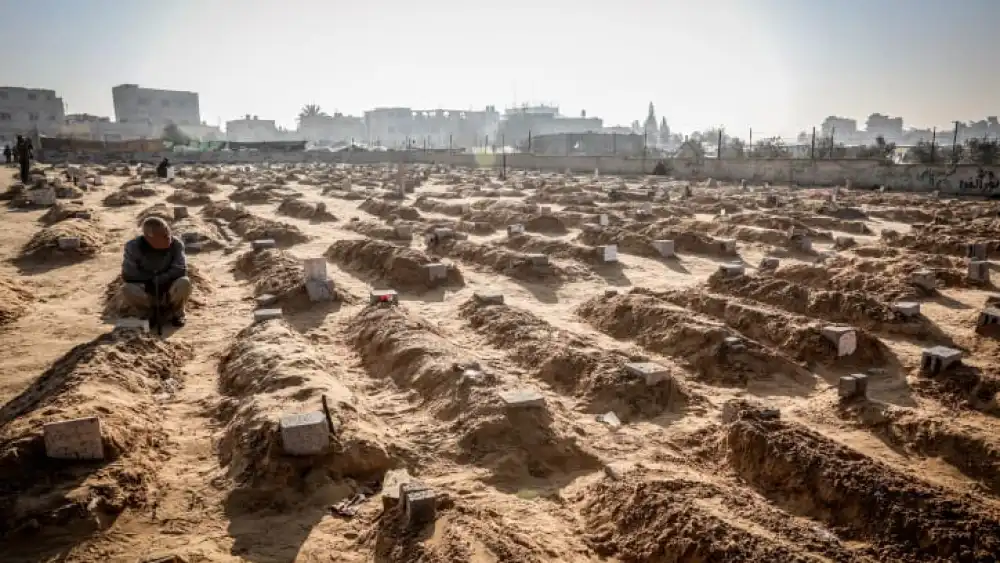
The Hamas-run Ministry of Health in Gaza says it has “incomplete data” for one-third of the Palestinian fatalities it claims to have documented from its current war against Israel.
The acknowledgment in a report on the social networking app Telegram last week raises anew questions about the veracity of its casualty count from the war.
The April 6 report said that Hamas had “incomplete data” for 11,371 of the 33,091 recorded Palestinian deaths it claims, and is missing one or more key data points including identity number, full name, date of birth, or date of death.
In a report three days earlier, the ministry admitted the “incompleteness” of 12,263 records. It was not immediately clear why, after three more days, that figure dropped to 11,371.
Before its admissions of incomplete data, the ministry asserted that the information in more than 15,000 fatality records had stemmed from “reliable media sources.” However, the ministry never identified the sources in question and Gaza has no independent media.
David Adesnik, director of research at the Washington-based Foundation for Defense of Democracies (FDD), said, “The sudden shifts in the ministry’s reporting methods suggest it is scrambling to prevent exposure of its shoddy work.
“For months, U.S. media have taken for granted that the ministry’s top-line figure for casualties was reliable enough to include in daily updates on the war. Now we’re seeing that a third or more of the ministry’s data may be incomplete at best—and fictional at worst,” he added.
Joe Truzman, a senior research analyst at FDD, said, “It is important to recognize that Hamas is deeply invested in shaping the narrative that emerges from Gaza, particularly regarding the number of casualties in the war.
“Moreover, this control of data extends beyond the statistics provided by the Hamas-controlled Health Ministry, as there is also a deliberate effort to downplay the number of terrorists who have been killed by Israel in the war,” he added.
The Israel Defense Forces has said that at least 13,000 of the Palestinians killed in the war against Hamas in Gaza, and another 1,000 slain inside Israel during the Oct. 7 invasion, were terrorists.
Last month, a statistics expert asserted the Hamas claim that 70% of the casualties of the war were women and children was “statistically impossible” and “not reliable at all.”