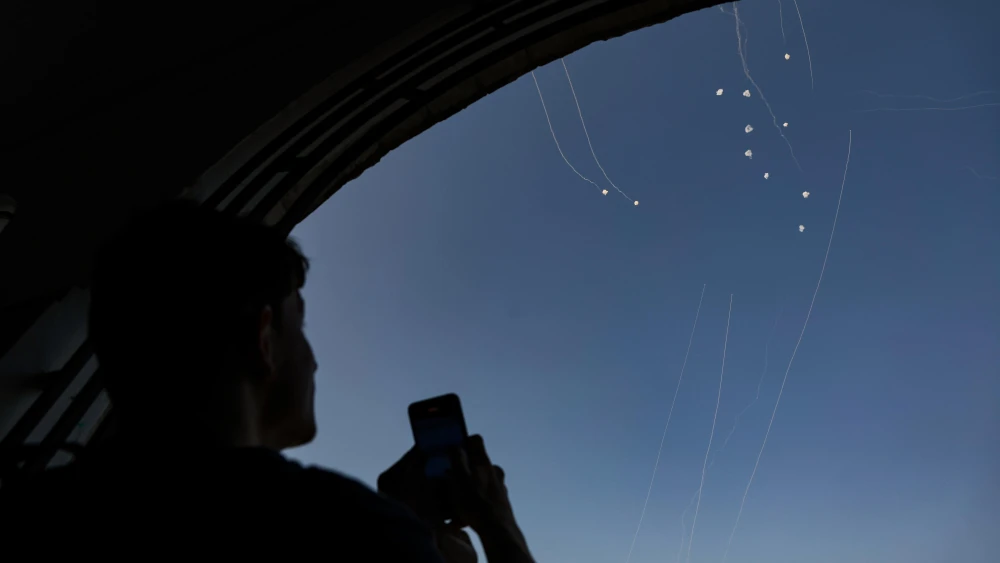
The Lebanese terrorist organization Hezbollah targeted the Haifa area with a massive rocket barrage on Monday afternoon, wounding three Israelis.
Magen David Adom, Israel’s national emergency medical service, reported that the wounded were a 52-year-old man who was listed in moderate condition after being hit with shrapnel in his back, as well as a 55-year-old man and a 17-year-old boy with minor injuries.
Around 80 rockets were fired in an initial barrage, followed by a second attack consisting of approximately 10 projectiles, the Israel Defense Forces told reporters. Most rockets were intercepted or hit in open areas.
Shortly following the attacks, the Israeli Air Force announced it had struck a rocket launcher used in the attacks on the country’s north.
בהכוונת מכלול האש של חטיבת האש 282, כלי טיס של חיל האוויר וסוללות הארטילריה תקפו משגר ממנו זוהו שיגורים שנורו לעבר מספר מרחבים בצפון הארץ לפני זמן קצר pic.twitter.com/8nsbIAnG6Q
— צבא ההגנה לישראל (@idfonline) November 11, 2024
Earlier on Monday, the Iranian-backed terrorist organization launched some 50 rockets into the Lower Galilee.
Three people sustained shrapnel injuries; a 27-year-old woman who was in moderate condition, a 35-year-old man whose condition was not specified and a one-year-old infant who was listed as being in fair condition.
Only some of the rockets were intercepted, according to the IDF.
A residential building in the city of Karmiel suffered a direct hit.
Hits were also documented in the vicinity of the towns of Bi’ina and Deir el-Asad near Karmiel.
Around the same time, the Israeli Air Force intercepted a drone launched from Lebanon over the area of Malkia, a kibbutz in the Galilee panhandle, the IDF spokesperson said.
A second batch of rockets was fired into the Galilee shortly after the first barrage. No injuries or damage were reported.
Earlier today, the head of the Arab Media Branch in the IDF Spokesperson’s Unit, Lt. Col. Avichay Adraee, issued an evacuation warning to residents of 21 villages in Southern Lebanon.
“Hezbollah’s terrorist activities force the IDF to act forcefully against it in these areas, and we do not intend to harm you,” tweeted Adraee in Arabic. “For your safety, you must evacuate your homes immediately and move to the north of the Awali River.
“For your safety, you must evacuate without delay. You are prohibited from heading south. Any movement south could be dangerous to your life. We will inform you of the appropriate time to return to your homes as soon as the conditions are suitable.”
On Saturday night, reports emerged that diplomatic negotiations toward a ceasefire on the northern front had made significant progress recently.
A senior Israeli diplomatic official characterized the proposed agreement as highly advantageous to Israel’s strategic interests, describing the progress as “very substantial” while maintaining discretion about details.
A second high-level government source, while confirming the positive developments, cautioned that no final agreements had been reached. The official emphasized that the IDF will retain operational freedom to respond to any security threats from across the northern border, regardless of any diplomatic arrangements or paper agreements.