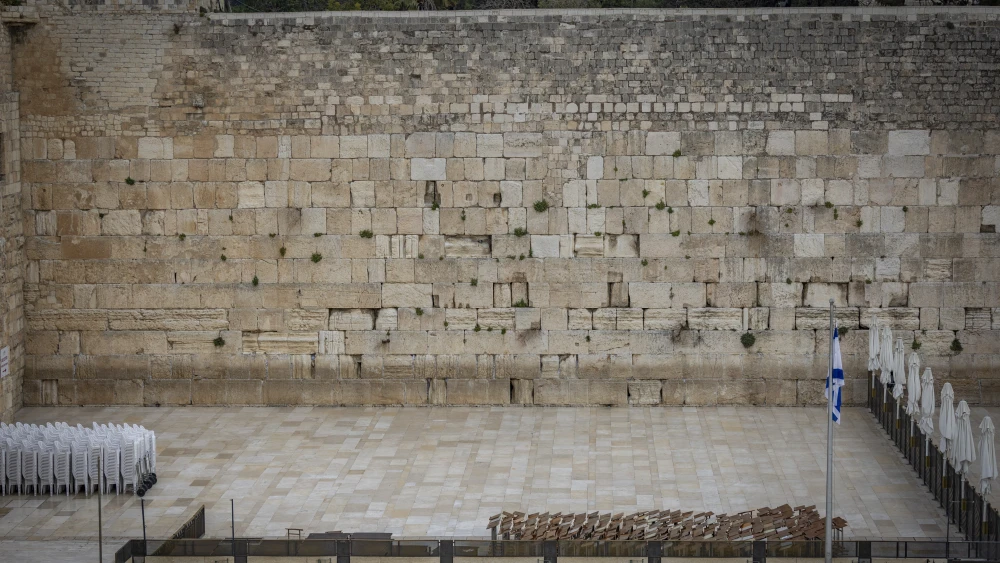
Jewish, Christian and Muslim holy sites in Jerusalem have been closed “for one reason: protecting worshippers,” the Israeli Foreign Ministry said on Saturday, after official Palestinian Authority TV claimed that wartime restrictions were in place to facilitate a “Passover sacrifice.”
“The same safety measures apply to the Western Wall, Al-Aqsa Mosque, and the Church of the Holy Sepulchre,” the ministry wrote in an X post.
“While the Iranian regime fires missiles at civilians of all religions—even toward Jerusalem’s holy sites during Ramadan—Israel protects the life and safety of all worshippers,” the Foreign Ministry added.
Jerusalem’s holy sites stand empty for one reason: protecting worshippers. The same safety measures apply to the Western Wall, Al-Aqsa Mosque, and the Church of the Holy Sepulchre.
— Israel Foreign Ministry (@IsraelMFA) March 14, 2026
While the Iranian regime fires missiles at civilians of all religions - even toward Jerusalem’s… pic.twitter.com/34DVmaT3tD
The Israel Defense Forces’ Home Front Command instituted an across-the-board ban on all public gatherings of more than 50 people due to security concerns following the outbreak of the fighting with Iran.
However, official P.A. TV on March 9 claimed that the limitations were geared to enable Jews to carry out a Passover sacrifice at the Al-Aqsa mosque on the Temple Mount, which has long been a tinderbox.
Israel’s High Court of Justice has repeatedly rejected petitions to carry out Passover sacrifices on the Temple Mount, citing a threat to security and the inflammation of religious tensions. The Israel Police has also prevented some Jewish groups from carrying out such practices.
Dean Elsdunne, the police’s international spokesperson, said in a social media post on Friday that “an area such as the Temple Mount complex has no proper shelter for ballistic missiles—definitely not for tens of thousands of people.”
On Feb. 28, the first day of the war, an Iranian warhead impacted “just a few hundred meters” from Jerusalem’s Old City.
The bomb was neutralized by bomb disposal teams of the Israel Police, “who transferred it for further examination at explosives laboratories.”