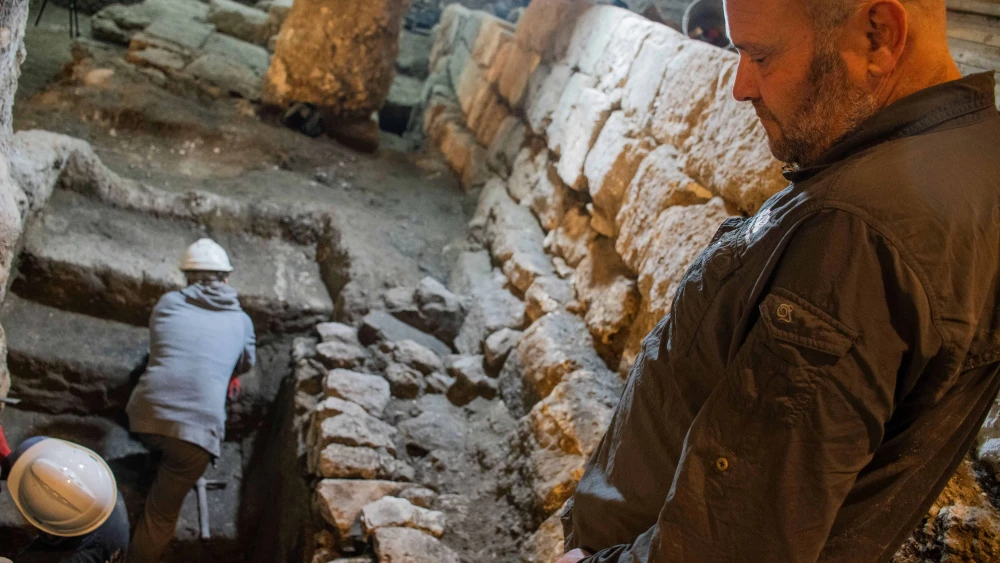
A Jewish ritual bath, or mikveh, dating back to the final days of the Second Temple period has been unearthed near the Western Wall, the Israel Antiquities Authority announced on Monday.
The bath, which still bears ash remains that testify to the destruction of the Temple, was discovered recently beneath the Western Wall Plaza, the state-run archaeological body said.
Hewn into the bedrock, the mikveh, which is rectangular in shape, measuring 3.05 meters in length, 1.35 meters in width and 1.85 meters in height, was found sealed beneath a layer dated to the year 70 C.E.
Within this layer, which contains ash, numerous pottery vessels were discovered, along with stone vessels characteristic of the Jewish population that lived in the city on the eve of the destruction, according to the IAA.
The excavations are located in close proximity to the site of the ancient Temple and to what served as its main entrances some 2,000 years ago—the Great Bridge to the north and Robinson’s Arch to the south.
According to Jewish law, people who wished to visit the temples were required to purify themselves via a ritual bath before entering.
Researchers believe that the bath served the Jews who lived in the area as well as the many pilgrims who frequented the site and the Temple.
“Jerusalem should be remembered as a temple city,” explained Ari Levy, excavation director on behalf of the IAA. “As such, many aspects of daily life were adapted to this reality, and this is reflected especially in the meticulous observance of the laws of ritual impurity and purity by the city’s residents and leaders.”
According to Israel’s Heritage Minister Rabbi Amichai Eliyahu, “The exposure of the ritual bath beneath the Western Wall Plaza strengthens our understanding of how deeply intertwined religious life and daily life were in Jerusalem during the Temple period.”
The discovery was announced on the eve of the Jewish Tenth of Tevet Fast, which falls on Tuesday this year and commemorates the beginning of the Babylonian siege that led to the destruction of Jerusalem and the First Temple in the 6th century BCE.
“The exposure of a Second Temple period ritual bath beneath the Western Wall Plaza, with ashes from the destruction at its base, testifies like a thousand witnesses to the ability of the people of Israel to move from impurity to purity, from destruction to renewal,” said Mordechai Eliav, the director of the Western Wall Heritage Foundation.