Newsletter
Newsletter Support JNS

Cemetery fence to be lowered after uproar over Hamas victim’s burial

Alina Plahti began a conversion process during her IDF service but had not completed it.

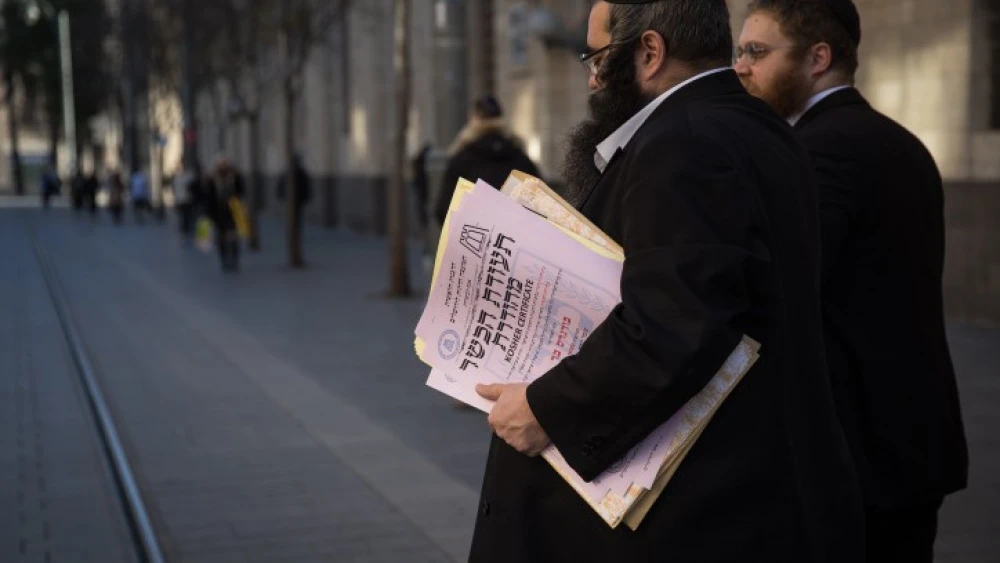
Representatives of the Chief Rabbinate of Israel cross Jaffa Road as they deliver a kashrut certificate to a restaurant in Jerusalem, Dec. 31, 2019. Photo by Hadas Parush/Flash90.

A fence that separates graves at a cemetery in the Israeli city of Beit She’an based on religion will be lowered and covered with vegetation following an uproar over the separate burial of a victim of the Hamas attack whom the Chief Rabbinate does not consider Jewish.

The Chief Rabbinate official’s announcement on Thursday came after public criticism over the burial of Alina Plahti, 23, who was buried last month at a separate compound of the city’s New Cemetery.

Her father is Jewish and she began a conversion process during her IDF service but had not completed it.

Plahti, who was murdered by Hamas terrorists at the Supernova music festival near the border with Gaza, was interred in the section of the cemetery for people who are not considered Jewish according to the Orthodox interpretation of halachah, Jewish religious law.

Her family expressed the wish that she had been buried in the central section of the cemetery, and not be separated by a tall fence.

Rabbinical officials have issued various rulings on the mixed burial of Jews and non-Jews, ranging from unequivocal rejection of the prospect to permission to do it if this helps preserve peaceful relations.

Religious ceremonies for Jews in Israel, including funerals and weddings, remain under the control of the ultra-Orthodox.

“Harvard’s efforts demonstrate the very opposite of deliberate indifference,” the university said, in response to the U.S. Justice Department lawsuit.
A small business owner in the Big Apple told JNS that she is being hurt by tariffs more than by the credit rating.
Jay Greene, author of a new report on the subject, told JNS that the unions communicate in an “overwrought and extreme” way about Israel.
“Why are we to trust the U.N.’s own vetting procedures?” Adam Kaplan, of USAID, asked a congressional committee.
The pro-Israel group “has become increasingly problematic for many American Jews and for many candidates running for office,” Lauren Strauss, of American University, told JNS.
Sharon Liberman Mintz, of Jewish Theological Seminary, told JNS that the 1526 Haggadah “is one of the most exciting books that I have ever had the pleasure to turn the pages of.”
