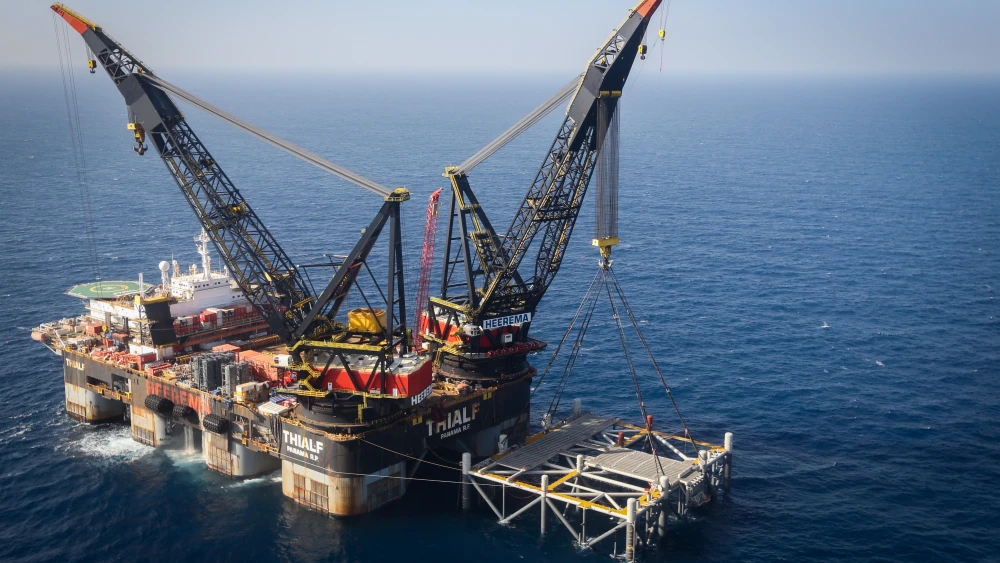
Gas pumping from Israel’s Leviathan offshore natural-gas field got under way on Tuesday after Israel’s Environmental Protection Ministry said Noble Energy and its partners had met all necessary conditions, despite ongoing protests from coastal residents and environmental activists warning of pollution emitted by the pumping rigs.
The largest energy project in Israel’s history, it is expected that the Leviathan field will yield 22 trillion cubic feet of natural gas. After extraction, the gas will then make a 120-kilometer journey via pipelines to a processing platform 10 kilometers off the Israeli coast.
From there, the processed gas and stabilized condensate will be transported by pipeline to the national gas transmission system and pipeline.
“For the first time since its establishment, Israel is now an energy powerhouse, able to supply all its energy needs and gaining energy independence,” said Delek Drilling CEO Yossi Abu, a partner in the field. “At the same time, we will be exporting natural gas to Israel’s neighbors, thus strengthening Israel’s position in the region. [The] Leviathan project will bring the coal era in Israel to an end, and will supply efficient, inexpensive and clean energy to people in Israel and in the Middle East.”
Residents along the coast have expressed concern over the possible carcinogenic effects of chemicals and pollutants from the project, with thousands of residents of Zichron Yaakov and areas south of Haifa even evacuating their homes and shuttering schools as nitrogen was flushed from pipes during initial tests on Tuesday.
The Environmental Protection Ministry, however, said there was no cause for concern.
Earlier this month, a petition to Jerusalem’s District Court argued that the single eight-hour test on Tuesday would release more pollutants than two years of drilling operations.
The court ruled that the tests could move forward, citing the petitioners’ failure to provide expert testimony refuting the state’s claims that the test would be safe.
In October, the scientific journal Environmental Impact Assessment Review found that environmental impact assessments by Noble Energy “grossly underestimate” the volume emissions that will be spewed into Israel’s air, contain “a series of flaws,” rely on “overly simplistic” models and should be redone.
Noble Energy rejected the article, saying it was installing technology on the platform that would keep emissions close to zero.