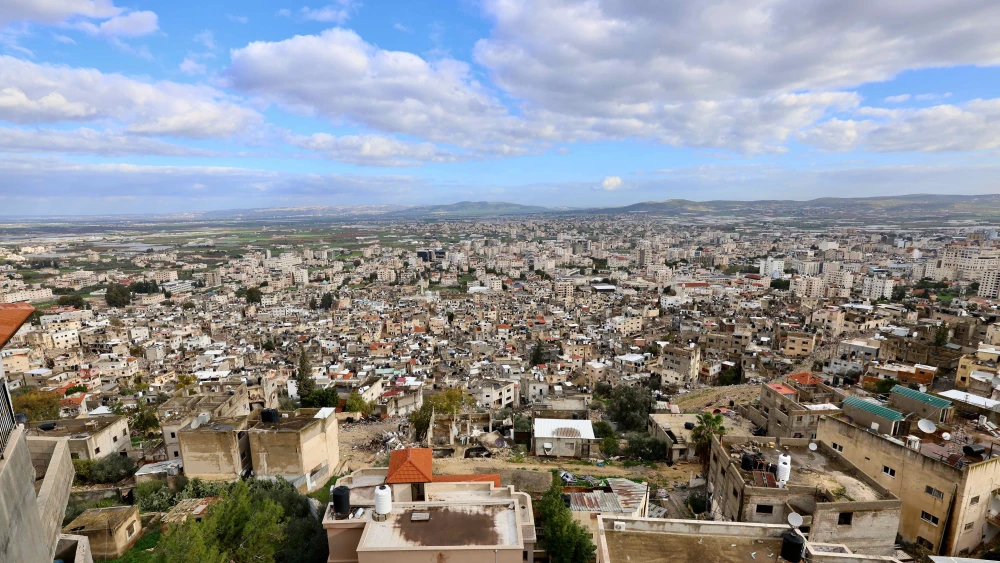
Mainstream media outlets increasingly use the term “occupied West Bank” in their coverage of Judea and Samaria, according to an analysis from the watchdog HonestReporting.
The report, shared exclusively with JNS, analyzed 5,370 articles from 17 major news outlets, including the New York Times, CNN, BBC and Guardian, between May 2025 and last month. The watchdog found that 46.3% of the articles used the term “occupied West Bank” when describing Judea and Samaria, and 62.3% used “broader and related terms” like “occupation” and “occupying.”
“The BBC used it in 71% of its West Bank articles, CNN in 68%, NBC in 64%, the Los Angeles Times in 61%, Reuters in 60% and Fox News in only 12%,” the report stated. “Reuters, the New York Times and CBS often write ‘Israeli-occupied West Bank.’”
The Associated Press, from which many other outlets run wire copy, uses the term “occupied West Bank.” It says in the 57th edition of its stylebook, commonly referred to as the “journalist’s Bible,” not to use the term “Palestine” except “in the context of Palestine’s activities in the international bodies to which it has been admitted,” because “it is not a fully independent, unified state.”
According to the HonestReporting analysis, 38.9% of articles used the term “occupied” to refer to Judea and Samaria between May and October 2025, and 52.2% did so from May to October of this year.
The report sampled 60 articles and found that 50 (83%) used the term “occupied West Bank” in a statement that wasn’t quoting or attributed to a source.
Sharon Levy, an editor at HonestReporting, told JNS that media coverage of Judea and Samaria has increased as has “more extreme language.”
“You see this increase in coverage, and you also see the increase in terms such as ‘occupation,’ which is also coupled with other extreme terms such as ‘apartheid,’ that are being used in conjunction with each other,” she said. “Those are the terms that the public is being exposed to more and more frequently.”
News events in Judea and Samaria merit coverage, and the amount of coverage can vary depending on the “levels of violence.” But Levy thinks that there is a “hyper focus” on the region, due to the amount of coverage devoted to “really mundane incidents and mundane issues.”
The report found that the term “occupation” is increasingly used early in articles. From May to October of last year, 8.5% of articles referred to “occupation” in the first sentence. In that span in 2026, the number nearly doubled to 15.4%. In those same periods, 14.9% used the term in the first three sentences last year, compared to 24.2% that did so this year, according to the report.
“The four outlets most clearly driving the shift of this terminology to the top of articles are the New York Times (from 5% to 24% of articles in the first three sentences), the Guardian (from 6% to 22%), Reuters (from 33% to 48%) and the BBC (from 30% to 46%),” HonestReporting said.
One of the consequences of the increased use of “occupied West Bank” in the media is that it “normalizes the term to make it something that’s no longer a legal term,” Levy told JNS. “It’s a stated fact, and with that, it becomes very confusing what’s international law versus what is Israeli law.”
“There is a difference between how international law views the West Bank versus how Israel views the West Bank and certain settlements,” she told JNS. “International law views effectively the entire West Bank as illegal, as not part of Israel. Israeli law is much more complex.”
There are “certain settlements” in Judea and Samaria that have become legalized through a “lengthy and complicated” process, according to Levy. There are also outposts, which she said are “when people just go and start to build on any given hill” and are considered to be illegal under Israeli law.
“The legal process to take a small group of homes and make them into something that’s legal is a long process in Israel, and there’s different legalities within each,” Levy told JNS. “In the eyes of international law, it doesn’t matter whether it’s a settlement or an outpost. All of the above are illegal.”
The report found that the percentage of articles that used the word “illegal” in describing communities, outposts or “occupation” in Judea and Samaria increased from 12% from May to October in 2025 to 26% in that span this year. Only one in eight of the articles that used the word “illegal” in that context also shared Israel’s view, according to the report.
Levy thinks that the media has been “softening the ability to let these words enter the mainstream consciousness.”
“When these words are entering more frequently in the news, people, whether they’re on the Left or Right side of the political spectrum, feel more comfortable saying terms like ‘occupation’ and ‘apartheid’ or ‘illegal,’” she told JNS. “People across the political spectrum are taking it more seriously from the news.”